• العربية
  • فارسی
Brand
  • Iran Insight
  • Politics
  • Economy
  • Analysis
  • Special Report
  • Opinion
  • Podcast
  • Iran Insight
  • Politics
  • Economy
  • Analysis
  • Special Report
  • Opinion
  • Podcast
  • Theme
  • Language
    • العربية
    • فارسی
  • Iran Insight
  • Politics
  • Economy
  • Analysis
  • Special Report
  • Opinion
  • Podcast
All rights reserved for Volant Media UK Limited
volant media logo

US Envoy Lambasts Iran On Anniversary With Harsher Tone

Iran International Newsroom
Feb 11, 2024, 12:52 GMT+0Updated: 11:05 GMT+0
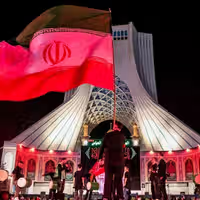
People walking under a large Islamic Republic flag during regime-sponsored demonstrations to mark the 45th anniversary of Islamic Republic establishment, Tehran, February 11, 2024

A tough-worded message on Sunday by the Office of US Special Envoy for Iran on the 45th anniversary of the Islamic Republic signaled a change of tone towards Tehran.

Deputy US Special Envoy for Iran Abram Paley released a video message stating that “the Islamic Republic has brought only violence and corruption at home and abroad.”

“Forty-five years ago today, the revolution in Iran led to the establishment of a regime based on fear, violence and oppression,” Paley said, as the Islamic Republic holds nationwide government-organized rallies to celebrate the 45th year of its establishment. “Flagrant and human rights abuses against dissidents, journalist, artists and minorities persist on a daily basis, and only underline the regime’s weakness.”

Paley’s message has drawn thousands of online responses by Iranians, who point out that Washington’s appeasement of Tehran while it is engaged in abuses at home and destabilizing acts abroad has encouraged the regime to continue such behavior. A large number of activists as well as American Republican politicians say the Biden administration is “soft” on Iran, demanding more pressure and less compromise.

In an interview with Iran International in January, Paley himself said that “words are not enough” but no decisive action has been taken by the US to stop Iran. Washington regularly announces sanctions on Iranian officials and entities but overall enforcement is so lax that the Islamic Republic’s oil revenues have tripled since President Joe Biden assumed office.

The Biden administration seems to have framed its Iran policy around a wish to revive the abandoned 2015 nuclear deal or at least come to another (written or unwritten) agreement that would limit Iran’s nuclear program. It also agreed to release billions of dollars of Iran's revenues frozen in South Korea and Iraq under US sanctions as part of a prisoner swap deal, described by critics as the biggest ransom ever paid to a hostage taker. About $6 billion was freed up for Iran in September after Iran released five Iranian-Americans held in Tehran in exchange for five Iranians imprisoned in the US, and another $11 billion from Iraq.

Paley highlighted that instead of providing for its people's needs, the Iranian regime spends money “on expanding its nuclear program in ways that have no credible, peaceful purpose, fueling instability across the region, proliferating dangerous weapons to places like Russia and disrupting international commerce.”

Considering Iran’s supply of drones and missiles for the Russian invasion of Ukraine, it is no surprise that Moscow was among the first countries that congratulated Iran on the anniversary. In a video message, Russian Foreign Ministry Spokeswoman Maria Zakharova echoed a propaganda line reiterated by Iranian authorities, including Supreme Leader Ali Khamenei, saying that Russia and Iran are joining forces to establish a new global order.

Iranian President Ebrahim Raisi also delivered a speech for the occasion, which -- not-surprisingly – was again focused on Israel and the war in Gaza. Since Iran-backed Hamas attacked Israel, Tehran and its regional proxies have ramped up their operations against US targets. Iran-backed groups in Iraq and Syria have been striking US bases, Hezbollah in Lebanon has been launching missiles towards northern Israel, and Yemen's Houthis have been attacking commercial vessels in the Red Sea, all in allegiance with Hamas to pressure Israel into ceasing its offensive in Gaza. Hamas is part of Iran's "Axis of Resistance", a regional alliance that includes Lebanon's Hezbollah, the Syrian government of President Bashar al-Assad, Shiite militia groups in Iraq and the Houthis who control a large part of Yemen.

A boy stands on an Israeli flag painted on a street during regime-sponsored demonstrations to mark the 45th anniversary of Islamic Republic establishment, Tehran, February 11, 2024
100%
A boy stands on an Israeli flag painted on a street during regime-sponsored demonstrations to mark the 45th anniversary of Islamic Republic establishment, Tehran, February 11, 2024

While thousands of people chanted "Death to Israel" and “Death to America” in rallies across Iran on Sunday, with some burning US and Israeli flags, President Raisi accused the United States and some Western countries of backing "the Zionist regime's (Israel) crimes against humanity in Gaza".

Paley, elsewhere in his message, claimed that “the Islamic republic has never been more isolated than it is today” because of its own choices. The statement was reflected in Raisi’s speech from a very different perspective as he claimed Iran is “the most independent country in the world, not depending on the West or the East”

Paley also acknowledged that “the people of Iran have demonstrated courage and resilience in the face of a system that sensors, arrests, tortures and execute them." Raisi said that “contrary to what proponents of free speech claim, real freedom exists in this country and system.”

Addressing Iranians, Paley said “the United States will continue to support you in your fight for a free and Democratic future.” “We will continue to provide tools to access the uncensored Internet that you need to advocate for your future, and we will continue to work with partners to counter the regime support for terrorism across the Middle East, which comes only at your expense.”

Many Iranians marked the 45th anniversary of the 1979 Revolution on the eve of regime-sponsored celebrations with cries of "Death to the Dictator" and “Death to the Islamic Republic,” ringing through neighborhoods in the capital Tehran.

Most Viewed

Iran negotiators ordered to return after internal rift over Islamabad talks
1
EXCLUSIVE

Iran negotiators ordered to return after internal rift over Islamabad talks

2
ANALYSIS

US blockade enters murky phase as tankers spoof signals and buyers hesitate

3
ANALYSIS

Why the $100 billion Hormuz toll revenue is a myth

4

US tightens financial squeeze on Iran, warns banks over oil money flows

5
ANALYSIS

US blockade targets Iran oil boom amid regional disruption

Banner
Banner

Spotlight

  • Hardliners push Hormuz ‘red line’ as US blockade tests Iran’s leverage
    INSIGHT

    Hardliners push Hormuz ‘red line’ as US blockade tests Iran’s leverage

  • Ideology may be fading in Iran, but not in Kashmir's ‘Mini Iran'
    INSIGHT

    Ideology may be fading in Iran, but not in Kashmir's ‘Mini Iran'

  • War damage amounts to $3,000 per Iranian, with blockade set to add to losses
    INSIGHT

    War damage amounts to $3,000 per Iranian, with blockade set to add to losses

  • Why the $100 billion Hormuz toll revenue is a myth
    ANALYSIS

    Why the $100 billion Hormuz toll revenue is a myth

  • US blockade targets Iran oil boom amid regional disruption
    ANALYSIS

    US blockade targets Iran oil boom amid regional disruption

  • Iran's digital economy battered by prolonged blackout
    INSIGHT

    Iran's digital economy battered by prolonged blackout

•
•
•

More Stories

‘Death to the Islamic Republic’, Iranians Mark the ‘79 Revolution

Feb 11, 2024, 08:12 GMT+0
•
Iran International Newsroom

Many Iranians marked the 45th anniversary of the 1979 Revolution Saturday night with cries of "Death to the Dictator" ringing through neighborhoods in the capital Tehran.

Video clips recorded on mobile phones show people chanting against the regime during official fireworks to commemorate 22 Bahman (11 February), the day the Pahlavi dynasty collapsed and gave way to what is now known as the Islamic Republic.

“The government celebrates, we mourn,” says Ramtin, a freshman at Tehran University who lives in east Tehran. “They know everybody hates the system. They know people are angry. And still they rub their celebration in our face –on TV, on billboards across the city, and now these fireworks. I’m not sure I would’ve chanted tonight if there were no fireworks.”

The gulf between the state and the majority of Iranians has never been wider. The society at large, and the younger generation, in particular, have ‘moved on’ from the Islamic Republic.

“The anniversary is as relevant to us as the Chinese new year, perhaps less,” says Saba, a 34-year old musician who’s turned to catering to earn a living. “No one cares, really. But when the thugs come to your neighborhood crying Allah-o Akbar, you fume and you cry your lungs out to shut them up.”

This seems to have been the pattern of protests Saturday night. There was no ‘call to action’, no online campaign even, to spur people to protest on the anniversary of the revolution. In most places, so far as it can be gathered from posts on social media, the protests have been spontaneous reactions to the regime’s propaganda.

“It is depressing, in a way,” Saba explains, “to stand by the window in your room and cry Death to the Islamic Republic. It does nothing to the Islamic Republic. We just show them we hate them. But even that they know already. Or you can say we remind ourselves that we’re still there. And we’re the many. Yeah, that’s the most important thing, I think.”

Ironically, the ‘home-chanting’ is a legacy of the 1979 Revolution. During martial law and at times of curfew, those who didn’t want to risk going out would chant against the Shah (Mohammad Reza Pahlavi) from their rooftops.

“They were mad,” Ramtin says jokingly. “My uncle was roughly my age in 1979. He was very active at university. After the revolution, he wasn’t allowed back in the university. He fled before I was born, during the war [with Iraq], first to Germany and then to the US. He’s living his best life now and people like me have to suffer the consequences of his madness after 45 years.”

The younger generation of Iranians see the Islamic Republic and its ideology as an obstacle to the life they want to live. Their opposition to the regime is more personal than political.

“When I cry Death to the Islamic Republic, it’s a political slogan. It’s an expression of rage,” Saba says, “but when my younger cousin says it, it’s a literal wish. And it sounds less desperate, as if she’s confident that it will happen.”

Saba lives with two roommates in a one-bed apartment in west Tehran. Her parents live in Ekbatan, a huge residential complex and a hotbed of activism during the 2022 protests.

“Ekbatan was really loud again tonight,” Saba says. “My mom called me and held her mobile outside the window so that I could hear the slogans. She’s too cautious, too afraid maybe, to protest, but she’s become extremely political since the Women Life Freedom movement, and because of all that she has witnessed in Ekbatan last year.”

Dozens were arrested in Ekbatan during the protests in 2022 after a Basiji militia was killed in the area. The case is still ongoing with at least four young men charged with murder.

“I know one of the Ekbatan boys,” Saba says, referring to those arrested more than a year ago. “I’m really worried that he or others may get long sentences or even be executed. Their innocence cannot save them, just as it didn’t those who’ve been hanged in the last year or so. It’s not for no good reason that we say Death to the Islamic Republic.

Iran’s Biggest Online Retailer Threatened By Vigilantes

Feb 10, 2024, 23:13 GMT+0
•
Iran International Newsroom

Two days after Iran’s judiciary accused online retailer Digikala of blasphemy, pro-government vigilantes wrote threatening messages on the walls of the company’s building in Tehran.

On Saturday, social media users in Iran shared images of the slogans written in red and black on the building’s walls. Messages such as “Blasphemy is our red line,” “It must be shut down,” and “We will go after every single employee” conveyed ominous threats.

Digikala has faced criticism for designing mugs, cups, and shoes with names and humorous short texts, some of which reference holy Shia figures like Fatemeh Zahra, the daughter of Islam’s prophet.

Iran’s judiciary denounced these designs as “sacrilegious” and declared that Digikala would face prosecution in Tehran’s general and revolutionary courts. No further details regarding the complaint have been disclosed.

Some users argue that many Iranians have religious names, suggesting that Digikala’s use of such names in its designs is not inherently sacrilegious or blasphemous.

This is not the first time the Islamic Republic’s judiciary has targeted Digikala, the largest online retailer. In February 2023, the company’s office building was attacked after photos surfaced showing female Digikala employees without hijab, prompting calls from hardliners to take action against the company and its staff.

Digikala processing center with a large group of employees in 2022
100%
Digikala processing center with a large group of employees in 2022

Digikala employs tens of thousands of individuals, subcontractors, and businesses that supply its merchandise.

Independent news website Rouydad24 criticized the judiciary for penalizing businesses over hijab enforcement, questioning why online enterprises are being shuttered amid economic challenges.

Donya-ye Eqtesad newspaper echoed these concerns, highlighting the impact of online business closures on employees, contractors, and others in the industry, particularly when the economy is a pressing national issue.

In addition to Digikala, the Iranian regime has closed thousands of businesses in recent months for failing to comply with mandatory hijab regulations, resulting in significant job losses. Restaurants, cafes, bookstores, and hotels have faced closure or warnings due to staff and patrons violating hijab rules.

Since the death of Mahsa Amini in police custody in September 2022, sparking the Women, Life, Freedom protests, civil disobedience has grown increasingly challenging for the regime to suppress. Daily images of women without compulsory hijab continue to circulate online.

In response, Iranian authorities have implemented various measures, including sealing commercial venues, restricting services to women without hijab, issuing warnings, and employing car seizures and violent arrests.

In September, the Iranian parliament approved a bill titled “Protection of Family Through Promotion of Hijab and Chastity Culture,” outlining penalties, including hefty fines, for deviation from Islamic dress codes.

Armita Geravand, a sixteen-year-old girl, was one of the latest victimsof the regime’s repressive hijab policy. She died on October 28 after spending about a month in a coma due to brain damage sustained during a violent encounter with hijab enforcers at Tehran’s subway stations. Her funeral, held at Tehran’s Behesht-e Zahra cemetery, was heavily guarded.

According to HRANA’s annual report for 2023, 44 women were detained for women’s rights activism, with at least 20 activists sentenced to 182 months in prison, along with fines. Two individuals also received sentences of 222 lashes.

Iran Announces Grain Purchase Deal With Russia

Feb 10, 2024, 21:28 GMT+0

In the backdrop of expanding ties between Tehran and Moscow, a long-term agreement for the purchase of grains from Russia was announced on Saturday.

According to Iranian government media, the agreement, was inked during the visit of Iran's deputy minister of agriculture to Moscow. Under the terms of the agreement, leading Russian banks Sberbank and VTB will play pivotal roles by facilitating necessary credit lines.

The development follows a credit line worth 6.5 billion rubles (equivalent to over 71 million USD) announced in December for importing essential goods from Russia to Iran.

The deepening political, trade, and military ties between Russia and Iran have been closely watched, particularly by the United States, which views the relationship with growing concern. The alliance between Tehran and Moscow has strengthened, especially as Iran has supplied Russia with drones and missiles amid the ongoing conflict in Ukraine.

Analysts suggest that the Gaza war has provided Russia with a strategic advantage by diverting global attention away from its involvement in Ukraine while enabling alignment with nations expressing solidarity with the Palestinian cause.

In a recent announcement, the Russian foreign ministry highlighted an acceleration in efforts to finalize a "major new interstate agreement" with Iran. The scope of the agreement remains undisclosed, but it underscores the deepening ties across political, trade, and military domains.

Despite delays in renewing a two-decade-old strategic agreement with Iran, Russia's reliance on Iranian weapons, including kamikaze drones, amid its war in Ukraine, underscores the importance of the alliance for Moscow.

Much like North Korea, Iran remains a declared adversary of the United States and holds potential to furnish Moscow with military hardware crucial for its operations in Ukraine.

Ahmadinejad Eyes A Return To Office, Former Aide Says

Feb 10, 2024, 15:18 GMT+0

A former adviser to Iran’s ex-president Mahmoud Ahmadinejad said that the controversial politician might consider running for president or accept the vice presidency in the future.

Ahmadinejad’s main goal is to run for the presidency in 2025, Abbas Amirifar stated, adding, “His perception, even his delusion, is that the government has failed to control inflation and high prices, so the system has no other way but to stand behind him” and back his candidacy.

According to Amirifar, if Ahmadinejad registers as a presidential candidate, the Guardian Council will definitely disqualify him in the vetting process because “the system no longer trusts him.”

In the case of disqualification, he may support some of his allies, such as Gholamhossein Elham and Abdolreza Sheikholeslami, during the presidential campaign and may even accept the vice-presidency in an attempt not to fade away from Iran’s political scene, Amirifar went on to say.

Amirifar, a cleric, was once recognized as Ahmadinejad’s exorcist. He also served as the head of the cultural council and the cultural advisor during Ahmadinejad’s 8-year presidency.

Amirifar later distanced himself from Ahmadinejad as the populist figure incurred the wrath of Supreme Leader Ali Khamenei and was removed from his inner circle.

Abdolreza Davari, another of Ahmadinejad’s former aides, claimed in December that Sadegh Mahsouli, the leader of Iran’s ultra-hardliner Paydari Party, is paving the way for the return of the former president to politics.

In an interview with the IRGC-affiliated Fars news agency, Mahsouli praised Ahmadinejad, calling him “charismatic” and a person with “innate management capabilities” and a good command of many things, including the economy and diplomacy.

The Guardian Council barred Ahmadinejad twice from running in Iran’s presidential elections in 2017 and 2021.

China's Housing Project In Tehran Stirs Legal, Economic Concerns

Feb 10, 2024, 03:59 GMT+0
•
Iran International Newsroom

Tehran’s municipality has announced that China will soon start building housing units in the capital, raising question about surrendering public land to foreign companies and other issues.

Mayor Alireza Zakani, who has recently visited China, announced earlier in February that several contracts have been signed with Chinese companies to revamp the capital’s infrastructure, including construction and transportation projects.

The Iranian capital grapples with severe housing and transportation challenges, characterized by exorbitant real estate prices that are beyond the means of ordinary Iranians, who can barely afford rent. Daily congestion on Tehran's main streets and highways often transforms short journeys into hours-long ordeals.

Zakani announced plans for the construction of hotels, buildings, amusement parks, and water parks within Tehran, adding, "We have finalized agreements to develop five five-star hotels in collaboration with Chinese companies, building 200,000 housing units, and establish two amusement parks and two water parks in Tehran." In January, Hamidreza Saremi, Zakani’s deputy, said that parcels of land exceeding one hectare in size in the southern regions of Tehran have been allocated to Chinese firms. In December, Hassan Tizmaghz, an advisor to the Minister of Roads and Urban Development, said that Chinese and Belgian companies have presented housing construction proposals, ranging from $200 to $300 per sq meter across Iran, well below construction costs in neighboring Turkey, where the minimum rate is $500 per sq meter.

Economic journalist Reza Gheibi  (undated)
100%
Economic journalist Reza Gheibi

Of course, some observers take the news with a grain of salt. First, there has been no word from the Chinese side confirming such a deal. Second, building affordable housing has always been an election season promise in Iran, with incumbent Ebrahim Raisi promising in 2021 that he would build one million units. Now, parliamentary elections will take place on March 1, a good time to renew housing promises.

Economic journalist Reza Gheibi told Iran International that Chinese encroachment into Iran's construction sector would have adverse effects related to opacity in the financial details of the scheme and its impact on local companies.

It is not clear what concessions the Iranian government will offer the Chinese and how it is planning to pay for their services, given that it faces a financial crunch.

Gheibi explained that the Chinese housing project is in line with the 25-year cooperation agreement between Tehran and Beijing. The pact, signed in 2021, has been very controversial in Iran because its details have never been disclosed. A leaked copy of the final text is very general, but Tehran officials, beleaguered by economic crisis they cannot solve, hope it will bring $400 billion in investment.

According to Gheibi, even without a strategic and long-term agreement, the Islamic Republic would welcome the Chinese housing scheme because it faces serious economic issues, especially attracting foreign investment, with no solutions in sight. He believes that Iran seeks to export oil and other products to China in return for construction projects, characterized by “a barter of oil for technical, engineering and construction services.” There is a catch, however, Gheibi says, highlighting that China has the upper hand in such deals, therefore it will impose its prices and terms, including more discounts on Iran’s crude and higher prices for its contractors.

With over $390 billion in debt in total, according to a New York Times report in 2023, Chinese construction companies' entry into the Iranian housing sector bears the risk that these companies announce bankruptcy after launching projects in the country, creating myriads of legal issues. Iran, of course, offers opportunities for Chinese firms. According to Tejarat news website in Tehran, most of Iranian construction companies are in slump or went bankrupt due to rising costs, inflation and a lack of demand in the country’s housing sector. Geibi said, “The Iranian market is a golden opportunity to reduce the accumulated debt of some of these companies.”

He also expressed concern about the “allocation” of public lands in Tehran to Chinese companies, pointing out that according to the Iranian constitution no foreign entity is allowed to own land in Iran. Gheibi said the Iranian authorities have not elaborated what they mean by allocating land to Chinese firms, underlining that the Islamic Republic prefers to have China as a stake holder in Iran. “Some analysts have said that the Iranian regime would like China to own assets in Iran, particularly in Tehran, so that in sensitive situations, such as a possible war, backs the Islamic Republic to protect its own properties.”