Nearly 2.5 Million Afghans Reside in Western Tehran

Almost two and a half million Afghans now live in the western part of Tehran, posing "a significant challenge" to the economy and dividing the government.

Almost two and a half million Afghans now live in the western part of Tehran, posing "a significant challenge" to the economy and dividing the government.
Abbas Johari from the Tehran governor's office said the issue "entails expenses, particularly in the realm of education."
Mohammad Taghi Naghdali, a parliament member from Khomeinishahr, said, "People are displeased with the increasing presence of foreign nationals in schools," referring to it as an "invasion".
Foreign nationals is a term commonly referring to Afghans, whose numbers have been steadily rising as they flow across borders in the wake of the Taliban takeover two years ago.
In January, the Director-General of Foreign Nationals and Foreign Migrants Affairs at the Ministry of Interior stated that there were five million Afghan citizens residing in the country.
Naghdali has called for an explanation from the parliament's speaker regarding the matter, while others have raised complaints.
Last month, it was revealed that plans are underway to grant many of the Afghan population citizenship. Announced by MP Mahmoud Ahmadi Bighash, he said the regime wants to formalize the presence of one of the country's largest immigrant populations, a move dividing the establishment.
The issue of unauthorized entry of Afghans continues to trouble the country, both economically and demographically. While the Islamic Republic might be considering accepting more Afghan Hazaras, who share Shiite beliefs with Iranians, there is a concern that an influx of Sunni migrants could potentially alter the country's social balance. Currently, Sunni Muslims constitute around 10 percent of Iran's nearly 88-million population.
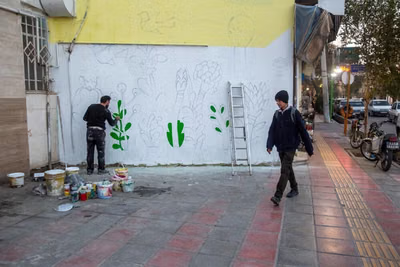

Hardliners have labeled concerns about rising Afghan immigration as "Afghan-Phobia," defending the government's perceived "open borders" policy, despite public outcry.
The fast-growing Afghan population in Iran has given rise to protests on social media and even debates in Iran's government-controlled media, with many claiming that the government has a hidden agenda in letting thousands of Afghans enter the country illegally every day. Videos from the border regions show crowds of Afghans simply walking into Iran, and some claim that “a network” quickly helps find housing and jobs for them.
Iranian officials say there are five million Afghans in Iran now of which only 780,000 have refugee status. Most others are undocumented. Some estimates of the Afghan population reach as high as 8 million. A Tehran province official said Monday that 2.5 million Afghans have settled just in areas west of the capital.
Some government critics claim authorities are actively encouraging the growth of the Afghan population with incentives such as subsidized energy and food to remedy the problem of population decline or even to bolster its military by recruiting young Shiite Hazara Afghans.
The Fatemiyoun brigade of Afghan fighters fought for the Revolutionary Guards in Syria.
Thousands of Afghan militia, recruited and trained by the Revolutionary Guard, played a significant role in supporting Bashar al-Assad's government by fighting in Syria.
Tehran Municipality’s Hamshahri newspaper is among the hardline media that has been describing popular concerns as “Afghan-phobia”. The newspaper whose chief editor Abdollah Ganji is a former editor of the IRGC-linked Javan newspaper, published an article entitled “Who Benefits From the Afghan-Phobia Project” last week.
The article said “exaggerated” news about the apparently fast-growing number of Afghan immigrants has affected the mindset of Iranians and that the concerns raised on social media have resulted in “unkind attitudes toward Afghan citizens”.
State media and other hardliner publications also appear to be unusually sympathetic to this unprecedented policy of opening the doors to Afghan immigration.
Recent video of Afghans celebrating the Taliban rule in Mashhad.
Not only reformist media that over the years had been more sympathetic to Afghan immigrants, but also some conservative media and figures such as Jomhouri Eslami newspaper and the former chairman of Iranian parliament's national security and foreign policy committee Heshmatollah Falahatpisheh, have become increasingly vocal in criticism of what they call uncontrolled Afghan immigration and warned about “security threats” that may result from that.
A commentary entitled, “The Dangerous Aspirations of Radical Afghans in Iran” published by the newspaper Sunday warned that the Taliban may be harboring dangerous plans for Iran and may attempt to use “radical Afghans in Iran” toward securing their own interests given “the [existence of a] divide between the people and government in Iran and extensive frustration of the Iranian people”.
The warning came after a video of pro-Taliban Sunni Afghans celebrating in Mashhad on September 29 went viral on Persian-language social media. The video showed the celebrants raising the flag of the Taliban Islamic Emirate of Afghanistan and chanting anti-American slogans.
The religious city of Mashhad is Iran's second largest city where the shrine of Imam Reza, the eighth Imam of Shiites, is located, while at least a segment of Afghan migrants are fierce Sunnis.
Hardliners’ positive attitude in the past two years toward the Taliban despite the Shiite-Sunni divide is unprecedented in the history of the Islamic Republic where hardliners and top Shiite clergy have always been highly sensitive to the growth of the Sunni population in the country.
“Around Mashhad, the Sunnis are buying land and houses from Shiites to increase their weight in the population. I told the officials that if they do not find a solution to these problems today, it may reach a point where no action can be taken," Nasser Makarem Shirazi, a source of emulation in Qom, warned in 2016.
Similar religious concerns may be behind some hardliners’ concerns over allowing an increase in the number of Afghan immigrants including Kayhan, a flagship newspaper close to Supreme Leader Ali Khamenei which has been extremely supportive of President Ebrahim Raisi and his government.
On Sunday Kayhan printed a reader’s message who has urged authorities to expel “illegal” Afghan immigrants because they are benefitting from “hidden subsidies including food, housing, public transportation and healthcare [subsidies]”.

The presence of Iranian hardliners on platform X has sparked criticism within Iran while ordinary citizens are banned from that and many other social platforms.
One such user is the propagandist Ali Akbar Raefipour, whose recent purchase of the blue verification tick has stirred massive controversy on social media.
Hashem Firouzi, a social media activist, voiced his concerns, stating, "They pay $8 a month for the Blue Tick to the United States, and then they tell us that the United States is on the verge of decline."
Several other Iranian officials, including Labor Minister Solat Mortazavi, also subscribed to X in June. Elon Musk, the owner of X (formerly Twitter), has rebranded the platform and introduced a premium option as the exclusive means of obtaining the coveted Blue Tick verification.
Parliamentarian Bijan Nobaveh Vatan recently criticized the presence of Iranian officials on the former Twitter platform (X), highlighting the hypocrisy, stating "The first step in fostering trust in domestic platforms and discouraging the use of foreign platforms is the adherence of officials to the relevant laws."
In a related development, a new Iranian social network called Virasty has emerged, closely copied from Twitter in both its features and logo design.
Iran has long maintained strict internet censorship, blocking major social media platforms such as Facebook, Twitter, and YouTube. In the wake of recent protests, Instagram was also blocked.
Social media users in Iran have largely refrained from using domestically developed social media applications like Rubika, Eitaa, Soroush, and Nazdika, citing concerns about their quality and privacy shortcoming as digital surveillance continues to gain pace.

Iran has once again expressed concerns regarding the ongoing conflict between Armenia and Azerbaijan and the existing threat to the territorial integrity of Armenia.
The Secretary of Iran's Supreme National Security Council threatened that any shifts in the region's geopolitical landscape would result in “heightened insecurity and the exacerbation of existing crises.”
Ali Akbar Ahmadian made the remarks during a meeting with his Armenian counterpart, Armen Gregorian, in Tehran on Sunday.
Since Armenia's defeat in the 2020 war on Azerbaijani soil, it has become vulnerable to potential incursions from its more powerful neighbor. In this scenario, Iran would lose a secure land corridor to the north, which connects it to Russia through Georgia. Tehran has repeatedly revealed its concerns and has warned that it would not tolerate such actions by Azerbaijan. It has also bolstered its military presence on the border to underscore this stance.
The conflict carries the potential to reshape the geopolitical dynamics of the South Caucasus region, which is intersected by vital oil and gas pipelines. Iran has previously cautioned against altering the political landscape in the Caucasus and adjusting international borders.
Tehran has stated that if either side attempts to modify the geopolitical balance in the Caucasus or the international borders, it will abandon its neutral position and respond directly. However, Tehran did not intervene this month when Azerbaijan attacked Karabakh, the Armenian autonomous enclave within its territory and forced more than 100,000 people to flee.

The former head of Iranian parliament's National Security and Foreign Policy Committee says Azerbaijan's attack on Karabakh is the beginning of a regional crisis.
Heshmatollah Falahatpisheh told Didban Iran [Iran Monitor] website in Tehran that the country is facing a serious challenge as one of its gateways to Europe is threatened because of the military development in the Caucasus.
Falahatpisheh also pointed out that Iranian officials and military commanders who used to deliver passionate speeches about Iran's interests and authority in the region are silent in the face of threats to Tehran's interest.
During the past months, several Iranian military commanders and politicians warned Azerbaijan not to attack Armenia and avoid closing Iran's gateway to Europe at its borders with Armenia. As Azerbaijan expelled 120,000 Armenians from the enclave, it now threatens to enter and occupy the narrow strip of land connecting Iran via Armenia to Russia and Europe.
Iran has also long warned Azerbaijan about its close military relations with Israel, which is the Baku’s main arms supplier.

Mashregh News, a media outlet with close links to Iranian security and intelligence organizations on September 9, called an attack on Karabakh Iran's "red line" and maintained that such an action will entail consequences for Azerbaijan. The threat later proved to be hollow.
Iran's silence in the face of the development is apparently linked to a visit to Iran by Russia's Defense Minister Sergey Shoigu immediately before the attack. Meanwhile, Tehran's inaction was quite embarrassing for the regime and its military commanders considering months of bragging on IRGC media outlets and social media channels about Iran's swift reaction in case Azerbaijan attacked Karabakh.
Some Iranian social media users ridiculed the Iranian military and posted a photo of a smiling Iranian military attache' walking alongside victorious Azeri officers in Karabakh following the attack. One user wrote: "I wrongly thought that the Iranian regime's officials were trying to be strategically patient in the face of Azerbaijan's alliance with Israel."
Falahatpisheh told Didban Iran that "All this is an outcome of Iran's outdated foreign policy. At times we saw Iranian officials delivering irresponsible speeches at the borders with Azerbaijan. If what is happening now is Iran's real policy, those speakers should be accountable for agitating the society at the expense of Iran's national interests."
The former lawmaker said that the forced displacement of ethnic Armenians in Karabakh is not the end of the conflict. On the contrary, it marks the beginning of a new crisis in the region. Tens of thousands of Armenians have been displaced and their private and public rights poses a new challenge for the region's leaders. This is likely to turn into a chronic challenge not only for Azerbaijan and Armenia, but also for other players such as Turkey and Israel. Particularly because Iran will perceive Israel's presence at its borders as a true challenge.
He said: "Turkish leader Recep Tayyip Erdogan's stance during the conflict were more realistic that the other leaders involved. At least he acknowledged that Iranians are not going to like the closure of one of their key gateways to Europe and the outside world.
Meanwhile, Erdogan’s call for a meeting between the leaders of Turkey, Russia, Azerbaijan and Armenia to discuss the aftermaths and implications of the attack on Karabakh, without mentioning Iran.
Falahatpisheh pointed out that Iran's policy about the region dated back to three decades ago and Tehran was oblivious to the developments and dynamics that have been taking shape during the past thirty years in the region.
He argued that as a result of the current conflict, Azerbaijan will have to allocate a major part of its annual budget to military spending. He added that by inviting countries from beyond the region into this conflict, Azerbaijan has made a mistake. It could have solved its problems with Armenia in a different way.

The chairman of Iran's chamber of commerce says he has heard rumors that the government intends to meet the standards of FATF, the global money-laundering watchdog.
Hossein Selahvarzi, the chairman of Iran's Chamber of Commerce, Industries, Mines and Agriculture said Sunday that there is “unofficial news about the accession to the money-laundering watchdog, the Financial Action Task Force (FATF) and the possibility of more serious economic negotiations.”
Iran’s previous government submitted four bills to parliament in 2017 to adopt laws to implement FATF’s standards. The parliament approved the bills, but the hardliner Guardian Council, which has the final say, rejected two of the bills: One about joining the UN’s Palermo convention to fight international organized crime and the other to join the CFT (Combat Financing Terrorism) convention.
As stated repeatedly by experts, Iran's international trade will continue to suffer without accession to the FATF, even if US sanctions are lifted. In June, FATF retained Iran on its blacklist along with North Korea as Tehran remains reluctant to comply with global regulations.
Experts say that even if sanctions imposed by Western countries on Iran are lifted, Tehran must adhere to FATF standards in banking and financial controls to be considered a safe business partner by international actors. Most important are measures to prevent money laundering and financing of terrorism.

Opponents argue that if Iran accedes to FATF demands it will not be able to provide financial help to allied groups in the region that are part of Tehran’s “axis of resistance”. These groups, such as the Lebanese Hezbollah and some Palestinian militant organizations, are designated as terrorists by the United States and others, and act as proxy forces to help the Islamic Republic spread its influence in the region.
Speaking at an event hosting representatives of the country’s chambers of commerce in Mashhad, he claimed that "News and rumors about removing barriers to foreign trade, the lifting of sanctions, and even the acceptance of FATF rules have emerged, which in reality are not accurate.” He cautioned against persisting with past foreign policies that have imposed significant limitations on economic activities, particularly on the private sector.
Most hardliners are of the opinion that abiding by the regulation of the FATF is too much transparency for the Islamic Republic, which has resorted to a repertoire of illegal tricks and loopholes to circumvent sanctions on its banking system for international trade and its secret financing of militant proxy groups.
Parliament Speaker Mohammad-Bagher Ghalibaf said Saturday that 'BricksPay system – a digital payments platform that is being jointly developed by the member countries of the BRICS -- can be a direct replacement for SWIFT (The Society for Worldwide Interbank Financial Telecommunication). However, even the BRICS members are not looking at the platform as a replacement for other international networks.
Criticizing the government’s economic policies that have created obstacles in the path of international trade, Selahvarzi said that today numerous economic entities are targeted by state bodies under the guise of controlling the rising inflation rate. He argued that “Inflation is controlled when the inflation-inducing engine is turned off," he said, referring to Iran’s money printing to finance its deficit, which in turn leads to vicious cycle of more inflation due to high market liquidity.
He also criticized the government for sidelining private businesses people in the process of devising the budget plans for the country. “I should say that if the oppressive sanctions do not lead to the collapse of Iran's economy, these economic measures will ground the country’s economy."
The recently elected chairman of Iran's chamber of commerce, who is being challenged by hardliners and the government, had to deal with a hardliner heckler during the Sunday meeting. A man asked about Selahvarzi’s support for the Women, Life, Freedom protests, accusing him of not being trusted by the Islamic Republic.