Iraq Holds Diplomatic Key To Arab World Says Khamenei Aide
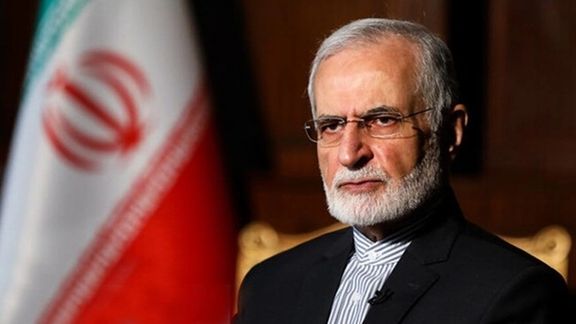
A senior advisor to Iran's Supreme Leader says Baghdad is a golden gate through which Iran can communicate with Arab countries.
A senior advisor to Iran's Supreme Leader says Baghdad is a golden gate through which Iran can communicate with Arab countries.
In a meeting with the Iraqi president in Baghdad, foreign policy advisor to the supreme leader, Kamal Kharrazi, also acknowledged the contribution made by Iraq "to bridge the gap between Tehran and Riyadh.”
Alongside meetings with government officials, Kharrazi, who travelled to Iraq as the head of a delegation on Monday, also met with with Iraqi cleric and politician Sayyid Ammar al-Hakim who is the head of the National Wisdom Movement.
Kharrazi’s trip to Iraq comes after a senior Iraqi official confirmed that his country has acquired a sanctions waiver from the US to pay $2.7 billion of its debt for gas and electricity to Iran.
The Iraqi foreign ministry source said that the funds will be transferred through the Commercial Bank of Iraq and confirmed that the money will be used for Iranian pilgrims' expenses and foodstuffs imported by Iran.



Iran’s foreign minister Hossein Amir-Abdollahian met Qatar’s Emir in Doha on Tuesday in what may be related to reported indirect talks with the United States.
Amir-Abdollahian who arrived in Qatar Monday evening is accompanied by a delegation and will also visit Oman, another friendly regional country that has been a traditional mediator between Tehran and Washington.
Iranian government media had little to say about the foreign minister’s trip early on Tuesday, simply reporting on the meeting with the Emir, Sheikh Tamim bin Hamad Al Thani, and saying that discussing international, regional and bilateral issues were the purpose of his visit to Qatar.
In recent weeks, both Iran and the United States have indicated that they are in indirect contact, although several media reports since January have also described direct talks between the US special envoy for Iran, Rob Malley and Iran’s ambassador at the United Nations, Saeed Iravani.
Israeli media and officials insist that already a limited agreement or a “mini-deal” has been worked out between Washington and Tehran aimed at stopping further Iranian uranium enrichment in exchange for US agreement to allow third countries to unfreeze Iranian funds and limited sanctions relief.
The US has denied these reports describing them as “inaccurate” or false, but earlier this month the Biden administration allowed Iraq to release more than $2.7 billion of money it owed to Iran for importing energy.
Although the administration insisted that the funds are earmarked for Iran to import food and medicines, the whole scheme is shrouded in mystery and it is not clear if Tehran would actually get its hands on cash US dollars, something Washington has tried to prevent since 2018 when it imposed economic sanctions.
Critics argue that any transfer of cash to the Iranian regime will bolster its ability to foment instability in the region. Some say that even financing its humanitarian needs will free up government funds for its military and proxy forces in the region.
The regime has been hosting leaders of Palestinian militant groups in Tehran and Supreme Leader Ali Khamenei held a meeting with them.
Ziyad al-Nakhalah, the leader of the Palestinian Islamic Jihad (PIJ), has been in Iran since last week, culminating in the arrival of Hamas leader Ismail Haniyeh in Tehran on Monday.
The groups, both designated terrorist outfits by the European Union, the US, the UK, Canada, and Israel, have been receiving financial support from the Islamic Republic, presumably for wreaking havoc in Israel, or what the regime calls “resistance.”
Amir-Abdollahian’s trip to Qatar and Oman followed the visit of Saudi foreign minister Prince Faisal bin Farhan to Tehran over the weekend after the two countries agreed to re-establish diplomatic ties in March after seven years of bitter animosity.
Although the détente with Saudi Arabia heralded an end to Iran’s isolation in the region, Riyadh has expectations from Tehran, the most important of which is security in the Persian Gulf region and an end to hostilities in Yemen.
"I would like to refer to the importance of cooperation between the two countries on regional security, especially the security of maritime navigation... and the importance of cooperation among all regional countries to ensure that it is free of weapons of mass destruction," Prince Faisal said during a press conference in Tehran.
A popular website in Iran slammed a senior cleric and regime official recently for claiming that the main job of religious seminaries is engagement in politics.
“Who and what entities are supposed to promote Islam and the rules of Sharia if the main job of religious seminaries (Ḥowza-ye elmiyeh) is engagement in politics? You can’t say that the main job of seminaries is engaging in politics and [at the same time say] the main job of seminaries is promotion of religion,” Asr-e Iran asked Ayatollah Mohsen Araki in a commentary June 15.
Ḥowza-ye elmiyeh in Persian means a religious seminary where senior clerics, usually grand ayatollahs, teach various Islamic subjects including theology and law, according to the tenants of Shiism, to future clerics.
The city of Qom is home to the largest seminaries in the country but there are similar establishments in other cities including Najafabad in Esfahan Province and Mashhad, the capital of Khorasan-e Razavi. There are nearly three hundred thousand clerics in Iran's seminaries.
Asr-e Iran, which has moderate conservative leanings but no known political affiliations and is usually more critical of authorities than similar news websites, argued that engagement in politics is permissible when promotion of religion requires it but that does not mean its main mandate is interference in politics.
The commentary also listed several prominent Shia academics of the highest rank who never got directly engaged in politics including Grand Ayatollahs Mohammad Fazel-Lankarani and Mohammad-Taghi Bahjat in Iran and Ali Sistani in Iraq.
“Like any other citizen, Ayatollah Araki has the right to become a political activist, get engaged in politics and even hold political office. No one has the right to deny this to him and others…There is no need for him to reduce the mandate of religious seminaries…to engagement in politics to [justify] the political activities of himself and other clerics,” the commentary said.
Araki, born into a family of notable Shia clerics in Najaf, Iraq, teaches at Qom Seminary. He has served as the head of the World Forum for Proximity of Islamic Schools of Thought by Supreme Leader Ali Khamenei since 2012.
Araki was appointed as a member of the Expediency Council by Khamenei in 2022. He has also been a member of the Assembly of Experts since 1998, which is responsible for overseeing the performance of the supreme leader and election of a new leader if he passes away.
Many clerics in Iran hold government offices and the government also annually allocates tens of millions of dollars to religious seminaries and other religious institutions that play the role of its propaganda arm.
A report, claimed by an opposition group to have been hacked from the Iranian presidency servers, shows that the budget for seminaries increased by 96% last year. Iranian media had reported in January that the budget for religious organizations would increase by 130 percent, reaching $500 million, while at least 20 million more Iranians are now considered poor compared to two years ago.
In a recent speech, Iran's top Sunni cleric Mowlavi Abdolhamid said clerics and religious seminaries must not be funded by the government to remain independent and critical.
“Clerics must be independent and have their own opinions to be able to speak the truth and call the government to enjoin what is good and forbid it from doing what is wrong,” Abdolhamid said in another fiery Friday sermon in the southeastern city of Zahedan on June 3.
France has banned an upcoming Iranian opposition rally over the risk of an attack, according to a letter sent to the organizers and seen by Reuters.
The ban comes as Western powers seek to defuse tensions with Iran and a few weeks after Tehran released several Europeans from prison, including two French nationals. French President Emmanuel Macron held a 90-minute call with Iranian President Ebrahim Raisi on June 10.
The Paris-based National Council of Resistance of Iran (NCRI), political arm of the People's Mojahedin Organisation of Iran (PMOI), has held frequent rallies in the French capital over the years, often attended by high profile former US, European and Arab officials critical of the Islamic Republic.
In February, the NCRI attracted several thousand people to an event in central Paris, and plans its annual rally on July 1.
However, given a recent spate of mass anti-government protests in Iran over the death of a 22-year-old woman while in morality police custody, a "tense context" had developed posing "very significant security risks" to NCRI gatherings, said the document, a letter from Paris police chief Laurent Nunez.
Therefore, "this meeting, organized every year since 2008, cannot be held..." read the letter, sent to the NCRI rally's organizing committee.
In response to an inquiry, Paris police issued a statement to Reuters confirming that they had informed the committee of the decision to ban the rally as it could "generate disturbances to public order due to the geopolitical context".
"Moreover, given the terrorist risk cannot be neglected, the holding of such an event would make its security but also the security of sensitive guests extremely complex," said the statement.
A senior NCRI official condemned the decision when asked about it by Reuters, before the police confirmation.
"If French authorities take such a stance, it will represent a brazen disregard for democratic principles, caving in to the ruling religious tyranny’s blackmail and hostage-taking," Shahin Gobadi, a member of the NCRI's Foreign Affairs Committee, said.
Foreign Support For Iran Unrest
Mahsa Amini's death in custody sparked months of nationwide protests, prompting Tehran to accuse the United States, its Western allies and Israel of exploiting the unrest to try to destabilize the Islamic Republic.
Thousands of supportive rallies have been held around the world since her death September, although the nationwide unrest has subsided after Iranian security police clamped down on it.
To dampen rising tensions, the United States has been holding talks with Iran to sketch out steps that could limit the disputed Iranian nuclear program, release some detained US citizens and unfreeze some Iranian assets abroad, according to Iranian and Western officials.
Abortive Plot
Nunez's letter put the July 1 NCRI rally in the context of the abortive plot led by Vienna-based Iranian diplomat Assadolah Assadi in October 2018 and three others.
Assadi, who French officials said was running an Iranian state intelligence network and was acting on orders from Tehran, was sentenced in Belgium to a 20-year prison term in 2021. He was exchanged in May for four Europeans held in Iran.
"This attempted attack, which underlines the operational capacities for attacking the PMOI, falls into a series of violent and lethal operations in France and Europe, in the form of assassinations and kidnappings of Iranian opposition figures," the letter said, without providing details.
"Partner countries have in this regard recently mentioned many planned violent attacks, potentially targeting Iranian opposition figures."
Nunez also said in his letter to the NCRI that given the group's rally would attract several hundred important foreign dignitaries and PMOI members coming from overseas, "securing the event would be particularly complicated".
There have been three attacks on an NCRI building in a Paris suburb since the end of May, the letter said, and these were under investigation. Two sources close to the investigation said gunshots, petrol bombs and other incendiary devices had been used to target the building. It was unclear who was responsible.
The letter said there was also an elevated risk of conflict between the NCRI and rival Iranian opposition groups at the rally, although there had been no incidents at past rallies.
Tehran has long called for a crackdown on NCRI activities in Paris, Washington and the Saudi capital Riyadh. The group, whose sources of funding and support are unclear, is regularly lambasted by Iranian state media.
Reuters Report
The IRGC intelligence has assigned a hitman to poison and kill the vocal Sunni cleric of Zahedan, according to local media.
Haalvsh website, which covers the events in Sistan-Baluchestan province, reported on Monday that the security guards of Makki Mosque in which Mowlavi Abdolhamid makes his sermons, arrested a man in the guise of a religious student who wanted to assassinate the Sunni leader.
“The person, who is a Baluch and a resident of Delgan region in Sistan and Baluchistan province, has been sleeping and worshiping in the mosque for a long time in the dress of a student of religious studies,” explained Haalvsh.
According to the report, the suspect admitted that he received a salary of 150 million rials per week since the beginning of his operation.
In recent months, Abdolhamid has been under pressure by Iranian security to end his weekly protests and critical sermons on Fridays.
Since September during ongoing protests following the death of 22-year-old Mahsa Amini in police custody, Mowlavi Abdolhamid has made fiery speeches against the heavy crackdown and killing of protesters, calling government actions "felony".
He has also called for holding a referendum in Iran with the presence of international observers.
The Sunni city of Zahedan in the southeastern Sistan-Baluchestan province has been witnessing protests against repressions and discrimination in the province following mass Friday prayers during the past thirteen weeks.
Teachers in non-government schools must now undergo a six-month selection period, up from the standard 15 days.
The announcement, made by Ahmad Mahmoudzadeh, an official at the Ministry of Education, came on the back of orders of Supreme Leader Ali Khamenei blaming “seditions, riots and creating insecurity in the streets” after schools and universities have been at the forefront of protests since September.
Mahmoudzadeh said: “After passing a 60-hour course, teachers must attend 60 hours of training related to educational knowledge, as well as general and professional competence within five years. Every year, after passing all these courses, they can get a professional competence card.”
Khamenei had previously demanded that the authorities make sure the "selection rules" of teachers "do not weaken."