EU Imposes More Sanctions On Iran For Human Rights Violations

The European Union Monday imposed a new package of sanctions against Iran in response to human rights violations, adding eight individuals and one entity to its list.

The European Union Monday imposed a new package of sanctions against Iran in response to human rights violations, adding eight individuals and one entity to its list.
"In particular, the Council is sanctioning members of the judiciary responsible for handing down death sentences in unfair trials, and for the torturing of convicts," the EU said in a statement.
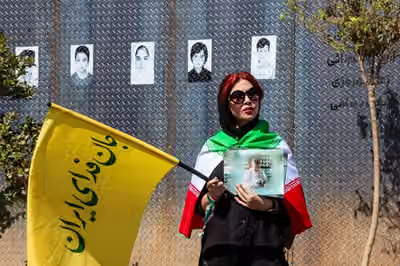
Iranian security forces have killed around 500 civilians, injured thousands and arrested 22,000 since September when antigovernment protests began in reaction to the killing of Mahsa Amini in 'hijab police' custody.
In total, EU sanctions now apply to 204 individuals and 34 entities in Iran. Monday's decision heralded the sixth round of sanctions.
"We want to make clear that nobody is above the law, which is why we will impose a sixth package of sanctions here in Brussels," German Foreign Minister Annalena Baerbock had told reporters earlier in the day.
Britain for its part said it had sanctioned senior officials from the Islamic Revolutionary Guard Corps (IRGC), including those who it said were responsible for managing the group's financial investments.
Iran has also been supplying killer drones to Russia that have been used by hundreds against infrastructe in Ukraine. The United States and the EU have warned Tehran against expanding military ties with Moscow.

Britain Monday added seven new designations to its sanctions list relating to Iran, including senior officials of the Revolutionary Guard (IRGC), following other recent sanctions.
The sanctions were imposed for what Britain said were actions contributing to the serious violation of human rights in Iran.
The UK sanctioned five members of the Board of Directors of the IRGC Co-operative Foundation, an economic conglomerate established by senior IRGC officials to manage the group’s investments in the Iranian economy.
Established initially to support IRGC service members, the Foundation has broadened out its remit to funding the IRGC’s repressive activities in Iran and abroad, a statement by the government said.
“The Foundation is also responsible for funding militant groups associated with the IRGC’s external operations arm, the IRGC-Quds Force. The Quds force is responsible for carrying out lethal activities outside of Iran by, for example, providing training, funding and weapons to groups such as Hezbollah and Hamas,” according the Foreign Office.
“Today we are taking action on the senior leaders within the IRGC who are responsible for funnelling money into the regime’s brutal repression. Together with our partners around the world, we will continue to stand with the Iranian people as they call for fundamental change in Iran,” Foreign Secretary James Cleverly said.
The UK also imposed sanctions on further IRGC provincial commanders for their roles in overseeing human right violations against protestors. Designations include Ahmed Zulqadr, Commander of the IRGC Seyyed al-Shohada provincial corps in Tehran province and Deputy Commander of IRGC corps in Tehran City, and Alireza Heydarnia, Commander of the IRGC for the Alborz Province.

Australia has issued sanctions on Iran for human rights violations and its support for Russia's war on Ukraine.
Targeted financial sanctions and travel bans will now apply to 13 Iranian individuals and targeted financial sanctions on one entity involved in the production and supply of drones to Russia.
The statement issued by Foreign Minister, Penny Wong, said the sanctions target those "responsible for egregious human rights abuses and violations in Iran".
Sanctioned targets also include senior law enforcement, political and military figures, including within the Islamic Revolutionary Guard Corps, the regime's agency involved in the violent crackdown on protests following the death of Mahsa Amini and the continued oppression of the people of Iran.
According to the list seen by Iran International, the commander of the IRGC's Sarallah Base, Mohammad Hossein Zibaee Nejad, also known as Hossein Nejat, is also on the list. Tasked with keeping Tehran secure, it is the most important IRGC ground force HQ in Iran consisting of several of its most important units, which protect key institutions and the offices of the government. The operations deputy of the Police Force, Hossein Sajedinia, also appears on the list.
Four members of the morality police cited as "responsible for the arrest, detention and ill-treatment of Mahsa Amini" are among those facing the Magnitsky-style human rights sanctions.

Sources say the European Union intends to impose sanctions on eight Iranians and an organization that had a hand in suppression of protests following the death in custody of Mahsa Amini.
EU countries have agreed to take new punitive measures against those responsible for the repression, the Dutch website De Telegraff quoted some sources as saying.
The bloc’s foreign ministers still have to approve the sanctions on Monday at their meeting in Brussels, but it is expected to be adopted.
The designated individuals and organizations will no longer be allowed to enter the EU and can no longer access any assets in the union. The EU has so far imposed such sanctions on 196 Iranians and 33 Iranian organizations and companies including prominent politicians and security officials.
The latest round of sanctions from the EU in late February included Iran's Culture Minister Mohammad Mehdi Esmaili for persecuting artists and filmmakers and also Education Minister Yousef Nouri for suppressing students.
The European Parliament has called on the EU to list the Revolutionary Guards as a terrorist entity, blaming it for the repression of domestic protests and the supply of drones to Russia.
However, the 27-nation bloc has so far stopped short of blacklisting the IRGC as a terror group, despite calls from Berlin and Amsterdam.

Firebrand Iranian cleric Ahmad Khatami claims the massive rise of prices in Iran is the result of a plot hatched by the United States.
The hardliner cleric and Friday prayer Imam in Tehran said that high prices are the result of an "economic war” waged by the US, referring to the heavy sanctions Iran is currently living under.
Although economic sanctions imposed by Washington have a major impact on Iran's economy, many among local media and politicians also blame government mismanagement and the centrally controlled economy plagued by corruption.
“I clearly announce that this high level of inflation is a conspiracy and economic war staged by the US, so the authorities should put in more effort to deal with the unbridled prices,” he said.
Khatami went as far as making a strange claim that “American think tanks have organized 200 conspiracies to overthrow the Islamic Republic.” Accusing American research outfits of conspiring against the regime has been a recent theme in sermons by hardliner clerics.
Iran has been struggling with above-40-percent inflation since 2019 when the United States imposed sanctions.
Last May the government eliminated an annual food import subsidy of at least $10 billion, which immediately led to steep price increases. This was followed by a fall in the value of the national currency.
Food prices continue to climb as the national currency declined by 50 percent in the past six months. According to the Statistical Center of Iran (SCI), in some months, food and beverage inflation hit 87 percent.
The ongoing Woman Life Freedom protests and the collapse of the JCPOA talks, have also worsened the country’s economy to levels not seen in recent history.

The United Kingdom, France and Germany known as the E3 have decided to shut down the INSTEX mechanism, launched in 2019 to facilitate trade with Iran.
The move by the group will be seen as another slap at the Islamic Republic amid souring ties.
The E3 set up INSTEX (Instrument in Support of Trade Exchanges) to help reduce the impact of US sanctions, particularly in relation to humanitarian goods.
However, in a harsh statement it cited Iran’s “continued obstruction” as the reason behind the mechanism’s liquidation this week.
The INSTEX shareholders – Belgium, Denmark, Finland, France, Germany, the Netherlands, Norway, Spain, Sweden, and the UK – voted in favor of the dissolution at the extraordinary general assembly on March 9 considering Iran’s persistent refusal to engage with the facility.
The group said it could no longer justify the INSTEX mechanism in spite of its demand from European exporters, as in the last four years, the Islamic Republic has systematically prevented INSTEX from fulfilling its mandate for political reasons.
“This was born from a political determination to impede the use of INSTEX under any circumstance,” the European countries said, highlighting that the Islamic Republic leadership has chosen “to act against the interests of its people by refusing to cooperate on the export of medicine and other life-saving goods”.
Reflecting the regime’s blatant disregard for its country’s needs, the group said it was clear Iran’s priorities were not in allowing humanitarian aid to reach its people.
“Iran only agreed to a single transaction, in early 2020, for the export of medical goods from Europe to Iran,” the group’s statement claimed. “After that, Iran consistently and deliberately blocked other proposals for transactions between the United Kingdom, Norway, the European Union and Iran.”
Considering the fact that Iran faces numerous difficulties for trade transactions with other countries and has been devising new methods to circumvent the US sanctions, the wording and timing of the E3 statement indicates the disappointment of the European states which have also been vocal in their condemnation of the violent suppression of protesters since September.
INSTEX was designed to reassure European companies that there was a safe mechanism for trade with Iran in the face of many fearing retaliation by the US where they had greater business interests than in Iran.
Major European companies left the Islamic Republic during the summer of 2018 when the Trump administration re-imposed Washington’s sanctions against Tehran following the pullout from the 2015 nuclear deal, the Joint Comprehensive Plan of Action (JCPOA).
At the time, Tehran was not so eager to use INSTEX because it seemed more of a symbolic gesture by the European parties of the JCPOA to make sure the Islamic Republic remains committed to the deal.
One Iran-born analyst in Germany said the reasons behind Iran’s reluctance is that INSTEX does not guarantee oil purchase from the regime, nor does it cover other countries such as China and India. Focusing on food, medicine and medical supplies, the regime felt it was not even a financial channel, more of an accounting company.
Responding to the announcement, Tehran said it never relied on the trade mechanism and has found other ways to safeguard its economic interests.
Foreign Ministry spokesman Nasser Kanaani said on Friday “Unfortunately, European governments failed in launching INSTEX effectively … and they did not implement the necessary measures for activating the instrument.”
He said that the main reasons for the failure of INSTEX are “lack of serious will” and “inability” on the part of the European governments to compensate for the US pullout from the JCPOA.
Masking the diplomatic setback, he said: “Tehran had never pinned hope on INSTEX as it has been conducting its international trade through other international financial and banking channels.”