Deputy Interior Minister Says Arrests Made In Connection With Poisonings
Deputy Interior Minister Majid Mirahmadi
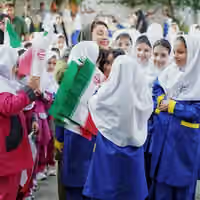
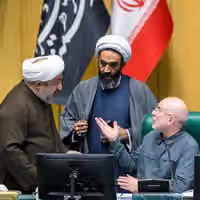
Iran’s Deputy Interior Minister Majid Mirahmadi announced on Tuesday that arrests have been in five provinces in connection with the chemical attacks taking place across the country on female students.
Mirahmadi quickly excused those arrested claiming they were "misguided", many of whom were released soon after having been given "advice" on their behavior.
Hundreds of girls have been targeted since November in a series of unexplained chemical gas poisonings around the country, believed to be aimed at quashing support for unrest triggered by the death of Mahsa Amini, who died in morality police custody after being arrested for not wearing her hijab properly.
"Some who did not have hostile intentions were also guided," Mirahmadi said, though gave no explanation how such attacks which have seen possibly hundreds of girls hospitalized, could be considered "non-hostile".
It suggests Mirahmadi believes the perpetrators to be supporters of the regime, long suspected on the global stage as being behind the spate of attacks which began in the religious city of Qom.
He played down the severity of the attacks which the regime also tried to brand 'mass hysteria', government mouthpieces such as Mohammad Marandi, claiming the attacks were a falsity created by psychosis. On Twitter, Marandi wrote, "Western regimes are responsible. They fund anti-Iran mercenaries to create hysteria & unrest. Western/Saudi Persian media terrorize schoolchildren & their families, while western controlled terror groups are deployed by command centers in Albania & northern Iraq to create unrest."
The deputy minister's statement on Tuesday affirmed the rhetoric, saying "there is no reason for serious concern as the number of cases that have occurred in schools has decreased significantly". Meanwhile, Baluch activists announced that over 300 female students were hospitalized due to gas inhalation in the southeastern city of Zahedan on Monday and chemical attacks continued in schools through Tuesday across several provinces.
The Islamic Republic had earlier blamed "enemies" and even the Farsi-speaking media based abroad as the "perpetrators" of the attacks, and President Ebrahim Raisi also condemned the poisoning of students as "enemy's conspiracy".
Iranian missile attacks across the Iraqi border are unacceptable and put regional stability at risk, German Foreign Minister Annalena Baerbock said on a visit to the Iraqi capital.
"With its missile attacks, the Iranian regime shows not only that it recklessly and brutally suppresses its own people, it also puts human life and the stability of the whole region at risk to hold on to power," she said on Tuesday.
"It is unacceptable and dangerous for the whole region," she told a news conference with her Iraqi counterpart.
Last year, Tehran fired missiles at bases of Kurdish groups in northern Iraq it accuses of involvement in popular protests against its restrictions on women, displacing hundreds of Iranian Kurds and killing some.
Iran has for years refuted Western claims it is a destabilizing influence in the region. Tehran, faced with its biggest anti-regime protests in 44 years, has accused Western countries of orchestrating unrest and has accused protesters in ethnic minority regions of working on behalf of separatist groups.
Baerbock, visiting Iraq on the same day as US Defense Secretary Lloyd Austin, said she was sending a signal that Europe's biggest economy wanted deeper cooperation with Iraq.
She said she would discuss Iraq's security and stability, the question of Yazidis, and cooperation on climate change.
Germany, and some other European countries, have adopted a tougher line toward Iran’s suppression of protesters since antigovernment unrest began last September. So far, government forces have killed more than 500 civilians.
As the United States calls the chemical gas poisonings on girls’ schools ‘unconscionable,’ demands are growing on international bodies to investigate the incidents.
US State Department Spokesperson Ned Price said the poisonings across the country, now affecting dozens of schools and university dormitories since November, must be "stopped immediately".
Referring to speculations about the regime’s intention to take revenge on schoolgirls for their participation in the protests ignited after 22-year-old Mahsa Amini died in custody of morality police, Price told a news conference, “If these poisonings were found to be related to women and girls’ participation in protest, then it would be within the mandate of the UN’s Independent International Fact-Finding Mission on the Islamic Republic of Iran to investigate.”
Price said that bodies such as the UN must demand answers as little information has so far been forthcoming from authorities in Iran.
"There is a fact-finding mechanism within the UN itself... If it is determined that there was a motive at play and an effort to suppress the ambitions, the abilities of women and girls in Iran, we do think it would be appropriate for that particular body to – within their mandate to investigate.”
“We’re also alarmed by reports that Iranian authorities have intimidated parents, that they have intimidated medical professionals into silence. The entire world is greatly concerned about these poisonings. Iranian authorities should cease suppressing the media and allow them to do their jobs,” Price stated.
White House Press Secretary Karine Jean-Pierre echoed Price's sentiments on Monday. She said, "The possibility that girls in Iran are being possibly poisoned simply for trying to get an education is shameful, it's unacceptable. If these poisonings are related to participation in protest then it is well within the mandate of the UN independent international fact finding mission on Iran to investigate."
On Tuesday, 20 prominent Iranian lawyers and human rights advocates issued a joint letter, calling on the WHO, the UNESCO, the UNICEF and the International Committee of the Red Cross to immediately visit Iran and probe into the serial poisoning of schoolgirls. They urged the bodies to use all tools within their mandate to ensure that these incidents are promptly and transparently investigated in accordance with international standards and that the perpetrators are identified and prosecuted.
The lawyers also called for solutions for special support for the affected female students. There are conflicting reports about the number of schools, girls, and cities affected by the attacks, not least, due to the suppression of both free media and internet access across the country.
On Monday, Iranian member of the parliament Mohammad-Hassan Asafari claimed that more than 5,000 students in 25 provinces and about 230 schools have been targeted by the poisonous gas attacks which began in Qom on November 30. The Islamic Republic authorities have only vowed to pursue the matter but only prosecuted those who reported or protested against the attacks.
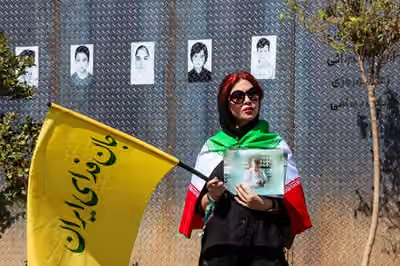
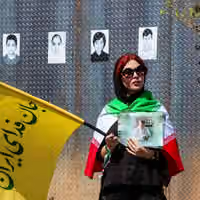
Iranians across the country have held anti-government protests outside education departments in dozens of cities demanding security protection for girls' schools and dormitories as mysterious chemical poisoning attacks continue.
Protesters chanted slogans such as "death to the child-killing regime" in cities including Kashmar, Saqqez, Harsin, Aligudarz and Ardebil, with security forces breaking up the protests in several locations and regime agents throwing tear gas at people in the northern city of Rasht.
In the capital Tehran, a group of protesters gathered in downtown Jomhouri Street with teachers and citizens also gathered in front of an education department office to slam the brutality against students, especially schoolgirls, who have been at the forefront of protests since September, seen cutting their hair and burning headscarves and photos of the Supreme Leader.
Reports say people in the religious city of Mashhad called for the resignation of officials as answers are still missing from the attacks which began in November and have since seen dozens of schools and university dormitories targeted by an unknown chemical poisoning.
The Coordinating Council of Iranian Teachers' Trade Association called for the gathering which took place on Tuesday, declaring their solidarity with the girls, hundreds of whom have been ill and hospitalized with symptoms including nausea, vomiting and dizziness, as well as respiratory issues. “We the working and retired teachers will not leave our children alone in such a painful situation," a statement said.
The Islamic Republic has failed to issue a clear report on those responsible, the type of chemicals used, or make any arrests. It is feared that the regime is quashing female protesters from backing protests triggered by the death in custody of Mahsa Amini, arrested by morality police for the incorrect wearing of her hijab.
Chemical attacks targeting female students with poison gas continued on Monday evening with two women's dormitories at Esfahan University of Medical Sciences.
Students Trade Unions Council said the attack forced the students to come out of the dormitory around 11pm following a bad smell which gave students symptoms typical of dozens of attacks which have been witnessed across schools and dormitories since November, namely nausea, vomiting and dizziness. The council said "there is still no accurate information on the number of those poisoned”. The United Students Telegram channel published some photos of girls gathered in the open area around the dormitories with images shared on social media showing several ambulances and police cars surrounding the buildings, suggesting large numbers needed medical support. The poison attack on female student dormitories began on Thursday, exactly three months after the attacks on schoolgirls began. The first poisonings at dorms were reported at Karaj Technical and Vocational University. After that, a dormitory for girls at Urmia Technical and Vocational University was attacked in the early hours of Sunday. At least 29 students were hospitalized after being transferred to Urmia clinics.
Serial chemical attacks on girls’ schools and dormitories that first were reported in the religious city of Qom have since spread to at least 21 of Iran’s 30 provinces.
On Monday, Iran's ruler Ali Khameini finally spoke out, saying: "The country’s officials must earnestly investigate the matter of the poisoning of students. This is a huge crime which is unforgivable. If the poisoning of students is proven, the perpetrators of this crime must be given the maximum punishment without pardon."
However, the government has made no arrests so far and Khamenei's hardliner supporters have tried to explain away or minimize the attacks.
The Tehran prosecutor has announced criminal charges are being filed against the directors of three news outlets and three famous figures for reporting or commenting on the recent wave of gas attacks on girls' schools.
The editors of centrist daily Ham-Mihan centrist daily, Shargh newspaper, and moderate news website Rouydad 24 have all been indicted for reporting on the attacks. Iranian academic and reformist political activist Sadegh Zibakalam, Secretary General of Unity of the Nation Party Azar Mansouri, and cinema star Reza Kianian have also had charges filed against them.
The harsh legal action comes amidst growing censorship from the regime and continued internet shutdowns as it battles the wave of revolutionary fervor. It also follows remarks made by Chief Justice Gholam-Hossein Mohseni-Ejei who called for "severe punishment" of those discussing the gas attacks which have seen hundreds of school girls across the country fall in and need hospital treatment, since November. Ejei on Monday described the attacks as a “clear example of corruption on Earth,” a Sharia term that can lead to the death penalty, but he also threatened those who would comment on the incidents. Almost four months after the attacks which have taken place in scores of schools, the Islamic Republic has failed to issue a clear report on those responsible, the kind of chemicals used, or make any arrests.
It continues to silence critics who fear this large-scale action has been initiated from the government's brutal security forces as they crack down on revolutionary dissent, which women and girls have played a vocal role in since the death of Mahsa Amini in September.
Interior minister Ahmad Vahidi, wanted by Interpol for his role in the bombing of a Jewish community center in 1994, has been tasked with leading the investigation. The ex IRGC commander has as yet announced no new leads.