Iran Dismisses Scholtz Comment Comparing Iran With Argentinian Dictatorship

Iran says a statement by German Chancellor Olaf Scholz comparing the situation in Iran with past Argentinian dictatorship is interference in its domestic affairs.

Iran says a statement by German Chancellor Olaf Scholz comparing the situation in Iran with past Argentinian dictatorship is interference in its domestic affairs.
In a statement on Monday, foreign ministry spokesman Nasser Kanaani said, “In an amateurish and biased comparison, the chancellor of Germany once again proved that he still stands on the wrong side of history.”
Scholz, who was speaking in Buenos Aires Sunday, remembered the victims of the 1976-1983 military dictatorship in Argentina and compared this regime with the one currently ruling Iran.
Scholz participated in a ceremony at Río de la Plata, explaining that he cannot help but think immediately of the young people who are being murdered in Iran when they defend their freedom and struggle for a better.
It is estimated that between 7,000 and 30,000 people lost their lives during the military dictatorship in Argentina. Some of the victims were thrown into the Rio de la Plata in so-called death flights without the relatives being informed.
“The fact that dictatorship brings suffering, oppression and death is very visible here, just as we perceive it everywhere in the world today,” the German chancellor noted.
US-based Human Rights Activists News Agency (HRANA) released a report Sunday that at least 527 protesters have been killed in Iran since the protests began more than four months ago following the death in custody of Mahsa Amini.
Iran has also executed four young protesters so far to contain the nationwide demonstrations.
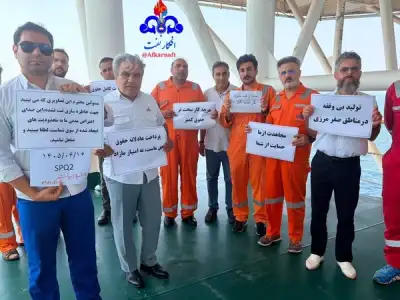

Five months into the nationwide uprising against the Islamic Republic, the regime has targeted universities, through forced retirement and dismissal of professors.
According to reports received by Iran International, the activity of at least nine professors at the Faculty of Political Science of Tehran Azad University have been terminated.
In Khorasan Razavi province in the east, Mahshid Gohari, professor of literature at Ferdowsi University of Mashhad, announced on her Instagram page that after seven years of teaching, the university has expelled her.
Javad Atefeh, a playwright, director and theater instructor, announced on his Instagram page, "For reasons that I am sure you know", he is not offered to teach in universities for the next semester.
Earlier, there were reports of suspensions and dismissals of university professors who supported the protests against the Islamic Republic following the death in custody of Mahsa Amini in mid-September.
Court cases have also been filed against many university professors and they have been arrested or summoned.
For example, in Kordestan Province in the west, Mohammad Sadeq Amiri, a professor of Sanandaj Azad University, was arrested by security forces on December 7.
Zahra Khoshkjan, a professor of political science at Shahid Bahonar University of Kerman, was summoned to the disciplinary committee for not holding classes on December 5, 6, and 7, in support of protests and she has now been banned from entering the university.

A leading activist has urged Iranians to unite and put aside disputes over an “unreal” fear of dictatorship or Iran's dismemberment after the fall of the regime.
“Let’s not fear having a dictatorship in the future. Let’s not fear Iran's dismemberment. These fears are not real … Let’s agree on [our] minimum demands and dig the grave of this rotten corpse,” the Canada-based Hamed Esmaeilion wrote in an Instagram post Sunday.
He wrote the comment on the anniversary of Ayatollah Ruhollah Khomeini’s return from exile to Tehran in 1979 and the establishment of the Islamic Republic. The post has been liked by nearly 200,000 so far.
In his long commentary, Esmaeilion urged Iranians both inside the country and abroad to unite, whether republicans or monarchists, belonging to minority religious or ethnic groups, on the right of the political spectrum or on the left.
“Many of the mistakes of the past will not be repeated if we leave political disputes to after the toppling of the descendants of the demon [Khomeini],” he wrote adding that unreasonable arguments would only delay the waves of protests in Iran where people no longer fear fighting the regime.

Like the exiled prince Reza Pahlavi, activists Masih Alinejad, Nazanin Boniadi, and footballer Ali Karimi, many on social media have expressed support for Esmaeilion’s membership in an opposition council to be formed for transition from the Islamic Republic.
Last week, Prince Reza Pahlavi also urged pro-democracy forces to unite. “I’m extending my hand, once again, for cooperation to all pro-democracy forces, including individuals, parties and groups, to support the Iranian national revolution,” he said in a statement published via his social media accounts.
The exiled prince’s plea came soon after his supporters launched a campaign to endorse him as the trustee of the Iranian people in transition to secular rule. Over 433,000 have so far signed the petition launched in mid-January.

Esmaeilion and others have recently been under heavy fire on social media for not having joined the campaign to give power of attorney to the exiled prince. Critics of the campaign say it has played a divisive role, caused rifts among the opposition, and led to the cooling of the revolutionary fervor on the streets in Iran.
In his recent statement, the exiled prince set three preconditions for cooperation with others: Accepting to ensure Iran's territorial integrity and the people’s right to determine the form of the future political system through a free vote as well as belief in human rights-based secular democracy.
Some Kurdish, Baluch, Turkic speaking groups and individuals, and those supporting federalism, argue that the mention of territorial integrity is divisive and is a sign federalism will not be tolerated. Others, particularly supporters of the exiled prince say demanding federalism is only a cover for separatism and dismemberment of Iran.
In the past four months, protesters across the country, particularly in Kurdish and Baluchi cities, have often chanted slogans such as “From Baluchestan (or Kordestan) to Tehran, we sacrifice our lives for Iran” to repudiate claims of separatism and stress the unity of all Iranians against the regime.
Hundreds of thousands of Iranians welcomed a New Year message tweeted by Prince Reza Pahlavi, Alinejad, Karimi, Boniadi, and Esmaeilion as well as actress Golshifteh Farahani on December 31 in which these opposition figures had wished that further solidarity and organizing could make 2023 the last year of the clerical rule in Iran.
Many believed that the tweet heralded the formation of a revolutionary council in exile that could take on the role of leading the Iranian revolution in the absence of strong revolutionary political parties and leaders in the country.

Iran’s hardliner Kayhan newspaper has proposed to form a national ‘soft war’ headquarters to deal with what it called the "hybrid war of the enemy".
According to Kayhan's proposal, the headquarters shall consist of 19 representatives from key ministries and organizations including the intelligence ministry, the Supreme National Security Council as well as the state TV.
The daily run by the hardliner editor Hossein Shariatmadari, who is Supreme Leader Ali Khamenei’s representative at the newspaper, has also suggested that mosques and Basij militia bases be used as the coordination centers for “regional and national action and counteraction against the enemy's soft war.”
In November, Khamenei called the ongoing anti-regime uprising following the death of Mahsa Amini a "hybrid war" led by the “enemies”.
“Enemies” in his view include the United States, Israel, Europeans, regional countries and any Iranian who is not loyal to him.
Following Khamenei’s lead, Iranian officials began to allege that the nationwide protests were instigated by foreign enemies mostly through social media.
Ali Fadavi, the second highest commander in the Revolutionary Guard, also said in October that the country’s ‘enemies’ who used to focus on ‘hard war’ against the Islamic Republic for decades have now adopted a hybrid approach, combined with soft power.

The Iranian regime continues to issue harsh sentences, including whipping and long-term imprisonment against journalists, students, teachers, lawyers, and other protesters.
Nazila Maroufian, a journalist, was sentenced to two years in prison, fined 15 million tomans (almost 350 USD) and banned from leaving the country for five years on the charge of "propaganda and publishing lies through an interview with Mahsa Amini's father".
Mahsa Amini, a 22-year-old Kurdish woman was killed in police custody for not having proper hijab in mid-September and her death led to weeks of nationwide protests against the Islamic Republic.
Another journalist, Vida Rabbani was sentenced to 11 years behind bars. Her mother wrote a letter to the chief justice saying that “Vida, now at the age of 33 has to spend 11 years of her young age behind bars arbitrarily upon verdicts issued based on bias.”
On the other hand, US-based Human Rights Activists News Agency (HRANA) reported that Zahra Mehrabi, a student of Tehran University and one of the detainees from nationwide protests, has been sentenced to five years of suspended imprisonment by a revolutionary court.
Amnesty International has also warned that Arshiya Takdastan, an 18-year-old protester who was arrested during the protests north of Iran, has been sentenced to a double death sentence on charges of "war against God" and "corruption on earth".
Amnesty also drew attention to the case of Mehdi Mohammadifar, a 19-year-old protester who has also received a double death sentence.

Members of the US Congress are ramping up efforts to pass new legislation in support of Iranian protesters and sanctions on top officials for rights violations.
A bipartisan group of Senate Foreign Relations Committee members and others numbering at least 28 Senators are re-introducing legislation in support of protests in Iran.
In a statement issued January 26, US Senators Bob Menendez (D-NJ), Chairman of the Senate Foreign Relations Committee, Marsha Blackburn (R-Tenn.), Chris Coons (D-Del.), Jim Risch (R-Idaho), Ranking Member of the Senate Foreign Relations Committee, and James Lankford (R-Okla.) announced that the resolution will call on the international community “to continue publicly highlight and condemn the Iranian regime’s crackdown since protests began…”
The resolution also urges the Biden administration “to strengthen international efforts to impose additional sanctions on officials and entities responsible for the violent suppression of demonstrations.”
In more than four months of popular protests, Iranian security forces have killed around 500 people, wounded hundreds and arrested up to 20,000 others. The government also executed four detained protesters in December and many more either face the death penalty or charges that could end in death sentences.
On the same day that Senators issued their statement the House of Representatives overwhelmingly approved a resolution expressing solidarity with Iranian protesters.
The 420-1 rare bipartisan vote marked the latest round of international condemnations against Iran’s government, which has deepened its isolation.
“It is vital that we in the US House of Representatives, a body that is among the greatest symbols of freedom and democracy around the world, stand with one voice to affirm our support for the brave Iranian people,” Rep. Claudia Tenney, R-NY, said during floor debate Wednesday.
The Washington Beacon also reported Friday that according to its sources House Republicans and Democrats are joining forces to sanction Iran’s Supreme Leader Ali Khamenei, who is the commander in chief of the armed forces, and other top regime officials for human rights crimes.
The legislation is dubbed the Mahsa Amini Act after the 22-year-old woman who was fatally wounded in hijab police custody in September and died in hospital. Her death triggered the anti-regime uprising by young people and women.
The Biden administration has imposed a series of sanctions on regime officials and entities since September, but sanctioning Khamenei directly for gross human rights violations will be a strong gesture for the international community and most Iranian who see him as the ultimate decider in the country.
It will also make more negotiation to revive the 2015 nuclear deal (JCPOA) more difficult, as Tehran will likely demand these sanctions to be removed before it agrees to curb its nuclear program.
Indirect talks that the Biden administration initiated in April 2021 have failed to revive the Obama-era agreement and some experts believe a new deal must be negotiated.
Republicans oppose resuming any negotiations with the Islamic Republic amid its killing of protesters and provocative moves, including supplying kamikaze drones to Russia for its war in Ukraine.
The Mahsa Amini Act was introduced in the previous Congress, but Democrats did not support the measure. Now, with Republicans in majority, the Washington Beacon says, “Democratic foreign policy leaders are lending their support to the bill.”