At least 100 Baluch Citizens Arrested By Iran’s Security Forces

The Islamic Republic’s intelligence ministry says as of Wednesday at least 100 people have been arrested in the Sunni-majority southeastern city of Zahedan.

The Islamic Republic’s intelligence ministry says as of Wednesday at least 100 people have been arrested in the Sunni-majority southeastern city of Zahedan.
Intelligence ministry directorate in Sistan-Baluchistan announced that at least one hundred people, who it called "criminals", "armed robbers" and "illegal immigrants", were detained with the cooperation of the Islamic Revolutionary Guard Corps and the police.
Using the common rhetoric of the Islamic Republic authorities, the directorate claimed, "the illegal foreign nationals played an effective role in insecurity, creating terror and violent robberies in Zahedan."
Almost three months after the "Bloody Friday of Zahedan" mass arrests of Baluch citizens has begun in the Sunni city.
The Bloody Friday in Zahedan took place September 30, when security forces killed at least 93 people, and injured hundreds more as civilians protested.
On Monday, regime forces arrested at least 40 citizens in a joint operation in the flashpoint city.
Reports say the arrest of Baluch citizens has continued in the past few days, and according to activists at least one hundred citizens, including children with no birth certificates have been detained.
According to Baluch Activists Campaign website, the military commanders have attacked ordinary citizens in public places of Zahedan on the pretext of "arresting criminals and armed robbers".
Among the detainees were seasonal workers who had gathered at a square in downtown Zahedan. Agents have reportedly arrested them while running over them in military vehicles. The report said those who tried to escape to different areas of the city, have been shot.
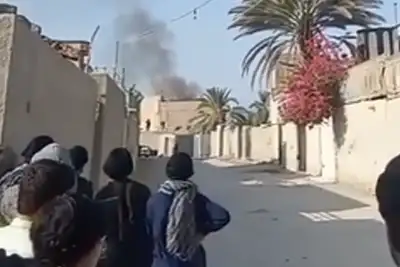

Turkish President Tayyip Erdogan said Thursday he may meet Syria's Bashar al-Assad, after their defense ministers met last week in Moscow with Iran absent.
In a speech in Ankara, Erdogan said the next step, following the landmark talks between defense ministers in Moscow, would be a trilateral meeting of the foreign ministers from Turkey, Russia and Syria, to further develop contacts.
"We have launched a process as Russia-Turkey-Syria," Erdogan said. "We will bring our foreign ministers together and then, depending on developments, we will come together as leaders."
Turkey has been the primary backer of Syria's opposition for more than a decade of war, while Russia has backed the Syrian government.
Iran, a major player in the Syrian war since 2011 and a participant in previous diplomatic efforts, was not invited to the meeting in Moscow.
The conflict continues into a second decade, although fighting is at a lower intensity than in earlier years.
With backing from Russia and Iran, Assad's government has recovered most Syrian territory. Turkish-backed opposition fighters still control a pocket in the northwest, and Kurdish fighters backed by the United States also control territory near the Turkish border.
A Turkish official said the Turkish and Syrian defense ministers met in Moscow on December 28., with the topics of migration and Kurdish militants on the agenda.
Turkish-Syrian rapprochement seemed unthinkable earlier in the conflict, and Syria's oppositions has urged Turkey to reaffirm its support.
With reporting by Reuters

The United States Central Command says two rockets have targeted coalition forces in northeastern Syria, a day after the 3rd anniversary of Qassem Soleimani's death.
In a statement on Wednesday, CENTCOM announced that two rockets hit coalition forces at Mission Support Site Conoco.
However, it did not give any further details about who was responsible for firing the rockets.
“The attack resulted in no injuries or damage to the base or coalition property,” the statement read, adding that the “Syrian Democratic Forces (SDF) visited the rocket origin site and found a third unfired rocket.”
No individual or group has yet claimed responsibility for this attack, but Rami Abdul Rahman, Head of the Syrian Observatory for Human Rights emphasized that this happened one day after the third death anniversary of former IRGC Quds Force Commander Qassem Soleimani, saying “pro-Iranian groups” have launched the attack.
The Islamic Republic and its proxy militia groups provide military support to Bashar al-Assad's regime in Syria.
After Qassem Soleimani was killed in a US attack in Baghdad, the top Iranian officials repeatedly threatened revenge for his death.
On January 3, 2020, the US military, on the order of President Donald Trump, killed Soleimani in a drone strike near Baghdad International Airport, saying that he had been "actively developing plans to attack American diplomats and service members in Iraq and throughout the region."
Several hundred American soldiers are stationed in the north and east of Syria as part of the international coalition against ISIS.
In recent years, the coalition bases have been sporadically targeted by rockets or drones.

Iran’s government has decided to act against those selling VPNs and circumvention software to people, as a measure to further restrict access to the Internet.
The Judiciary department in collaboration with ministry of communications will take legal action against "unauthorized sellers of the VPNs and circumvention tools," local media reported.
ISNA news website that published the news on Wednesday did not say who made the decision, however; many believe it could have been ordered by the Supreme National Security Council, or one of the intelligence services.
Since the beginning of protests in mid-September, the government has been severely restricting Internet access in general and access to popular social media platforms, such as Instagram, WhatsApp and others.
The government is extremely nervous that people use the Internet and social media to share news and images about protests, possibly motivating a larger segment of the population to join demonstrations.
However, restricting access also hurts internet-based businesses. Reports say up to 10 million people's livelihoods may be adversely affected by government’s Internet access denials and its ban on social media platforms.
This has prevented Internet-based businesses from marketing and selling their products and services. Economists believe it will have alarming repercussions for Iran's economy while the country is suffering from high inflation and a recession.
Officials, including Supreme Leader Ali Khamenei, have repeatedly criticized free access to the internet in recent years, and have been trying to prevent the free flow of information by expanding the "national intranet".

Amid increasing pressure on imprisoned protestors, the wave of hunger strikes in Iranian prisons is on the rise with the detainees’ health in danger.
Mohammad Reza Azhar, an 18-year-old teenager, who was arrested in the religious city of Mashhad in the northeast on September 22, said in an audio message that the blood vessels of his eyes were torn due to severe mental pressure.
Meanwhile, Armita Abbasi, and over a dozen other prisoners in Kachouie prison of Karaj, west of Tehran, have gone on hunger strike since Monday to protest the lack of attention to their indefinite detention, lack of access to lawyers and the danger of harsh verdicts.
Jasmin Haj Mirza Mohammadi, a 25-year-old citizen, who was sentenced to five years in prison has also refused to eat anything since Monday.
Hamideh Zarei, suffering from anemia and low blood pressure, is also on strike while her move is extremely dangerous for her health.
Another prisoner close to her said Hamideh was severely beaten while being arrested, adding that her court was held on December 29 through video call as she was not allowed to choose a lawyer.
On the other hand, reports say Farshid Nowrozi, an English literature professor at Mazandaran University, has been expelled for supporting protesting students.
However, the authorities of the Islamic Republic are still denying the bloody suppression of the protests. On Tuesday, Masoud Satayshi, the judiciary spokesman, called numerous reports about sexual harassment and rape of imprisoned women "lies”, saying no documents have been presented in this regard so far.

The Islamic Republic has framed several Iranian athletes saying they were planning a terrorist bombing in a case full of contradictory remarks by the officials.
Security organs have arrested at least five athletes – all hailing from the city of Shiraz – on charges of being involved in a "bombing" plot, which the agents of the Islamic Republic claim to have foiled.
The five were arrested in a period of about one month from late October to November 2022 in different cities. Iran International’s Maryam Moqaddam says at least 10 people were implicated in the case but only the names of five of them were released to the media. Snowboard instructors Dena Sheibani and Arsalan Mahdavi, climbing instructor Hesam Mousavi, former national team mountain biker Eshragh (Eshraq) Najafabadi, and mountaineer Mohammad Khiveh are the five detained on charges of planning the bombing.
As is the new normal for the detentions in Iran, the authorities also extracted confessions from them under duress. There are some unconfirmed reports that Sheibani and Khiveh were released on bail.
Their case had been full of conflicting statements since the beginning. Even the place of the alleged bombing is not yet known. On October 28, the authorities announced that they arrested someone carrying “a bag of explosives with strong destruction power” who wanted to plant a bomb in Shiraz’s Ma'aliabad neighborhood.
A deputy for political and security issues of Fars province’s governor earlier rejected reports of “the bombing” saying that no bomb was planted and explosives such as TNT were not involved. Someone with a package that contained “flammable liquids and some accessories" was arrested in the neighborhood, he claimed.

In a video of forced confessions, the climbing instructor Mousavi said that the bombing was planned to take place outside the governor’s office, which is more than a two-hour walk to the Ma'aliabad neighborhood. In the videos, Dena Shibani, the only woman accused in this case, was introduced as the "publicity officer responsible for advertising and testing operations" without providing further details about her role.
However, on December 1, some state media reported a different story of the alleged "bombing" saying that a “suspicious package” was “neutralized” by the bomb squad. In videos published by the state media, some officers seem to be removing small plastic bags of something supposed to be explosives from a small bucket.
The real reason for arresting so many sports people is not even clear, but the indications of extracting forces confessions and contradictory statements by officials clearly show an attempt to frame the detainees.
The arrests occurred only a few days after Iran’s intelligence ministry had announced the arrest of 26 people including foreigners on charges related to an attack on a Shia shrine October 26 that killed 15 people. The ministry said in a statement that these people were detained in different provinces as well as “at the eastern borders while fleeing the country.”
The ministry identified the assailant in Shahcheragh shrine as a Tajik citizen named Sobhan Komrooni with the nickname “Abu Aisha” and an Afghan person named Mohammed Ramez Rashidi as the “supporting element” of the operation. ISIS took responsibility for the attack on the Shahcheragh in Shiraz on October 26, but some questioned the Islamic Republic’s account saying it was staged by the regime itself to distract attention from nationwide protests.