Israel, Abraham Acord Countries To Build Cyber Iron-Dome Against Iran

Israel along with the UAE, Bahrain, and Morocco intend to build a “Cyber-Dome” defense system to fend off digital attacks presumably from Iran.

Israel along with the UAE, Bahrain, and Morocco intend to build a “Cyber-Dome” defense system to fend off digital attacks presumably from Iran.
The Times of Israel also said Wednesday that the meeting comes amid increased threats from Iranian hackers.
Based on the Jerusalem Post’s report, the statement said cyber chiefs from Oman and Kuwait also attended the same conference.
“There is life-saving value to the cyber defense dialogue, and in any case, the key is always to communicate, and to open different channels for joint research and reciprocal assistance,” reads the statement.
Meanwhile, Gaby Portnoy, the head of the Israel National Cyber Directorate told Kan public broadcaster, that “This is a historic meeting [in which] a statement by the parties [issued] regarding cooperation in the cyber field against common enemies.”
Earlier at a conference in Israel November 27 Portnoy noted that the cyber-style “Iron Dome” could employ using a mix of physical sensors with digital capabilities to “bring an awareness of the big picture to deal with our enemies and our attackers, using all of our assets and figuring out how to protect them.”
Earlier this month Human Rights Watch announced that hackers backed by the Iranian regime targeted activists, journalists, researchers, academics, diplomats, and politicians working on Middle East issues in a phishing cyber-attack.
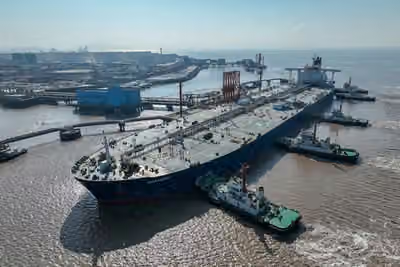

Iranian state media report that the country’s Oil minister Javad Owji has been taken to hospital after suffering a heart attack.
The emergency happened when Owji was attending a meeting to draft next year’s budget bill.
A source at Iran’s Oil Ministry said Owji has been under great pressure during this period to increase oil sales.
As the country is facing natural gas shortages amid the winter cold snap, Javad Owji has been at a dispatching center himself on Thursday to monitor the situation, the source has been quoted as saying.
Owji is currently under treatment at a hospital and according to the Oil Ministry-affiliated website SHANA, he is in a stable condition.
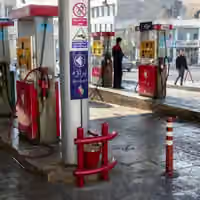
With cold weather gripping Iran in recent days and a surge in demand, shortages of natural gas have become acute.
ILNA news website reported Monday that Iran’s Oil Ministry has released the list of petrochemical units that must stop or reduce their gas consumption. In this letter, petrochemicals producers in Masjid-i Suleiman, Zagros, Shiraz, Bandar Imam, and several others must reduce their consumption.
Iran has the second largest reserves of natural gas in the world but is barely able to satisfy domestic demand as production steadily declines because of lack of investments in the oil and gas sector.

As Iran’s economic situation worsens, Tehran media report that in the past seven months more than 1,000 trillion rials were printed and added to the money supply.
Taking an average of the US dollar exchange rate, the amount comes close to just $4 billion, but Iran has been lavishly printing more money since 2018 when the United States imposed economic sanction after it withdrew from the Obama-era nuclear accord known as the JCPOA.
The astronomical amount in rials constitutes 18 percent of the money supply in this period. In August the money supply had reached 50 quadrillion rials. That is 50 with fifteen zeros.
Mahmoud Jamsaz, an economist in Tehran told Khabar Online news website in July that in the past Iranian year, from March 2021-to March 2022, the government was printing the equivalent of $15 million a day to finance its budgetary shortfall. That is 3.8 trillion rials every day.
The accumulated weight of the money in circulation has effectively devalued the currency, rial, by more than tenfold since early 2018. Money changers in Tehran on Thursday were selling one US dollar for 384,000 rials, a jump of more than 30 percent in one year.
US oil export sanctions have cut Iran’s shipments in half, which mostly go to China, but according to the desperate government in Tehran, all exports are up, and the picture is rosy. However, talking up the rial is not an effective strategy any longer, because few people believe the president, much less other officials.
In order to partially slow down the rial’s fall, the central bank injects dollars into the market, as can be detected from daily exchange rate fluctuations in Tehran, but no official information is given out.
Latest reports on social media indicate that the currency’s fall is not viewed as a normal trend anymore and a panic is setting in to buy foreign currencies and gold. This in turn accelerates the crisis, especially in the light of political uncertainty triggered by three months of anti-regime protests.
The biggest immediate reason for printing money is government borrowing from the Central Bank of Iran (CBI) to bridge its budget deficit estimated to be 50 percent. But the CBI has little gold or foreign currency reserves to back the rial banknotes it prints. The rial is not a fungible currency like the US dollar and no one invests in buying excess rials, the same way hard currencies function and better maintain their value.
The printing presses at the CBI were especially working overtime from September 21 to October 20 - the Iranian month of Mehr. This is after it became clear that talks with the United States to revive the JCPOA had hit a snag, and also after popular protests erupted.
This means that pessimism took hold in Tehran and people began hording dollars. In addition, the government was losing on tax collection as unrest closed businesses, while it had to paying extra to tens of thousands of security forces to keep them in the streets against the protesters. The government was perhaps also forced to be more generous with ordinary salaries, making timely payments to prevent more people from joining the unrest.
Another reason mentioned by local media is the scenario whereby government-owned banks began demanding money from the central bank amid their own balance sheet crises. The CBI charges the banks 21 percent interest for loans, which boosts the already 50-percent inflation rate.
Local sources say that bank borrowings from the CBI even accelerated in November and reached 910 trillion rials, which means the central bank has to print even more money in the coming weeks.

Iran’s Foreign Ministry spokesman says the move to remove the Islamic Republic from the UN Commission on the Status of Women was a “politicized move” that “lacked any legal validity”.
Naser Kanaani said Thursday that depriving a “legal” member of the United Nations Commission on the Status of Women of membership “discredits” this international organization paving the way for future abuses of international institutions.
As usual he blamed the US saying that Washington tries to destabilize Iran.
“How a country that is itself a major violator of the rights of the Iranian nation and women can support the rights of Iranian women now?” Kanaani addressed the US without providing any proof.
On Wednesday, the Islamic Republic was voted out of the United Nations Commission on the Status of Women (CSW) for policies contrary to the rights of women and girls.
Members of the UN Economic and Social Council (ECOSOC) adopted a US-drafted resolution to “remove with immediate effect the Islamic Republic of Iran from the Commission on the Status of Women for the remainder of its 2022-2026 term” over the regime’s bloody crackdown on protests ignited by the death of a young woman in custody of the so-called ‘morality police.’
The Commission on the Status of Women (CSW) is the principal global intergovernmental body exclusively dedicated to the promotion of gender equality and the empowerment of women.
Out of the 54-member body, 29 members voted in favor of the resolution while eight voted against and 16 countries abstained.

Belgian officials say the Islamic Republic of Iran has imposed a 28-year sentence on jailed aid worker Olivier Vandecasteele.
Belgium’s Justice Minister said on Wednesday that Vandecasteele has been sentenced for a “fabricated series of crimes”, stressing that Brussels was doing everything possible to secure his release.
Justice Minister Vincent Van Quickenborne said in parliament that Vandencasteele had been sentenced as retribution for a jail sentence the country imposed on a former Iranian diplomat last year convicted on terror charges.
“This is a compatriot who was innocently arrested in February and has been held under inhumane conditions since,” he added.
The sentence was announced less than 24 hours after a phone conversation between the foreign ministers of Iran and Belgium, the AFP reported.
The detention could be another example of the often-used Iranian tactic of imprisoning foreigners as hostages to exchange them with certain Iranians jailed in Western countries.
Vandecasteele, 41, has served in various international humanitarian organizations since at least 2006, including, Médecins du Monde, Norwegian Refugee Council (NRC), and Relief International.
In July 2021, Relief International ended its relationship with Vandecasteele.
He, however, later returned to Iran on a tourist visa to visit a friend. It is possible that his return to Iran was an arranged trap by Iranian intelligence to detain and exchange him with Assadollah Assadi.
Assadollah Assadi is serving a 20-year prison sentence in Belgium for planning a terror attack in Paris four years ago.

As the world expresses concerns over close military cooperation between Iran and Russia, they have signed a new agreement on cooperation in the space industry.
According to ISNA in Tehran, the two sides have agreed to jointly design and construct remote sensing and telecommunication satellites.
Joint development of infrastructure as well as holding training courses in this regard are among the other details of an agreement revealed on Wednesday.
The document was signed Wednesday by Iran’s head of Space Agency Hassan Salarieh and his Russian counterpart Yury Borisov on the sidelines of an International Aerospace Exhibition in the Kish Island in southern Iran.
Earlier in August, Iran launched a satellite called Khayyam into space from the Baikonur space station in Kazakhstan using Russia's Soyuz satellite carrier rocket.
The UK on Tuesday sanctioned 12 Russian military officials involved in missile strikes on Ukrainian cities as well as some Iranian businessmen involved in the production and supply of military drones used in the attacks.
The EU foreign ministers also lashed out at the Iranian regime Monday for supplying drones to Russia, saying the “weapons provided by Iran are being used indiscriminately by Russia against Ukrainian civilian population and infrastructure causing horrendous destruction and human suffering.”
The bloc sanctioned four people and four entities “for undermining or threatening the territorial integrity, sovereignty and independence of Ukraine.”