Islamic Republic’s Security Forces Arrest Dissident Rapper

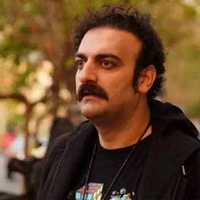
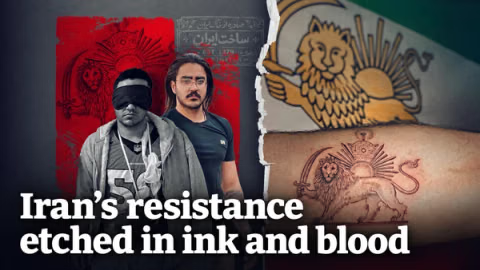
Iranian rapper Toomaj Salehi, who was one of the supporters of the current wave of antigovernment protests across Iran, has been arrested by security forces.

Iranian rapper Toomaj Salehi, who was one of the supporters of the current wave of antigovernment protests across Iran, has been arrested by security forces.
Fars news agency, affiliated with Iran’s Revolutionary Guard, reported his arrest on Sunday, describing him as one of “the leaders of the riots who promoted violence” on social media.
The IRGC-linked news website claimed that the dissident rap artist was arrested as he was trying to cross the border and flee the country. Later in the day, his official twitter account, run by a foreign-based administrator, announced that he was arrested in western province of Chaharmahal and Bakhtiari, which is not a border province.

His page also posted his conversation with the rapper, in which he told the administrator how to continue covering the events of the uprising in case of his arrest. He had told the administrator to continue publishing stories about the protests and strikes in support of the people, warning him/her not to back any political parties or politicians.
Earlier in the year, he was summoned by a revolutionary court in the central province of Esfahan. He did not elaborate on his sentence in a tweet he posted on January 24 but wrote that his prison sentence is suspended for a year. He was previously arrested in September 2021 by dozens of security officers who raided his house. He was released on bail eight days later, pending a trial.
Prime Minister Justin Trudeau has spoken about the likelihood of regime change in Iran, saying that Canada will no longer be a haven for those affiliated with it.
The prime minister, who attended a large gathering of Iranians in Ottawa with his wife, said probably when the regime changes and the situation gets better in Iran, those responsible for oppressing the people will never be forgotten and will never be allowed to come to Canada.
Trudeau is the first Western leader to acknowledge that current protests in Iran can bring about regime change.
In a powerful show of solidarity with the people in Iran, hundreds gathered in the Canadian capital on Saturday to speak out against Iran’s religious, authoritarian government.
Demonstrators formed a human chain, tramped their feet, and chanted Mahsa Amini’s name. She was the young woman whose death in September sparked the uprising in Iran.
Iran has been gripped by six weeks of protests that swept the country when Amini, 22, was arrested for not following Iran’s strict dress rules for women known as hijab. She received fatal head injuries in police custody and died on September 16.
“We will stand with you, I will march with you, and I will hold hands with you,” Trudeau said, adding “We will continue to stand with this beautiful community and demonstrate to the world that we will not forget Mahsa Amini.”

Elsewhere in his remarks Trudeau stressed, “We know there are people in Canada now who have benefited from the corrupt, from the horrific regime in Iran and who are hiding amongst ... this beautiful community.”
In recent years, several Iranian officials accused of corruption or human rights abuses have been seen in Canada, either permanently or on a trip.
One of them was Mahmoud-Reza Khavari, the former CEO of the state-owned Melli Bank, who fled to Canada in 2010, after being accused of embezzling billions of dollars.
The other was Morteza Talaei the former commander of Tehran’s police force. He was in office when the regime beat the Canadian-Iranian journalist Zahra Kazemi to death in Evin Prison in 2003. A photograph was published on social media showing him at a gym near Toronto in 2020. His presence in Canada sparked outrage among Iranians who urged the government to expel officials and agents of the Islamic Republic.
During the rally on Saturday Trudeau said “Taking advantage of Canada's freedoms, Canada's opportunities, and using the riches they stole from the Iranian people to live a good life in Canada. Well, we say no more.”
The Canadian premier also noted that his government will be working to ensure his country is never again a safe haven for “killers, murderers, and those responsible for the oppression of Iranian people.”
Trudeau also raised his fist chanting slogans in Persian saying, “We will stand with you. I’ll march with you, I will hold hands with you. We will continue to stand with this beautiful community.”
After his statements, Trudeau accompanied hundreds of protesters in a march across the city.
Iranian diaspora also held similar demonstrations and formed human chains in other cities from Australian to Berlin and to Canada, including, Montreal, Toronto, and Vancouver.
The shift in the Trudeau cabinet's approach to Iran comes as he was criticized earlier on Iranian social media for not participating at any event or demonstration related to Iran.
Many believe the Canadian government has realized the facts on the ground have changed and increasing pressure by the Iranian-Canadians has finally brought about a change in policy.

Iran is in the grip of what may be its most serious domestic and foreign crises since the establishment of the Islamic Republic, pundits in Tehran say.
The unprecedented protests that have rocked more than 100 cities since mid-September have now challenged the legitimacy of regime’s rule.
As supreme leader Ali Khamenei tries to quell the protests, every day a new move by Iranians inside and outside the country startles his regime.
The United States has time and again announced that in the current situation it will not hold negotiations with Iran over its nuclear program, but president Ebrahim Raisi’s team at the foreign ministry keep making false claims about the willingness of the West for talks. These claims seem to be an attempt to make up for the legitimacy crisis that is tightening the noose on the clerical government in the light of intense public protests.
Supreme leader Khamenei, who considers himself the embodiment of the “sovereignty of God” on earth, seems to be unable to show “heroic flexibility” this time to save his rule. Khamenei first used the term in 2013 when he acknowledged that he had allowed negotiations with the West over Iran’s nuclear program.
Decades of political repression, pervasive corruption, and mismanagement have eroded public confidence in the government and now with the help of Iranian diaspora the West is under pressure to get tough with the clerical regime.
The United States has openly stated that its “focus” now is on “the remarkable bravery and courage that the Iranian people are exhibiting through their peaceful demonstrations”, and the EU has come up with new sanctions on Tehran since the protests began.

Iran’s supply of drones to Russia in its war against Ukraine has also made the situation worse for the Islamic Republic.
During previous antigovernment protests in Iran since 1999, the West had usually stayed aloof, not showing strong support for the protesters who mostly remained unknown to foreigners. This time, the world is paying more attention, as the unrest began with the death of Mahsa Amini, a 22-year-old woman, which garnered strong sympathy around the globe. At the same time Iran’s unwillingness to compromise on the nuclear issue and its military assistance to Russia persuaded the US and even Germany to adopt tougher positions.
The situation now is so awkward that pundits inside the country are warning the government of the consequences of its misguided domestic and foreign policies.
In an interview with Nameh website, Iranian political analyst Amir Ali Abolfat’h said that with these policies, the situation will not change, and negative conditions will continue to bedevil the regime.
“The [continuation] of verbal attacks and propaganda war of the parties [Iran and the West] will worsen the atmosphere for public diplomacy as a result,” he added.
In his opinion, Iranian officials are making “optimistic statements” about the fate of the nuclear deal, but the US and its three European allies show “no sign of a return to the 2015 nuclear deal”.
The Iranian regime should understand that without public legitimacy it cannot reach agreements with the international community, the commentator added.
Hardliners must know that they cannot quell the protests indefinitely because young Iranians, who comprise almost 65% of the country’s population, are weary of decades of revolutionary rhetoric and theocratic dictates.
Hamid Reza Jalaiepour a reformist political activist said as long as the Islamic Republic shows no flexibility, the situation will get worse, and the society will see more protests.
In an interview with Aftabnews earlier this week, he criticized the fundamental approach of the regime saying that “the country has been the scene of nationwide protests for [over] a month, but people’s requests have fallen on deaf ears. The power institutions must show flexibility toward the people's demands, which is not the case now.”

Protests in Iran are turning into a daily defiance of the clerical regime as some of its top officials demand a bloody crackdown on what they say is an enemy plot.
All signs on Saturday pointed to an escalation by government forces who have started to fire assault rifles and there is one picture evidence of snipers deployed.
Friday was supposed to be a “normal” day when no protests were announced by the anonymous group, Youth of Tehran Neighborhoods, which has routinely called for demonstrations on Saturdays and Wednesdays throughout October.
But apparently young people, university students and an increasing number of middle aged and older Iranians feel there is no need for an announcement as they come out during the day and night to defy the stretched-out security forces who must be always everywhere. Protests were reported in 15 cities across the country.
As the unrest intensified, the chief commander of the Revolutionary Guard, Hossein Salami in a Saturday speech announced that it is the last day of protests, and no demonstrations will be allowed to happen on Sunday. This is easier said than done without use of military firepower that could result in hundreds and perhaps thousands of civilian deaths.
It is not just the capital Tehran or a disgruntled outlying province where a protest may flare up. It could be on any university campus or city where a protester was killed 40 days ago and residents according to Iranian tradition come out to pay their respects.
These always turn into new antigovernment demonstrations with chances that more people might be shot by security forces and create another martyr for the next round of protests. It was the same scenario in 1978 when protests were gaining traction against the monarchy.
Saturday began with university protests and more mourning gatherings in the streets as the chief commander of the IRGC sounded another warning that the regime will not tolerate “foreign plots” to destabilize the country. This has become a new straw to grab for the embattled regime, as it feels the need to use more brutal force against protesters.
In the evening, the situation in the University of Tehran and Mashhad became dangerous for students as government forces encircled that campuses and seemed ready to storm the dormitories.
Almost a similar situation existed in 1999, when security forces stormed Tehran University after midnight and killed several students, in some cases throwing them out from upper floors of the dormitories.
Below, we provided coverage of events on Saturday, October 29, 2022. Our coverage ended at 01:00 on Sunday.
-----------------------------------------------------------------------------------------------------------------------------
-----------------------------------------------------------------------------------------------------------------------------
In this video from Yazd the commander of a security forces' unit is yelling at his troops that "People beat you up like chickens." The voice of the person filming says, "This is the end of them."
-----------------------------------------------------------------------------------------------------------------------------
In the religious city Mashhad, people heard cries for help from inside the university and broke down the gate to rescue students under attack by regime forces, but they began firing at the people to pin them down near the gate. The video below is a small glimpse into the developing standoff.
A protester pouring flammable liquid on a large garbage can to block the street to prevent the movement of security forces.
-----------------------------------------------------------------------------------------------------------------------------
A national student organization tweeted Saturday evening that plainclothes agents have entered the campus of Tehran University and fired shotguns at students. The concern is that after midnight regime forces will assault the students with full force.
One person tweeting from inside the school said that security forces "filled three vans" with students and took them away. They were firing guns but still some students "were resisting".
There are reports of attacks on university dormitories in Esfahan, Qazvin and Arak Saturday night.
In the video below, Tehran students chant "Liberty, liberty."
-----------------------------------------------------------------------------------------------------------------------------
Security forces firing military weapons in Kuhdasht, Lorestan Province in another sign of escalation by government forces.
-----------------------------------------------------------------------------------------------------------------------------
Protesters in the northern city of Astara chanting, "This year is the year of blood, Seyyed Ali will be gone," referring to Supreme Leader Ali Khamenei.
-----------------------------------------------------------------------------------------------------------------------------
In this video security forces are firing assault rifles at protesters in Marivan, western Iran. Clearly, the government has unleashed military weapons against unarmed protesters.
The same use of military weapons can be seen in this video from the Kurdish town of Saqqez, the hometown of Mahsa Amini who died in police custody in September. Her brutal killing triggered the six-week-old protests.
-----------------------------------------------------------------------------------------------------------------------------
A tweet by an Iranian human rights group with presence on the ground says security forces have closed off a street near Tehran University's campus and asks people to march to the area to prevent violence against students.
-----------------------------------------------------------------------------------------------------------------------------
A man, Aref Gholampur, was shot dead in a district of Rasht in northern Iran. Here is a scene of protests in the district Saturday evening.
-----------------------------------------------------------------------------------------------------------------------------
Students in Mashhad's Azad University are under siege by security forces, this tweet says. "Their lives are in danger."
-----------------------------------------------------------------------------------------------------------------------------
As darkness fell, the usual evening and night time protests began in various cities and town. This video shows Piranshahr.
-----------------------------------------------------------------------------------------------------------------------------
Saturday evening October 29 in Bukan. Regime forces setting fire to the homes of people in an act of escalation.
-----------------------------------------------------------------------------------------------------------------------------
In a serious escalation IRGC snipers are placed on buildings to shoot protesters after chief commander Hossein Salami warned that protests should end. This photo was taken Saturday in Karaj, 20 miles west of Tehran.
-----------------------------------------------------------------------------------------------------------------------------
In the medical university in Ahvaz students chant, "This is the last message - The target is the whole regime." It seems the slogan is a response to the IRGC commander who earlier the day issued what seemed to be a last warning to protesters that overwhelming force will be used if unrest does not stop by Sunday.
-----------------------------------------------------------------------------------------------------------------------------
A large crowd of people in an spontaneous protest at a metro station in Tehran chanting "Khamenei is a murderer, his leadership is void".
-----------------------------------------------------------------------------------------------------------------------------
Government's Basij plainclothes agents attack Tehran university student who were protesting at the main campus on Saturday.
-----------------------------------------------------------------------------------------------------------------------------
IRGC's Basij elements enter Esfahan University campus and throw rocks at students who shelter in an enclosure. According to Iranian law, the military and police are not allowed into universities, which have their own campus security, but in the past few weeks this law has been broken numerous times.
-----------------------------------------------------------------------------------------------------------------------------
-----------------------------------------------------------------------------------------------------------------------------
Security forces fired at medical students in Kordestan province, badly injuring a student in the head. The video shows seconds after the shooting.
-----------------------------------------------------------------------------------------------------------------------------
Medical students protesting the arrests in the morning on Saturday.
-----------------------------------------------------------------------------------------------------------------------------
In the northern city of Babol protesting students cut their hair as a sign of protest against Islamic Republic's mandatory hijab and the death of Mahsa Amini in September.
-----------------------------------------------------------------------------------------------------------------------------
Another video showing the size and the mood of the crowd in Arak.
Protesters in Arak are chanting, "For every person killed, a thousand will follow".
-----------------------------------------------------------------------------------------------------------------------------

Iranian expatriate communities are holding gatherings and creating human chains in at least 80 cities as unifying gesture in support of the ongoing protests in Iran.
Upon a call by the Association of Families of Flight PS752 Victims, shot down by Iran’s Revolutionary Guard in January 2020, tens of thousands of members of the Iranian diaspora held long lines of people holding each other's hands to express solidarity with the people of Iran, who are holding daily protest rallies since mid-September when 22-year-old Mahsa Amini was killed in custody of hijab police.
In some cities the lines are hundreds of meters long but in cities with a large Iranian population the lines are expected to extend to over 10 kilometers.

The main organizer of the global event, Hamed Esmaeilion -- the Canada-based activist who lost his wife and daughter in the downing of the Ukrainian Airlines flight – has spearheaded several international events in support of the protests.
Last Saturday, October 22, a huge gathering of Iranians, estimated to be over 100,000 people, took to the streets in the German capital Berlin to support their fellow-countrymen struggling against government brutality.
On October 1, Iranian diaspora communities and human rights activists launched unprecedented rallies in over 150 cities throughout the world against the Islamic Republic.

Commander of Iran’s Revolutionary Guard has threatened people not to take to streets anymore saying that Saturday is the day that protests will be over.
During a speech at the funeral of those killed in an attack on a shrine in the city of Shiraz, Hossein Salami claimed that young Iranians are deceived but they must not sell their honor to America.
“Take off the uniforms of the American army,” stated Salami.
The Islamic Republic routinely blames most economic and political problems on enemy plots, meaning primarily the United States and also Israel and often European countries such as Britain and France
Elsewhere in his remarks the hardliner IRGC commander addressed young Iranian protesters saying that “Some of you may think this isn’t an American plot. But don’t think Joe Biden, General Martin Dempsey, Frank McKenzie, Benny Gantz, Naftali Bennett, Yair Lapid or Mohammed Bin Salman would call you on your phone and ask you to pour into streets. No! They do it through their media.”
Salami also urged the students not to turn universities into a “battlefield for America against the nation.”
In November 2019 when protests suddenly erupted in the country, the IRGC immediately resorted to large scale killing of protesters using military weapons often at close range. At least 1,500 people died, and thousands arrested. This time there has been less use of assault rifles and machine guns against protesters, but shotguns and beatings have killed around 270.
With Salami’s warning, the concern now is that the IRGC will soon resort to fill military intervention against unarmed protesters as a desperate measure against the longest-running daily protests in the 43-year history of the clerical regime.
The Islamic Republic calls the United States its arch enemy and refused to meet American diplomats in direct negotiations during 17 months of nuclear talks from April 2021 to August 2022.
Salami’s statements regarding an end to demonstrations came at a time when students have been staging more protests at different universities on Saturday blaming the IRGC for the Wednesday attack on a Shia shrine in Shiraz in which over a dozen lost their lives and many more injured.
Students chanted slogans against Supreme Leader Ali Khamenei and the IRGC forces during their gatherings saying that they are “murderers”.
There are also signs that older Iranians have started joining the protests and the regime has begun to fear the wrath of the people who this time clearly have one demand: regime change. They are not asking for reducing the 40-percent inflation rate or lifting the mandatory hijab rule. They are openly demanding a different kind of government.
The regime still has its supporters who are either religious or receive benefits from the government. But they seem to be in a minority.