Iraq Elects New President And Premier, Ending Stalemate

Iraq’s parliament Thursday elected Kurdish politician Abdul Latif Rashid as president, who named Mohammed Shia al-Sudani prime minister-designate, ending a year of deadlock.

Iraq’s parliament Thursday elected Kurdish politician Abdul Latif Rashid as president, who named Mohammed Shia al-Sudani prime minister-designate, ending a year of deadlock.
The presidency, traditionally occupied by a Kurd, is a largely ceremonial position, but the vote for Rashid was a key step toward forming a new government, which politicians have failed to do since the election.
Rashid, 78, was the Iraqi minister of water resources from 2003-2010. The British-educated engineer won against former President Barham Salih, who was running for a second term.
He invited Sudani, the nominee of the largest parliamentary bloc known as the Coordination Framework, an alliance of Iran-aligned factions, to form a government. Sudani, 52, previously served as Iraq’s human rights minister as well as minister of labour and social affairs.
Sudani now has 30 days to form a cabinet and present it to parliament for approval.
Thursday's parliament session comes a year after an election in which populist Shi'ite Muslim cleric Moqtada al-Sadr was the biggest winner but failed to rally support to form a government.
Sadr withdrew his 73 lawmakers in August and said he would quit politics, prompting the worst violence in Baghdad for years when his loyalists stormed a government palace and fought rival Shi'ite groups, most of them backed by Iran and with armed wings.
Sadr, who has not declared his next move, has a track record of radical action, including fighting U.S. forces, quitting cabinets, and protesting against governments. Many fear protests by his supporters.
Reporting by Reuters
United States Middle East policies are under renewed focus after President Joe Biden said Saudi Arabia faced “consequences” over the OPEC+ cut in oil output.
In his CNN interview Tuesday, Biden did not endorse a call from some Democrats to downgrade relations with Riyadh. Neither did the US president back draft legislation from Senator Richard Blumenthal and House member Rohit Khanna to pause arms sales to the Saudis for a year.
But with the Democratic Party fearing higher gasoline prices will harm its chances in November 8 midterm Congressional elections,Biden addressed concerns that the Saudis had agreed the 2-million-barrels-a-day output cut with Russia, the other leading OPEC+ member, just as the US is backing Ukraine against Russia militarily.
Senator Robert Menendez, a New Jersey Democrat, cited the OPEC+ decision in vowing as chairman of the Senate Foreign Relations Committee to work against future arms sales to the Saudis. There are also Democrat concerns over Saudi Arabia’s human rights record, at home and its seven-year armed intervention in Yemen where its economic blockade of the country has left 3.5 million people acutely malnourished.
Biden came to office in 2021 pledging to hold Saudi Arabia accountable for the 2018 murder of Washington Post journalist Jamal Khashoggi, only to famously ‘fist-bump’ July Saudi Crown Prince Mohammad bin Salman al-Saud, whom US intelligence assesses was likely responsible for the killing.
Saudi relations and Iran
But as nuclear talks with Iran have faltered and Tehran is harshly suppressing popular protests at home, the question arises if any attempt to downgrade relations with Saudi Arabia would not present opportunities to Iran in the region.
Asked this question Tuesday, State Department spokesperson Ned Price answered, “we won’t take our eye off the threat that Iran poses not only to the region but in some ways beyond. You have seen us…respond and take action…against the malign actions and malign influence that Iran has perpetrated, that Iran has attempted to export throughout the region.”
But plans for organizing joint regional air defense against potential Iranian missile and drone threats, as well as other joint efforts might suffer if there is a cold spell in Washington-Riyadh ties.
Price also emphasized US responses to popular protests in Iran, including sanctions on some officials. Amnesty International has reported that Iranian security forces killed at least 130 protestors in late September, including 88 in the south-east province of Sistan-Baluchistan. Washington, Price said, aimed “to support these brave Iranians…across Iran’s cities and towns who are exercising peacefully their universal rights.”
‘Assassination plots’
Critics of the 2015 Iran nuclear deal, the JCPOA (Joint Comprehensive Plan of Action) which the Biden administration has worked to revive, and supporters of Saudi Arabia, have criticized calls for downgrading US relations with Riyadh.
“I don’t remember hearing from some voices who are calling for the US to cancel meetings with Saudi Arabia…after Iran plotted to assassinate Americans on US soil while US took part in JCPOA negotiations in Vienna,” tweeted Jason Brodsky, of the advocacy group, United Against Nuclear Iran, Tuesday, referring to reports from US law enforcement about Iranian involvement in a plot in 2021 to kill former US National Security Advisor John Bolton and threats against others.
Saudi Foreign Minister Faisal bin Farhan Al-Saud told Al-Arabiya television Tuesday that Riyadh’s thinking over cutting oil production was “purely economic.” Some Democrats and Saudi dissidents have pointed to the Saudis’ relationship with the entourage around former President Donald Trump and suggested the move was instead aimed at influencing the US elections.

Lebanon and Israel have finally agreed on a US-brokered proposal over a disputed maritime border in a rare cooperative move since 1948 when Israel was established.
Israeli Prime Minister Yair Lapid said on Tuesday that "This is a historic achievement that will strengthen Israel's security, inject billions into Israel's economy, and ensure the stability of our northern border," referring to the significant compromise that would open the way for offshore energy exploration and easing a source of tensions between states with a history of war and hostility.
In Lebanon, President Michel Aoun said the terms of the final US proposal were satisfactory and he hoped the deal would be announced as soon as possible.
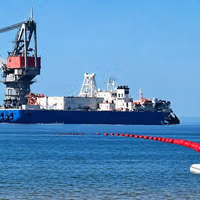
The agreement is meant to resolve a territorial dispute in the eastern Mediterranean Sea in an area where Lebanon aims to explore for natural gas. Israel is already producing natural gas at fields nearby. The deal establishes a mechanism for both countries to get royalties from TotalEnergies' exploration of the offshore gas field that straddles the boundary.
Last week, Lapid instructed negotiators to turn down Lebanon’s requested modifications, saying that any further negotiations would cease permanently if Lebanon's Iran-backed Hezbollah movement threatens or attacks Israel's Karish gas rig.
Earlier in October, Lapid said that as per the arrangement gas would be produced by a company under a Lebanese license in the disputed Qana prospect, with Israel receiving a share of revenues.
“Such a field would weaken Lebanese dependency on Iran, restrain Hezbollah and bring regional stability," he said.

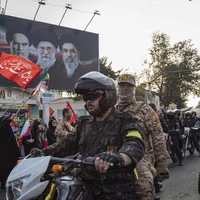
Lebanon's Iran-backed group Hezbollah is using all its propaganda tools to show support for the Islamic Republic and misrepresent the current nationwide protests in Iran.
Trying to show the realities in Iran differently and discredit the protests, Hezbollah organized rallies in support of the regime in Tehran with students from its private educational system – the Mahdi schools.
Lebanese activists have published videos of children from Al-Mahdi schools carrying photos of Supreme Leader Ali Khamenei and Qasem Soleimani, the slain commander of Quds force, the extraterritorial wing of Iran’s Revolutionary Guard.
Hezbollah held ceremonies at the schools in which children were used to show "obedience to religious authority" and “condemning the Western conspiracy” against the Islamic Republic and its "achievements," the Lebanese website al-Modon reported.
Mahdi schools are a cornerstone of Hezbollah’s “Society of Resistance,” featuring a standard modern technology-heavy curriculum mixed with its Islamic doctrine.
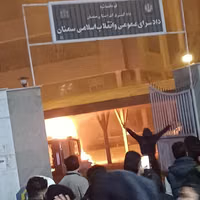
Iran has been engulfed in widespread antigovernment protests since September 19, after Mahsa Amini, a 22-year-old woman was killed in the custody of hijab police.
Oslo-based organization Iran Human Rights said on Saturday that at least 185 people have been killed in the uprising ignited by the death in custody of 22-year-old Mahsa Amini. The NGO added that about 20 of the killed were minors.
The protests first erupted in Mahsa Amini’s hometown Saqqez and capital Tehran and soon spread to all over the country and garnered support from Iranian expatriate communities around the world as well as foreign governments and officials.

Israel rejected Thursday Lebanese changes to a draft US-brokered proposal demarcating a maritime border with Lebanon, putting the fate of a deal for joint gas production in limbo.
Throwing into doubt years of diplomatic efforts to enable both enemy countries to extract gas in or around a disputed Mediterranean prospect, Prime Minister Yair Lapid instructed negotiators to turn down Lebanon’s requested modifications, according to a senior Israeli official.
Calling Beirut’s new demands “significant,” the official added that any further negotiations would cease permanently if Lebanon's Iran-backed Hezbollah movement threatens or attacks Israel's Karish gas rig, without providing further details for the volte-face.
If Lebanon-based Hezbollah tries to strike the Karish offshore gas field or threaten Israel, the talks would “end permanently, and [the terror group’s leader] Hassan Nasrallah will have to explain to Lebanese civilians why they don’t have gas rigs or an economic future,” the official noted.
The official said that Lapid emphasized that he would not compromise on Israel’s economic and security interests even if it meant that there would be no deal in the near term.
The statement cast doubt on the viability of a deal that, only days ago, Israeli officials were speaking of it as a foregone conclusion.
On Saturday, the Biden administration’s energy envoy Amos Hochstein presented what was seen as the final proposal aimed at addressing competing claims over offshore gas fields in the Mediterranean Sea.
On Thursday, Lebanon’s caretaker prime minister said the deal with Israel would avert a war in the Middle East. “We are avoiding a definite war in the region,” Najib Mikati said.

Israel has finally given its green light to a draft US-brokered deal demarcating a maritime border with Lebanon that may lead to cooperation in gas production with Lebanon.
The US handed over the long-negotiated written proposal – that could lead to possible profit-sharing from future gas production by Beirut in a disputed Mediterranean prospect -- to Lebanese President Michel Aoun on Saturday to potentially resolve a maritime border dispute between Israel and Lebanon.
According to the Lebanese presidency, Aoun met with US ambassador to Lebanon Dorothy Shea and received the written proposal from US mediator Amos Hochstein. Beirut is studying the 10-page draft, details of which have not been made public.
Iran-backed Lebanese Hezbollah, which is a declared enemy of Israel and previously voiced suspicions over any demarcation deal, called the draft "a very important step".
Israeli approval of the draft awaited legal review, Prime Minister Yair Lapid told his cabinet at its weekly session, "but," he said in televised remarks, "just as we insisted from day one, the proposal fully preserves Israel's national security interests, as well as our economic interests".
Lapid implied that as per the arrangement gas would be produced by a company under a Lebanese license in the disputed Qana prospect, with Israel receiving a share of revenues.
“Such a field would weaken Lebanese dependency on Iran, restrain Hezbollah and bring regional stability," he said.