Speaker of the United States House of Representatives Nancy Pelosi
Amid global outcry over the death of a hijab victim in Iran that has sparked an uprising, Speaker of the US House Nancy Pelosi called the courage of Iranian women awe-inspiring.
Pelosi told Iran International’s correspondent that “we’re all in awe of the courage of the women of Iran” coming out to hold protests for their own personal freedom.
Calling Mahsa Amini’s death a heartbreaking “murder” by the Islamic Republic, she said it has provoked a response and “that anguish has turned into action that can be helpful in terms of freedom for women and others in Iran."
“If that leads to a change in government in Iran, we’ll see what happens there... let’s see how that change takes place,” she said, noting that when the Shah of Iran was overthrown in the 1979 revolution people thought the new government was going to be a democratic one. “The same people who fought so hard for removing the Shah ended up in jail by the same leaders that are there now,” she added.
Pelosi said that people had their hopes and prayers and they fought for change, and that change turned into “a very oppressive regime.”
Tweet unavailable
She underlined that democracy is about security, economy, and governance, and “how you respect and treat your people” indicates how democratic a government is.
In addition to voices of support from the US House and the Senate, Secretary of State Antony Blinken also said on Friday that "When we see the Iranian Government firing on peaceful protesters, then cutting off people’s access to the global internet, we’re not only watching this. We’re taking action in response."
“We’ll continue to look for ways to support those who are engaging in expressing themselves peacefully in Iran as well as taking actions against those who are responsible for the most repressive human rights violations that one can imagine," he added.
On Thursday, a bipartisan resolution was introduced at the Senate, calling on the Islamic Republic to end its violent crackdown against peaceful protestors. Several representatives of the House also co-sponsored a resolution, H.Res 1397, condemning the Iranian government's "torture and murder of Mahsa Amini and its crackdown on protesters."
Earlier in the day, National Security Advisor Jake Sullivan said in his press briefing said that the US continues “to condemn the brutality and the repression against the brave citizens of Iran, the brave women of Iran, who are simply marching for their rights and their dignity and their justice." “We continue to stand with them — not just in word, but in deed.”
“We have issued several sanctions against Iranian entities for what they have done in this killing and brutality. And, yes, we will continue to look for targets to impose sanctions in response to these brutal human rights violations,” he added.
Special Envoy for Iran Robert Malley also said on Friday that "Fifty-four countries across the globe signed a statement proposed by Chile and Spain urging Iran to stop using force against peaceful protestors,” calling on the Islamic Republic’s authorities “to listen to this world-wide call and end the violence against their people."
Despite government claims that calm was returning to the streets, the situation in Iran turned worse Friday with police firing on protesters, killing several.
As Friday in Iran is the weekend day off, people in several cities came out to protest midday instead of the usual evening hours. A demonstration in largely Sunni city of Zahedan at noon turned into gunfire and many casualties.
The official government news agency IRNA Friday evening quoted "eyewitnesses" as saying that 19 people were killed and many wounded when security forces opened fire on protesters, after tensions that led the local ethnic Baluchi youth to attack three police stations. The exact number of casualties is not clear yet.
News about protests in Tehran was slow in coming, due to the government's shutdown of the internet. But around 22:15 local time reports emerged of fierce protests in the capital.
An ominous development for the government was protests in Ahvaz, the capital of the oil-rich Khuzestan province that had remained calm in the past two weeks. Young protesters came out midday and were met with tear gas. Instability in Khuzestan can easily lead to disruption in oil production, the lifeline of a cash-starved government.
Protesters were chanting “Woman, Life, Freedom”, the mainstay slogan after a 22-year-old woman died in police custody on September 16 because of fatal wounds she received in the head after being detained by the so-called “morality police” for her “improper hijab”.
A union representing oil workers has already threatened a strike if people arrested during the past two weeks are not freed.
There were also protests in the northern city of Ardebil Friday, where demonstrators shouted, “Death to the Dictator” and “Death to Khamenei”, the 83-year-old cleric who has ruled the country for 33 years.
The intelligence ministry issued a statement Friday evening blaming foreign intelligence agencies and opposition groups abroad for the protests and claimed to have arrested diozens of protest "leaders" connected with foreign conspirators. It also blamed The United States and Britain for instigating the unrest.
The Iran Atrocities (Aban) Tribunal, a people's tribunal organized by human rights advocates, said Friday its panel "unanimously" concluded that there's a powerful case against 13 Iranian officials to answer for crimes against humanity during the November 2019 protests. Supreme Leader Ali Khamenei comes at the top of the list.
The symbolic tribunal opened in London in November 2021. The protests were the bloodiest in Iran’s history with security forces opening fire on demonstrators in many cities, killing hundreds.
Iranians all over the world have called for protests on Saturday in major cities and capitals. Activists in Iran have also called for a gathering outside universities.
This live coverage lasting seven hours ended at 01:00 Iran time on Saturday.
Young women in Gohar Dasht west of Tehran took off their headscarves chanting, "We are all Mahsas", referring to Mahsa Amini who was killed in the custody of hijab police. Her death triggered the current protests.
The first video showing a relatively large and noisy protest in Tehran Friday night. The exact location of the demonstration is not mentioned. Protesters are heard chanting, "Death to Khamenei" and beating on metal sheets.
Those who stayed home in Tehran, are shouting slogans from their apartment windows. Here "Death to Khamenei" and "Death to the dictator" ring out in a residential part of the capital.
Iran's intelligence ministry Friday night rushed in to claim that it has arrested nearly 200 protest leaders afilliated with foreign-based opposition groups who according to the Islamic Republic are behind the current uprising. The ministry said it had areested 92 monarchists, 77 people connected to Kurdish groups and 49 individuals linked with the Mojahedin Khalq (MEK) opposition group.
Protests Friday night in Dezful, in the oil-rich Khuzestan province. This is the first reported protest in the city. Earlier in the day, there were demonstrations in the provincial provincial capital Ahvaz.
A new video received from events in Zahedan earlier on Friday shows some protesters throwing incindiary devices at a police station that they seized later.
Gunshots are heard in Mashhad, northwest Iran in a short video that does not show a bigger picture of the protests. Mashhad is Iran's second largest city and an important religious center.
Young people protesting in Sanandaj, a major Kurdish-populated city in Western Iran. They are chanting "Woman, Life, Freddom", the hallmark slogan of the current protests.
Fierce protests in the mainly Kurdish city of Saqqez in western Iran, the hometown of Mahsa Amini whose death in thehands of Iran's hijab police in mid-September triggered the current protests. People were chanting "Deth to the dictator."
A social media monitoring group, @1500tasvir, says that according to its information government forces killed 36 people in Zahedan today, using military weapons. However, protesters burned down a police station and control most of the streets. This news was received 18:30 local time. A video below shows wounded people in a hospital.
Iran International cannot confirm the high death toll cited by this source. A Baluch community activist in Norway told us that 10 people were killed but expressed concern about the lives of wounded protesters taken to hospital.
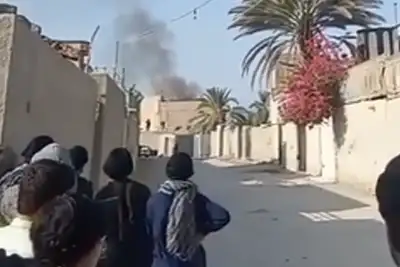
Screen grab from a video shows smoke rising over Zahedan, where a police station and a supermarket were set on fire by protesters
A young woman standing at the grave of her mother Minoo Majidi who was killed by security forces in Kermanshah on September 20, holding her hair which she has shaved in protest.
Reports coming from the mainly Sunni city of Zahedan in southeastern Iran say at least 19 people were killed on Friday as police opened fire at protesters.
Videos obtained by Iran International showed security forces violently cracking down on the protests in the city.
Gunshots are heard in videos as protesters congregate outside a police station. Local sources say that angry protesters have managed to take control of a police station. In the videos, choppers are also seen flying over the protesters in the city.
The government says protesters tried to storm three police station, but that cannot be verified from videos published on social media.
The official IRNA news agency has confirmed 19 deaths, but unofficial sources cite higher figures.
Molavi Abdolhamid, the religious leader of Iran’s largely Sunni Baluch population living in the province and Iran's top Sunni cleric, has called on the Law Enforcement forces to crack down on protesters.
The Sunni cleric in Iran, sometimes critical of the government, confirmed reports last Friday about the rape of a 15-year-old girl in June by Colonel Ebrahim Khouchakzai, the commander of the police in the city of Chabahar.
A group of seminary students and teachers have said that Supreme Leader Ali Khamenei's ‘Guardianship’ is no longer valid considering the numerous atrocities and crimes committed under his rule.
According to a statement released to media on Friday, by some members of seminaries in Qom, Mashhad and Tehran, Khamenei is not considered a ‘mujtahid’, using an Islamic legal term which means he does not have the required expertise in the Arabic language, theology, revealed texts, and principles of Sharia jurisprudence. They added that he cannot be a "source of emulation" or "religious reference".
"As people who have spent their lives studying religion, we firmly and with full knowledge state that in this so-called Islamic government, none of the influential officials and authorities are mujtahids,” read the statement, which bears no name of signatories.
Using Islamic or jurisprudential argumentation, they said his rule is illegitimate due to his numerous documented crimes and faults.
They added that a letter was sent to the seminaries by the office of Khamenei in the city of Qom, led by his son Mojtaba, warning the senior clerics not to express support for the ongoing protests.
There are reports that Khamenei has also forced the seminaries to give his son, reportedly being groomed to succeed his father as Supreme Leader,the title of “Ayatollah,” an honorific title for high-ranking Shia clergy.
After two weeks of protests and uprising in Iran, the country's media and politicians are beginning to know one of the key players fighting for change.
Iran's Generation Z is a generation like no other. The country's ruthless security forces realized this as soon as they set foot in the streets that have been turned into battlefields. They seem to be the first generation of Iranians who not only stand face to face with the security forces, but they also fight back after every attack.
They do not mind hitting and kicking policemen and militia that shoot at them often at point blank range. And they have no respect whatsoever, for the teachings and favorite lifestyle of the Islamic Republic and its clerics. They want one thing: Change; most notably a regime change.
He is probably right. It was the first time after 43 years that Iran's security forces in Qom were attacked by Molotov Cocktails.
According to Sadeghi those who are carrying out the ongoing uprising are neither like the working class that revolted in 2017, nor like the Middle Class that mourned for the victims of the downing of a Ukrainian airliner in 2020. They are a new generation that has baffled politicians and security forces alike. Sadeghi further said: "They are neither left nor right winger. They are rebels. They are the children of social media who have staged a rebellion against the country's decision-makers and traditional media they no longer trust. Instead, they turn to foreign-based media."
"They follow a different lifestyle, spend time at cafes and take long walks with friends while discussing cultural issues. At the same time, they want to know why so many restrictions have been imposed on them," Sadeghi wrote. The ruling clerics wish to dictate their own lifestyle upon them, but they won't take it.
Like Sadeghi, Mahmoud Vaezi, the former Chief of Staff of ex-President Hassan Rouhani, suggests that "the government should try to understand this new generation and listen to their demands." He said in an interview on Thursday, that what is happening these days in Iran is far more violent than the protests in 2019, when security forces killed at least 1,500 protesters. But like hardliner officials of the current government, Vaezi warned that no one should be allowed to take advantage of the protests and destroy public property.
In a symbolic gesture that reveals a bit of what the new generation is looking for, a video on social media show children at a school in Tehran replacing the picture of Ayatollah Ruhollah Khomeini, the founder of the Islamic Republic with a poster carrying one of the main slogans of the uprising in Iran: "Women, Life, Freedom."
Since the early 1980s, the Islamic Republic has violently suppressed all resistance against its dictatorship, never apologized for its mistakes, and has never been accountable for its crimes against humanity and violation of human rights, but this new generation, the Generation Z, has shown at least during the past two weeks, that it is posing a tough challenge that the Islamic Republic might find difficult or even impossible to tackle
Residents in the southwestern city of Ahvaz, which had been relatively quiet during the past two weeks compared to other Iranian cities, held protest rallies on Friday.
According to videos posted on social media, security forces have used teargas to disperse the gatherings in Ahvaz, the capital city of the oil-rich Khuzestan province.
In the videos, women are seen removing their headscarves and swinging them in the air as a symbol of their protest to the compulsory hijab or dress code rules as well the death of Mahsa Amini, the girl whose was mortally wounded in the hands of the country’s so-called morality police, which hassparked an uprising in the country.
Late in May and into the following months, many cities across the province were scenes of angry protests over price rises and economic deprivation triggered by the deadly collapse of a building in the city of Abadan. The gatherings to mourn victims who died in the collapse soon turned intoanti-government protests, with people chanting slogans popular at other antigovernment protests including “Clerics Must Get Lost”, “Our enemy Is Here, It’s a Lie To Say It’s America”, and “Neither Gaza, Nor Lebanon”.
The protests were followed in several other cities and towns across the country and took the Islamic Republic security apparatus one month to repress them.