Strong Quake Kills At Least 1,000 People In Eastern Afghanistan

An earthquake of magnitude 6.1 killed at least 1,000 people in Afghanistan early on Wednesday, leaving over a thousand of others injured while the toll is likely to rise.

An earthquake of magnitude 6.1 killed at least 1,000 people in Afghanistan early on Wednesday, leaving over a thousand of others injured while the toll is likely to rise.
According to the US Geological Survey (USGC), the quake struck about 44 kilometers (27 miles) from the city of Khost, near the Pakistani border. Photos and videos from the area showed homes reduced to rubble and bodies covered in blankets on the ground.
The strong jolt was also felt in parts of Pakistan, India and Iran.
Most of the confirmed deaths were in the eastern Afghan province of Paktika, where 255 people had been killed and more than 200 injured, said interior ministry official Salahuddin Ayubi, adding that In Khost province, 25 people had been killed and 90 taken to hospital.
He said the toll will rise as information is trickling in from remote mountain villages, where it will take some time to collect details.
Authorities said a rescue operation has been launched and helicopters have been dispatched to remote areas to carry some of the injured, but locals say people themselves are removing the bodies of the victims from under the rubble in the absence of government and systematic relief teams.
It was the deadliest earthquake since March 2002 that killed a total of 1,100 in the country, which has a long history of earthquakes, many in the mountainous Hindu Kush region bordering Pakistan.
Later in the day, a 5.2-magnitude earthquake also hit an area near the Persian Gulf port city of Bandar Mogham in Iran’s southern province of Hormozgan. No casualties were immediately available.
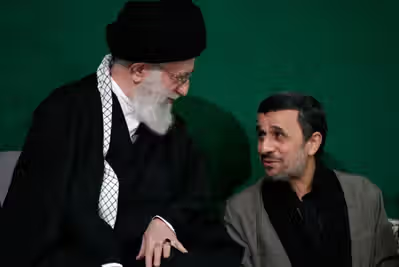

Germany has expelled an Iranian cleric who was the deputy head of the Islamic Center in Hamburg (IZH) from the country for his support for Shiite extremist and terrorist organizations.
According to a report by German newspaper Hamburger Morgenpost on Friday, Soleiman Mousavifar was served with a so-called expulsion order and has to leave Germany immediately or he will face deportation to his home country Iran.
In addition, an entry and residence ban was also imposed on him and if he violates the ban, he can face up to three years in prison.
According to the German authorities, Mousavifar, who shared Shiite extremist propaganda videos on Facebook, supports militant and terrorist organizations and has maintained links to two fundraising organizations working for Iran-backed Hezbollah – banned in Germany -- as well as close contacts with its representatives in Lebanon.
A Senator in Hamburg, Andy Grote told the "Bild" newspaper that "Anyone who demonstrably supports terrorist organizations or terrorist financiers represents a serious threat to our security. From my point of view, the immediate consequence could only be expulsion."
Earlier in the year, the Hamburg Shura Council -- an association of Muslim organizations that represents around 40 mosque communities and other Islamic institutions in the city -- removed the IZH from its board of directors for allegations that the center is Iran’s “long terrorist arm” in Europe.
In July, the German Office for the Protection of the Constitution also found evidence that the head of the IZH – known as Iran’s most “important propaganda center" -- Mohammad Hadi Mofatteh, is himself a member of the Revolutionary Guards.

The National Security Advisor to the Emir of Qatar said Doha has strong ideological ties with the Taliban, during a meeting with Afghanistan’s acting interior minister.
Mohammed bin Ahmed al-Misnad of Qatar and Sirajuddin Haqqani met on Friday and discussed bilateral ties during the Qatari official's formal trip to Afghhanistan.
Al-Misnad and his accompanying delegation also held separate meetings with Foreign Minister Amir Khan Muttaqi, First Deputy Prime Minister Abdul Ghani Baradar, and Information and Culture Minister Mullah Khairullah Khairkhah, where they pledged Qatar’s continued cooperation in political and economic affairs with Afghanistan.
In his meeting with the Qatari delegation, Muttaqi called on Qatar to help Afghanistan in investment, economic growth, humanitarian aid, and counter-narcotics efforts.
“Now that security has been restored in Afghanistan, employment for the people has been created, it is time to show the world the actual picture of Afghanistan,” said Baradar, adding that the ground is now paved for Qatar and other regional and international allies to invest in infrastructure projects in the country.
Despite assurances by the Taliban, security has not been fully established in Afghanistan as armed opposition continues and the fundamentalist group continues enforcing draconian restrictions on individual and political freedoms.
This marks the first official visit to Afghanistan by a high-ranking Qatari delegation since the United Arab Emirates (UAE) took over the ground operations and aviation security contract at Kabul Airport.

An Afghan cleric sent to Iran as a diplomat cannot find housing for his 15-member family of three wives and 12 children, Afghanistan International TV reported Friday.
The man, Mufti Alim Noorani, with no diplomatic experience or general education has been appointed as third secretary of Afghan embassy in Tehran.
Afghanistan International published copy of a letter the embassy sent to Kabul, saying that none of the mission’s housing facilities has enough space for the 16-member family. The embassy has several residences in Elahiyeh district of Tehran, an affluent area.
In the letter the embassy requests $2,300 a month for renting an appropriate residence for Noorani, which together with real estate fees would total $28,750 for the year.
Since the Taliban seized power last August, poverty and hunger have gripped Afghanistan, with international organizations issuing warnings and other countries discussing how to aid the isolated government.
The United Nations has said that 98 percent of the population is under-nourished, while most Western assistance has been stopped after the Taliban takeover.
The new rulers, who used widespread violence against civilians to weaken the elected government and come to power, had promised to form an inclusive government, but so far all important posts have been given to trusted members of the secretive group.

Amnesty International’s annual report on the worldwide use of the death penalty shows Iran as a country with a “disturbing spike” in executions.
The 66-page report, published Tuesday, found Iran executed at least 314 people in 2021, a 28 percent jump from at least 246 in 2020 and the highest figure since 2017. Amnesty drew attention to Iran’s “mandatory death penalty for possession of certain types and qualities of drugs,” with drug-related executions making up 132, or 42 percent, of all Iran’s executions in 2021, up from 23 in 2020.
The Amnesty report, Death Sentences and Executions 2021, also noted Iran’s execution of three people under 18 at the time of their offense, “contrary to international law,” and to the execution of 14 women, up from nine in 2021.
The global figures given in the report are for confirmed executions based on official records, media reports and evidence from families and civil-society organizations. Amnesty notes that no reliable data is available for China, North Korea, Belarus, and Laos. The report suggests that thousands were executed in China, “the world’s lead executioner.”
At 314 Iran was easily responsible for the highest number of confirmed executions, followed by Egypt with 83 (down from 107 in 2020), Saudi Arabia with 65 (up from 27), and Syria on 24. The US executed 11, Japan three and the United Arab Emirates one.
Instrument of state repression
Globally, the number of confirmed executions rose from 483 in 2020 to 579 in 2021, with the number of known death sentences meted out jumping almost 40 percent from 1,477 in 2020 to 2,052 in 2021.The reports relates this increase to both a general return to the use of the death penalty with the easing of the Covid-19 pandemic and “as a clear instrument of state repression against minorities and protesters.”
As well as highlighting torture and unfair trials by emergency courts in Egypt and the “deeply flawed justice system” in Saudi Arabia, Amnesty says that in Iran “death sentences were disproportionately used against members of ethnic minorities for vague charges such as ‘enmity against God’.” It points out that 19 percent of those executed (61) in Iran were Baluchi, an ethnic minority making up 5 percent of the population.
Globally, Amnesty finds at least 28,670 people under sentence of death at the end of 2021, including 8,000 in Iraq despite a fall in executions from 45 in 2020 to 17 in 2021. But the overall trend, at least on confirmed figures and outside certain states, confirms a long-term reduced use of capital punishment: the global figure of 573 is the second-lowest, after 2020, recorded by Amnesty since 2010.
‘A troubling enthusiasm’
“Instead of building on the opportunities presented by hiatuses in 2020, a minority of states demonstrated a troubling enthusiasm to choose the death penalty over effective solutions to crime, showing a callous disregard for the right to life even amid urgent and ongoing global human rights crises,” said Agnès Callamard, Amnesty International’s Secretary General.
“After the drop in their execution totals in 2020, Iran and Saudi Arabia once again ramped up their use of the death penalty last year, including by shamelessly violating prohibitions put in place under international human rights law.”
Amnesty opposes the death penalty in all circumstances.

US President Joe Biden and Saudi Arabian Crown Prince Mohammed bin Salman could meet for the first time as soon as next month, CNN reported on Thursday.
Biden administration officials are in talks with the Saudis about arranging a potential in-person meeting while Biden is overseas next month, the report added.
The White House said it could not confirm if there were any plans for Biden to meet the Saudi crown prince. National security adviser Jake Sullivan said on Thursday he discussed the issue of oil production with Saudi Arabia.
US-Saudi ties have been strained by Biden's decisions last year to curtail support for the Saudi-led military campaign in Yemen and to publish intelligence that the crown prince approved an operation to capture or kill journalist Jamal Khashoggi, who was murdered in Turkey in 2018.
The Saudi government has denied any involvement by the crown prince, who is known as MBS, in the murder.
Relations between the United States and the world's largest oil exporter have also been frayed by Biden's efforts to revive the 2015 Iran nuclear deal, which US allies in the Gulf argue does too little to prevent Tehran from getting an atomic bomb.
Washington has also been trying, so far without success, to persuade Saudi Arabia to pump more oil to offset potential losses in Russian supplies after Moscow was sanctioned by the West over its invasion of Ukraine. Saudi Arabia has refused to take sides in the Russia-Ukraine conflict.
Report by Reuters