US Not To Block $10 Billion Russian Deal To Build Nuclear Plants In Iran
Secretary of State Antony Blinken testefying in the Senate.
Secretary of State Antony Blinken has said the United States will not stand in the way of Russia-Iran nuclear cooperation if the Vienna talks succeed to revive the 2015 agreement, the Washington Free Beacon reported on Monday.

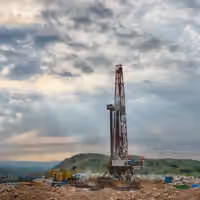
Blinken made the remarks before the House Foreign Affairs Committee last week, saying the United States will not try to stop Russia from cashing in on a $10 billion contract to build nuclear plants for the Islamic Republic.
Responding to California’s Republican representative Darrell Issa who urged assurances that sanctions on both Iran and Russia remain in place as long as Moscow continues the invasion of Ukraine, Blinken said any sanctions lifted as part of a new nuclear deal will be separate from current US pressure campaign on Russia.
The opponents of the revival of the Joint Comprehensive Plan of Action (JCPOA) are worried that the deal funnels billions of dollars to Iran and its allies, saying the money will be spent to further destabilize the region.
Former Special Advisor for Iran at the State Department Gabriel Noronha analyzed the new Iranian military spending data, and argued that Tehran will use the newly achieved leeway to fund and conduct terrorism.
Iran's budget for its new fiscal year shows significant rise in funding of the Intelligence Ministry and domestic oppression forces, TV propaganda and military R&D as well as about four times increase in security infrastructures of the Revolutionary Guard (IRGC).
A US-based think tank says data prove that the United States sanctions on Iran work as the Islamic Republic has less money to fund and conduct terrorism.
The CEO of the Foundation for Defense of Democracies (FDD), Mark Dubowitz, said on Monday that that the abandonment of US pressure under President Joe Biden has boosted Iranian oil sales, economic growth, regional aggression and nuclear escalation.
FDD has advocated a tough US policy on Iran and has opposed the 2015 nuclear agreement, the JCPOA.
He added that recent data contradict the Biden administration’s claims that pressure increases Iran’s aggressive behavior, noting that when US sanctions are enforced, Iran spends less for malign activities in the region. Pressure works; weakness invites provocation, Dubowitz tweeted.
He republished a post by the Jewish Institute for National Security of America (JINSA), showing that Secretary of State Anthony Blinken recent remarks before the Senate Foreign Relations Committee about Iranian aggression being only the result of the US withdrawal from the nuclear deal are “misleading and inaccurate”.
Dubowitz also shared a series of tweets by Gabriel Noronha, former Special Advisor for the Secretary's Iran Action Group in the Trump administration, who compared the Iranian military budget trends against US sanctions since 2013.
Iranian officials were silent on Monday regarding reports that the European Union wants to send its envoy back to Tehran to jump start the stalled nuclear talks.
Iran on Monday was in a total confusion, as it was not clear if Ramadan ended or not, and if there was a public holiday. The foreign ministry did not hold its weekly press briefing.
Western diplomats told the Wall Street Journal on Sunday that the EU is offering to send its top negotiator Enrique Mora to Tehran again to persuade Tehran to show flexibility.
Mora, the senior EU official chairing the Vienna process, has told Iranian negotiators he is ready to return to Tehran to open a pathway through the deadlock, diplomats told the Wall Street Journal. Mora failed to convince Tehran to return to the talks during his March 27 visit.
Talks in Vienna to restore the 2015 nuclear deal, Joint Comprehensive Plan of Action (JCPOA), have been in limbo since mid-March when Iran insisted that its Revolutionary Guard (IRGC) be removed from the US list of terrorist organizations. The US has not agreed to the demnd.
Reuters reported on Monday that the West has almost given up on the process and is contemplating what to do next.
"They are not yanking the IV out of the patient's arm ... but I sense little expectation that there is a positive way forward," one source, who like others quoted spoke on condition of anonymity because of the issue's sensitiviy, told Reuters.
Western diplomats told the Wall Street Journal that they want to put the onus back on Tehran, making it clear the talks could fail unless Tehran took a step to end the stalemate. Mora, they said, will try to persuade Tehran to leave the issue of IRGC's delisting to a future point and sign off on the deal now. Tehran has so far not responded to the proposition, the report said.
In a phone talk with Iranian Foreign Minister Hossein Amir-Abdollahian's on April 20, the EU foreign policy Chief, Josep Borrell expressed frustration over the pause in the talks and called for fresh contacts between Enrique Mora and Iran’s lead negotiator Ali Bagheri-Kani.
Iran insists that it will not give up on its demand for the removal of the IRGC from the US list of Foreign Terrorist Organizations (FTO), calling it a 'red line' it will not cross at any cost
The Biden administration is adamant that it will only negotiate the delisting of the IRGC if Tehran also agrees to discuss other issues which are important for Washington, presumably Iran's aggressive regional policies and support for militant groups, which are also outside the JCPOA purview.
Despite the deadlock in the talks that appears to have much to do with the IRGC regional activities and pledge to take revenge on American officials for ordering the targeted killing of Ghasem Soleimani, officials in Tehran have shown no signs of softening their rhetoric in the past few weeks
Soleimani, commander of the Qods (Quds) Force, the IRGC's extraterritorial arm, was killed in a drone attack in Baghdad in January 2020 on Trump's orders.
The pause in talks has given ample opportunity for JCPOA critics in both Tehran and Washington. The Republicans have highlighted the prospect that lifting US ‘maximum pressure’ sanctions on Iran in return for Tehran accepting JCPOA limits on its nuclear program would see Tehran repatriate billions of dollars currently frozen by creditors wary of punitive US action.
US Democratic Senator Bob Menendez (NJ) reiterated Sunday that no nuclear deal with Ian was better than a bad deal. “It’s 2022. It's not 2014. Some of the original deal sunsets are even closer… to ending a pathway where Iran could ultimately achieve its goal,” a reference to the belief that Tehran is bent on producing nuclear weapons.
An Iranian lawmaker says high prices for food has nothing to do with the United States’ sanctions but are a result of incompetent managers in the country.
In an interview with ILNA published on Sunday, Shahriar Haydari, a member of the parliament's National Security and Foreign Policy Committee, said economic problems and high inflation are not related to foreign countries, but are due to a lack of integrated management system.
He added the increase in the price of eggs, yogurt, buttermilk and meat has nothing to do with the United States and sanctions, noting that the current situation in the country and the effects of sanctions are two separate issues.
“To say that sanctions are ineffective in some respects may be wrong, but the current state of economic turmoil, high inflation, disorganized resource management indicates a management completely in disarray”, Haydari said.
Further criticizing the management of resources, he said, “One of the main problems of our country is the lack of resource management, not the lack of resources, because we have a lot of resources, but we do not have proper management”.
Food prices are rising in Iran with retailers saying supplies have decreased, while officials insist there is plenty of stored sugar, oil and other necessities.
Prices for most essential goods are nominally fixed by the government, but the private sector often disregards the guidelines based on supply and demand. Many complain to the media that merchants inflate prices perhaps with the help of government bureaucrats and politicians.
Another member of the Democratic Party has criticized the Biden administration for handling the threat posed by Iran, saying the 2015 nuclear agreement, JCPOA, is not an Iran policy.
Florida Congressman Ted Deutch said that “Iran threatens our allies and partners, and the IRGC funds proxies across the region while pursuing nuclear weapons”.
“Deal or not, we need a comprehensive strategy to lead in combating threats and to ensure Iran never has nukes”, he added, noting that he is glad that Secretary of State Antony Blinken affirmed that.
But Democratic Senator Chris Murphy said Thursday that all the measures the United States has taken against Iran have only accelerated the country’s nuclear program.
The Connecticut senator, a supporter of JCPOA. said in a tweet on Thursday that “We tried crippling unilateral sanctions. We tried assassinations and sabotage. All that did was expedite their research program.”
The Biden administration has been holding talks for more than a year with Iran to revive the 2015 nuclear agreement, but the diplomatic process is at a standstill since March. Iran is demanding the removal of its Revolutionary Guard from the US list of terrorist organizations, something the administration has so far not accepted.
Iranian government debts have soared since 2018, when the US imposed tough sanctions on the Islamic Republic, International Monetary Fund’s figures show.
According to IMF’s Middle East and Central Asia economic outlook report, Iranian government’s net debt equaled to 41.5% of nominal GDP or $591 billion (based on official USD rate at 42,000 rials) in 2021. It was only $45 billion during 2000-2018 on average, or 11.8% of nominal GDP. The figure reached $214 billion in 2019 and increased to $351 billion in 2020.
During last three years only 70% of government’s annual budget has been realized due to US sanctions and plunging oil exports. Therefore, the government had to borrow a huge amount of money from the Central Bank, The National Development Fund and other internal financial entities to compensate the budget deficit.
Last year, the Supreme Audit Court of Iran announced that the government’s net debts reached 10,000 trillion (10 quadrillion) rials by May 2021, which equals $238 billion based on official USD rate or $37.5 billion based on USD rate in open markets (1 USD: 26,500 rial).
The Supreme Audit Court hasn’t released a new report, but last year it warned that government debt is increasing rapidly, rising 72% only during March-May 2021.
The heavy borrowing from the central bank leads to priniting money and a dangerous rise in liquidity since 2017, which in turn fuels inflation currently standing at more than 40 percent.
Iranian government spokesman Ali Bahadori Jahromi said on April 19 that export revenues, especially from oil shipments, have substantially increased, but the government had to allocate 100 trillion rials per month to pay off mature debts.
IMF put the country’s total exports (oil, non-oil and service) at $54 billion in 2020, but the figure increased to $91 billion in 2021 and expected to reach $140 billion during the current year.
IMF also predicted that the government’s net debts remain unchanged in 2022. International organizations to a large extent have to rely on official figures issued by Iran, as they have no representatives on the ground and do not visit the country.
Iran’s oil and gas condensate export declined from 2.5 million barrels per day (mb/d) in 2018 to 320,000 b/d in 2020 due to the US sanctions, but increased to around 670,000 b/d during last year, according Kpler data intelligence firm. The oil price has also been increasing from $41 in 2020 to above $100 now.
The Wall Street Journal reported on April 28 that Iran’s oil exports rose to 870,000 barrels a day in the first three months of 2022, up 30% from an average of 668,000 barrels a day in 2021, according to Kpler’s estimates.
Iran also exports around 450,000 b/d of petroleum products, which remained unchanged during last years, while oil products prices have also dramatically increased since 2018.
On the other hand, Iranian custom statistics indicate that the value of Iran’s non-oil exports increased by 41% to $48 billion during last fiscal year, ending March 20, due to significantly higher prices for petrochemicals and mine products.