Daughter Of Former Iranian President Defends US Sanctions On IRGC

Outspoken former lawmaker Faezeh Hashemi Rafsanjani in Iran has said that the Revolutionary Guard, IRGC, should remain on the United States' terrorist list.

Outspoken former lawmaker Faezeh Hashemi Rafsanjani in Iran has said that the Revolutionary Guard, IRGC, should remain on the United States' terrorist list.
Speaking in the social audio app Clubhouse, the political activist added that removing the IRGC from the list of Foreign Terrorist Organizations (FTO) is not in Iran's interest.
Negotiations to restore Iran’s 2015 nuclear deal came to a halt in March as Tehran reportedly demanded that the IRGC be removed from the terrorist list.
Hashemi, who is the daughter of former president Akbar Hashemi Rafsanjani and a pro-reform politician, said "The IRGC fires missiles and announces that it was our job”.
Calling IRGC's actions detrimental for the country, she added, “The only way for the IRGC to return to the barracks is to keep them on the sanctions list”.
What the Iranian society gets from IRGC is negative consequences and this must be stopped at some point, she noted.
Hashemi is known for her critical remarks about the Islamic Republic, its leaders, and policies. Her father, who for decades was the second most powerful man in the Islamic Republic, helped bring Supreme Leader Ali Khamenei to power in 1989 and allowed the IRGC to become an economic player in the country.
US opponents of removing the IRGC from the FTO – including lawmakers from both sides of the aisle, as well as current and former American officials and military leaders -- have urged President Joe Biden not to take such a move.

Iran's official news website IRNA has again claimed that a deal is in place to free the country’s frozen funds, despite a categoric denial by the United States.
In a report on Sunday IRNA claimed that an unnamed official of the Central Bank of Iran (CBI) confirmed the existence of an agreement and even said that a “regional delegation” visited Iran to facilitate its implementation.
Iran has billion of dollars frozen in various foreign countries because of United States sanctions on its banking sector and the threat of retaliation against third parties conducting financial transactions with Iran.
One of these countries is South Korea, where two banks hold an estimated $7 billion accrued from Iranian oil purchases prior to full US sanctions imposition in May 2019 on Tehran’s oil exports.
Iran has been putting pressure on Seoul to free the funds and last January it seized a South Korean tanker in the Persian Gulf and held it for weeks.
A top Seoul diplomat visited Vienna in January where talks were taking place to revive the 2015 nuclear deal known as JCPOA. The diplomat met various delegations involved in the talks, raising expectations that a deal was in the offing to free the funds in case of a nuclear agreement.
On April 11, IRNA claimed that frozen funds will be released soon, saying that a “high-level regional” official was to visit Tehran to finalize the details. In an odd turn of events, Iran’s foreign ministry immediately denied that any such visit was in the cards.

The US State Department spokesman Ned Price on Thursday denied the existence of any agreement to free blocked funds.
Sunday’s IRNA report has several odd points. One was a reference to Ned Price’s denial “yesterday”, meaning Saturday. It appeared that either IRNA mixed up the dates or perhaps its text was written on Friday, the day after Price’s statement.
The other strange point is that the report quoted the “manager of international affairs” of the central bank as its source, without naming him.
A search revealed that four days ago Hossein Yaghoubi Miab was appointed as the head of CBI’s international department. He was sanctioned in November 2018 by the US Treasury Department for being part of an illicit network facilitating Iranian-Russian oil shipments to Syria.
IRNA quoted the central bank official, presumably Yaghoubi Miab, as saying that a considerable part of the frozen funds from “a country” will be freed and a delegation has already visited Iran. Asked about how much the funds in question are, the official only said it is much more than what was recently freed by the United Kingdom
In March, the UK paid Iran more than $500 million for the release of two dual nationals held hostage by the Islamic Republic for years.
Periodic claims by Iranian officials about frozen funds being released might be intended to support the battered national currency, rial. As nuclear talks came to a halt in March, the rial has been falling against major currencies once again.
On Sunday, the US dollar rose against the rial to 280,000. Just a few weeks ago the rial was trading at around 255,000 to the dollar.
The CBI official told IRNA that Iran is exporting more oil and receiving more hard currency, a claim often made by officials in recent months. But the impact of more revenues from oil sales is not visible in the local market, with consumer prices rising fast and criticism intensifying even among hardliner supporters of the government.

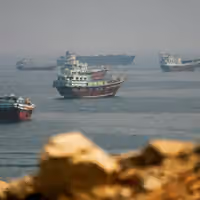
Iran must close the Strait of Hormuz to South Korean vessels until Seoul releases $7 billion frozen funds said a newspaper funded by Supreme Leader on Saturday.
"We can and must close the Strait of Hormuz to South Korean cargo ships and oil tankers and all ships that carry South Korean commodities … and not allow them to navigate through the Hormuz Strait as long as they have not paid their $7 billion debt to our country," Hossein Shariatmadari, the chief editor of Kayhan, wrote in an editorial note entitled "Let's Begin Imposing Sanctions From South Korea".
Since former US President Donald Trump's introduction of ‘maximum pressure’ sanctions in 2018 after withdrawing from the 2015 nuclear deal, Joint Comprehensive Plan of Action (JCPOA), the US has threatened punitive action against any third-party buying Iran’s oil or dealing with its financial sector. The funds held in South Korea by two banks are Iran’s proceeds from oil exports before the Trump sanctions.
Shariatmadari argued that countries such as South Korea use US secondary sanctions as an excuse to freeze Iranian assets, but Tehran also has effective tools to counteract US sanctions.
"We can show that their actions are not without cost and could even entail heavier costs than if they violate US sanctions [on Iran]," the firebrand editor of Kayhan, an appointee of Supreme Leader Ali Khamenei, wrote.

Shariatmadari, a well-known opponent of the JCPOA and relations with the West, also claimed Iran is entitled to close the Hormuz Strait to oil tankers and cargo ships including those carrying weapons based on the 1956 Geneva Convention on the Law of the Sea and 1982 Jamaica Treaty, if they cause harm to Iran's security. South Korea is to be punished, therefore, for harming Iran through enforcing US sanctions, he argued.
On April 6, the government mouthpiece, Iran newspaper, quoted an unnamed official as saying that a large sum of Iran's frozen assets would be released in a deal separate from the nuclear talks which have come to a halt since mid-March due to sticking issues including Iran's demand that the US remove the Revolutionary Guards (IRGC) from its list of Foreign Terrorist Organizations (FTO).
American journalist Laura Rozen wrote on Friday that the Biden administration has apparently decided not to send a counter proposal to Tehran to close the final outstanding issues. "Iran would either get a deal with the IRGC remaining on the FTO list, or no deal,” she quoted Ali Vaez, director of the Iran program at the International Crisis Group, as saying.
Farhikhtegan newspaper in Tehran said in an article titled “Releasing Iran’s Frozen Assets Through Non-Nuclear Means” on April 7 that Iran had been negotiating in parallel with the nuclear talks in Vienna to access its frozen assets and quoted an unnamed "informed source" as saying that Iran would free three American-Iranians held in Iran in exchange for the $7 billion Seoul owes to Tehran.
Tehran and Seoul have been in a diplomatic standoff since February 2020 over the frozen money. Iran’s chief negotiator Ali Bagheri-Kani who met the Korean diplomat in Vienna on January 5 demanded the unconditional release of the funds, but Washington said it would waive third-party banking sanctions for Seoul only with “everything” agreed in the nuclear talks and a final deal.
In January 2021 Iran detained a Korean tanker and in April the same year, Khamenei banned the import of home appliances made by the two leading Korean manufacturers. Iranian media said this was a "diplomatic message" to Seoul.

The United States said any reports about the release of Iranian funds frozen by third countries are false, after Tehran claimed it would soon receive billions of dollars.
In a press briefing on Thursday, State Department Spokesperson Ned Price said US partners have not released any blocked funds to Iran, nor has the United States authorized or approved any such funds to Iran.
In a joint press conference with his visiting Iraqi counterpart Fuad Hussein on Wednesday, Iranian Foreign Minister Hossein Amir-Abdollahian repeated the claim, made several times in recent days by Iran’s state-controlled media, saying an "initial agreement" has been reached to release Iran's funds held by a foreign bank.
Price denied “any breakthrough” in two parallel tracks that are underway with Iran – one in Vienna for mutual return to full implementation of the JCPOA, and one on the release of all four US citizens who are unjustly held in Iran, cautioning everyone about such reports.
Iran’s trading partners have frozen tens of billions of dollars because of United States sanctions that make it illegal for third parties to engage in financial dealings with Iran.
Iran's government news website IRNA Monday reported a high-level visit by a “regional official” on Tuesday to conclude a deal to unblock $7 billion of Iran’s funds frozen abroad because of United States’ sanctions.
Foreign ministry spokesman, Saeed Khatibzadeh immediately denied the report but later told the media that an agreement to free some frozen funds does exist.

An advocacy group says the Islamic Republic has illegally sent over 337 million barrels of crude oil to China since 2021, worth approximately $22 billion.
According to United Against Nuclear Iran (UANI) estimates, Iran’s daily oil exports in violation of US sanctions soared from 825,000 barrels per day in March 2020 to 1.34 million bpd in March 2022, including just under 900,000 barrels per day to China.
UANI announced on Tuesday that its campaign to identify and track rogue vessel operators engaged in the Iran's oil and gas smuggling has stymied Tehran’s efforts to circumvent sanctions, leading to 100 vessels being stripped of their flags by authorities worldwide.
The Islamic Republic has a “ghost armada” of 182 rogue foreign vessels -- distinct from but complementing Iran’s own National Iranian Tanker Company fleet – that evades tracking and scrutiny and skirts US sanctions and exploits regulatory loopholes to ship millions of barrels of oil.
Every commercial vessel must be registered to the flag of a country to have docking rights and travel globally, these flag states are responsible for enforcing regulations.
UANI detects rogue operators misusing flags as part of Iran’s smuggling activities – often accompanied by the formation of new shell and front companies, ownership and name changes, and even alterations to ships’ physical markings, as well as flag-hopping, which involves repeatedly switching a ship’s flag to different national registries.
The group then alerts relevant authorities to take action, and when the vessels are "de-flagged,” the Islamic Republic is unable to complete the transfer that generates the export revenues.

A US official has denied Iranian media reports that $7 billion of Iran’s frozen funds will be freed in exchange for the release of three American dual citizens held as hostages.
An unnamed senior State Department official said on Monday that “We have two separate negotiations underway with Iran: one for a mutual return to full implementation of the JCPOA and one on the release of all four US citizens unjustly detained in Iran”, noting that “At this stage, neither negotiation has been successfully concluded”.
“Any reports otherwise, including reports about the transfer of Iranians funds are false. Our partners have not released these restricted funds to Iran, nor has US authorized transfer,” the source said.
Warning of Iran’s propaganda campaign that regularly suggests progress on agreements to prop up its currency, the source said that such reports usually appear whenever the Iranian rial is under strong market pressure, adding that there is “no reason to think any different this time”
Iran’s currency hit a new low against the US dollar in over two months, as nuclear talks remained deadlocked.
“Given the sensitivity, we urge caution in relying on anything other than official" US confirmation on this topic, the source added.
“We are continuing to approach these negotiations with the utmost urgency and urge Iran to do the same. Iran must allow US citizens Baquer (Bagher) and Siamak Namazi, Emad Shargi, and Morad Tahbaz to return home to their loved ones”.
Iran official government news website, IRNA reported Monday that a senior foreign official would visit Iran on Tuesday to conclude a deal to free the frozen funds. The foreign ministry immediately denied the claim.