Former Diplomats Discuss Iran's Outlook For 2050

Two former senior diplomats in Iran have explained their vision about how the country will look like in 2050, emphasizing good governance, as it faces multiple crises.
Two former senior diplomats in Iran have explained their vision about how the country will look like in 2050, emphasizing good governance, as it faces multiple crises.
Their conversation with Sharq newspaper, published on March 5, was recorded before the Russian invasion of Ukraine, obviously, without considering developments sparked by the ensuing international crisis.
Both diplomats are now working in academic and energy fields. Ali-Akbar Salehi was Iran's Foreign Minister (2009-2010) and (2011-2013) and nuclear chief (2013-2021). Abbas Maleki was the head of the Foreign Ministry's think-tank, the International Studies Center and deputy foreign minister (1980-1997).
Sharq's reporter Zeynab Esmaili, asked whether in 30 years Iran will be a developed country or a poor state crippled by water shortages and environmental crises, as current condition point to. Salehi said it is difficult to predict, however, it is a matter of good governance. If the government is not bothered by the needs of the people, one could say for sure that the country has no future.
In the 1979 revolution the people wanted a change in the style of governance and wanted to get rid of despotism, Salehi said. The chaos brought about by the revolution continued with debates about whether political reforms were more important or economic development. Should progress be put before economic justice? Or justice before freedom? Was freedom more important than security?
Salehi’s emphasis on good governance belies a general perception in Iran that the Islamic Republic has pursued harmful policies for too long and its ability to propel the country toward prosperity is highly questionable.
Salehi emphasized that having large oil reserves is not a substitute for good governance.
“Our roadmap to the future should be based on good governance, knowledge, democracy and attending to the needs of the middle class,” he said.
Maleki also emphasized good governance and the importance of planning. “Plans tell us where we are headed,” he said. So, if we wish to be at a certain point in 2050, we should start working today. But Maleki stressed that government control is better than leaving affairs in the hands of the private sector, claiming that Iran’s response to natural disasters have been more efficient than in the United States where private companies run the infrastructure, such as power and water.
International surveys of economic performance contradict the view that Iran’s government and economic system perform reasonably well.
Maleki also emphasized that developing fossil fuel resources are important for Iran’s near future.
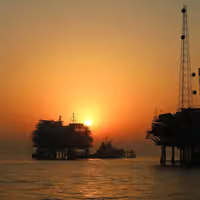
Salehi agreed with Maleki by saying that oil and gas can revive Iran. “We have one percent of the world's landmass but 11 percent of its oil and 17 percent gas resources,” he said. There is no value in these resources unless we turn them into an engine of development. There are gigantic gas and oil reserve under Bandar Lengeh, but the port city has no pipelines. We should turn the reservoirs of Yadavaran and Azadegan oil fields into money. And there are a lot of resources still untouched in the northern part of Iran. Energy is capital but it is not endless. It will end one day. So, Iran should use it rationally.
However, looking at the record, Iran has sold well over one trillion dollars of oil in the past four decades but because of its centrally controlled economy and inefficient governance it has little to show for it compared with regional counties such as Turkey that has no oil or the United Arab Emirates.
Asked why Iranians believe that the government has left them to their own devices or in other words has let them down. Salehi expressed hope that the system can still correct itself, but the young generation is mostly hopeless about the future of the country and they blame policies pursued in the past three decades since Supreme Leader Ali Khamenei has ruled the country.