• العربية
  • فارسی
Brand
  • Iran Insight
  • Politics
  • Economy
  • Analysis
  • Special Report
  • Opinion
  • Podcast
  • Live TV
  • Iran Insight
  • Politics
  • Economy
  • Analysis
  • Special Report
  • Opinion
  • Podcast
  • Live TV
  • Theme
  • Language
    • العربية
    • فارسی
  • Iran Insight
  • Politics
  • Economy
  • Analysis
  • Special Report
  • Opinion
  • Podcast
  • Live TV
All rights reserved for Volant Media UK Limited
volant media logo

Iran Claims To Launch $19-Billion Projects Despite Sanctions

Mardo Soghom
Mardo Soghom

Iran International

Feb 9, 2022, 09:35 GMT+0Updated: 17:26 GMT+1
Iran's President Raisi with some of his top aides.

Iran’s government has announced 48 industrial and infrastructure projects worth $19 billion to help reduce the impact of sanctions and jump-start the economy.
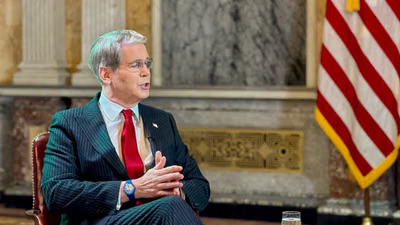

President Ebrahim Raisi and his top economic officials in a brief announcement on Sunday said that large state companies with foreign currency reserves will start the projects regardless of United States’ sanctions and will expand the petrochemical industry, oil and gas, and build power stations.

Critics immediately questioned the claim by demanding more details about “agreements” the government claimed large companies have signed. The official announcement was not more than a few paragraphs long, without providing a clear breakdown of projects and their related targets and costs.

The government claimed that large steel and energy companies have “foreign currency reserves” that they can use to launch the infrastructure projects, without any need for borrowing. The reserves could be referring revenues from exports that steel and petrochemical companies have, but these funds are not really fungible capital. Revenues from exports enter the government’s foreign currency ‘pot’ that are used to finance essential imports.

Iran has been exporting more crude oil in the past one year and it could be assumed that the government has received some foreign currency for the shipments, although details of oil exports and revenues are tightly held as “state secrets.”

Because of years of sanctions and economic inefficiency, Iran has failed to sufficiently invest in its economy, particularly in maintaining production in its vital oil and gas sectors. Oil minister Javad Owji announced in November that $160 billion is needed to revitalize the industry.

The government claimed that once the projects reach completion, they will produce 52 million tons of products and will have an annual turnover of $20 billion dollars, creating 85,000 jobs. However, some media asked to see what exactly these projects are and a timeline for their progress. They asked if agreements the government says were signed between state companies are binding contracts or just memorandums of understanding.

The announcement could have also been made in anticipation of a successful conclusion to nuclear negotiations with the United States that could free up at least $20 billion in Iran’s frozen funds and lift oil export sanctions. The government might have decided to boost morale in the country with the announcement, as more officials and pundits express serious concerns about the political ramifications of the current economic crisis.

Inflation has been hovering above 40 percent for more than a year and food prices rising by 60 percent in 2021 compared with 2020. Politicians warn that the country is facing the danger of a “social explosion.”

The government’s news agency IRNA wrote on Wednesday that the “big achievement” shows Iran can thrive despite sanctions and officials “are not waiting behind the doors of the Coburg Hotel,” a reference to the venue of the nuclear talks in Vienna.

Hardliners in control of Iran’s government have been often making contradictory remarks regarding the impact of US sanctions. At the same that they say Iran has defeated US ‘maximum pressure’ they also call sanctions “cruel” punishment and blame shortcomings on restrictions imposed by the United States. The contradiction can be seen on daily basis in remarks by officials and in government-controlled media.

Most Viewed

US rules out Iran truce extension as Tehran official sets new deadline
1

US rules out Iran truce extension as Tehran official sets new deadline

2

State TV host sparks backlash over ‘southern Iran for southern Lebanon’ remark

3
INSIGHT

Forced to serve in the IRGC, now fighting to stay in Canada

4

Iran’s ‘infiltration’ bill sparks backlash over sweeping reach

5
VOICES FROM IRAN

Seven months on, January protests still shape Iranians’ lives

Banner
Banner
Banner

Spotlight

  • For Iranian journalists, exile can last a lifetime
    OPINION

    For Iranian journalists, exile can last a lifetime

  • Seven months on, January protests still shape Iranians’ lives
    VOICES FROM IRAN

    Seven months on, January protests still shape Iranians’ lives

  • Forced to serve in the IRGC, now fighting to stay in Canada
    INSIGHT

    Forced to serve in the IRGC, now fighting to stay in Canada

  • Iran’s ‘infiltration’ bill sparks backlash over sweeping reach

    Iran’s ‘infiltration’ bill sparks backlash over sweeping reach

  • To survive maximum pressure, Iran kept pumping and broke its oil company
    ANALYSIS

    To survive maximum pressure, Iran kept pumping and broke its oil company

  • They carry the evidence of Iran’s crackdown on their bodies

    They carry the evidence of Iran’s crackdown on their bodies