• العربية
  • فارسی
Brand
  • Iran Insight
  • Politics
  • Economy
  • Analysis
  • Special Report
  • Opinion
  • Podcast
  • Iran Insight
  • Politics
  • Economy
  • Analysis
  • Special Report
  • Opinion
  • Podcast
  • Theme
  • Language
    • العربية
    • فارسی
  • Iran Insight
  • Politics
  • Economy
  • Analysis
  • Special Report
  • Opinion
  • Podcast
All rights reserved for Volant Media UK Limited
volant media logo

Iran Plans to Work With China On Technology To Further Restrict Internet

Maryam Sinaiee
Maryam Sinaiee

Iran International

Feb 3, 2022, 20:07 GMT+0Updated: 17:32 GMT+1

Iran may cooperate with China over information technology, the spokesman for the parliamentary committee reviewing Internet censorship legislation has said.
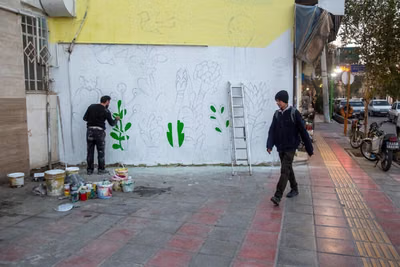

Lotfollah Siyahkali told Khabar Online that while agreements with China covering various aspects of the economy required parliamentary ratification, there would “probably” be agreement in “information and communication technology” (ICT).

An ad hoc parliamentary committee, called the Joint Siyanat Committee, is reviewing a draft bill on cyberspace regulation proposed to parliament in June, to further restrict access to various apps and websites.

Some of the bill’s supporters argue Iran should emulate China's in creating a national intranet. "The Chinese have unique and innovative experience in this field, which we can put to use," lawmaker Ali Yazdikhah said January 18.

"Passage of time proved that speculation over imitating the Chinese in Internet restriction are more true than other theories [such as using European models, which have generally aimed to extend non-digital rules into cyberspace]," the reformist Etemad newspaper wrote January 25.

China uses its ‘Great Firewall,’ a fortified digital border, to manage access to information entering and exiting the country through the Internet.

If passed, the legislation currently under review in Iran would require foreign and domestic social-media networks and messaging applications to register with a regulatory and supervisory body that would include representatives of intelligence organizations. The ministry of communications and information technology would be charged with blocking any social networks or messaging applications that failed to gain approval.

Lawmakers behind the bill, including the committee spokesman Siyahkali, want foreign social networks and messaging applications to designate a responsible Iranian company as their legal representative and to agree to abide by rules set by the regulator.

The Great Firewall

Iran has been heavily restricting access to the Internet for the past 20 years. Many foreign and Iranian websites, including media websites, are already blocked in Iran although controls are readily sidestepped by VPNs (virtual private networks) and anti-filtering software. While Instagram is the only major social-media platform not blocked in Iran, millions of Iranians use Facebook, Twitter, YouTube, and WhatsApp.

Despite China’s national intranet, the Chinese use various means, including VPNs, to circumvent restrictions.Tech Rader, the technology news and reviews website, recently recommended for visitors and residents the top five VPNs for piercing China’s ‘Great Firewall.’

Tehran in March signed a 25-year cooperation agreement with Beijing. It was launched during Foreign Minister Hossein Amir-Abdollahian's recent visit to China. With around 18 percent of the world’s population, China is home to 20 percent of Internet users globally.

Most Viewed

Khamenei fills six top military posts as key intelligence gaps persist
1

Khamenei fills six top military posts as key intelligence gaps persist

2
INSIGHT

First red meat, now dairy: Iran’s household diet keeps shrinking

3
ANALYSIS

The strange power of Iran’s absent supreme leader

4

Rezaei named Iran’s top security chief and Khamenei representative

5
INSIGHT

From Karbala-4 to AMIA: Mohsen Rezaei returns to Iran’s security helm

Banner
Banner
Banner

Spotlight

  • Two years on, Pezeshkian’s presidency is a tale of survival
    INSIGHT

    Two years on, Pezeshkian’s presidency is a tale of survival

  • Iran plays down Mecca Pact as regional security order shifts
    INSIGHT

    Iran plays down Mecca Pact as regional security order shifts

  • From Karbala-4 to AMIA: Mohsen Rezaei returns to Iran’s security helm
    INSIGHT

    From Karbala-4 to AMIA: Mohsen Rezaei returns to Iran’s security helm

  • The strange power of Iran’s absent supreme leader
    ANALYSIS

    The strange power of Iran’s absent supreme leader

  • First red meat, now dairy: Iran’s household diet keeps shrinking
    INSIGHT

    First red meat, now dairy: Iran’s household diet keeps shrinking

  • Tehran rents hit three times many workers’ monthly pay

    Tehran rents hit three times many workers’ monthly pay