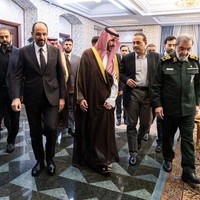
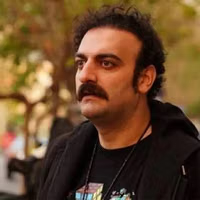
Hossein Amir-Abdollahian with China's foreign minister Wang Yi. January 14, 2022
Iranian Foreign Minister Hossein Amir-Abdollahian and Chinese Foreign Minister Wang Yi have announced the launch of a 25-year cooperation deal signed in March.
•
Amir-Abdollahian said after a meeting with Wang, who is also a state councilor, that the two sides had agreed previously to announce January 14 as the official commencement of the agreement's implementation.
In a tweet in Chinese Friday, Amir-Abdollahian said during his visit he had exchanged views with Wang on a wide range of issues including the cooperation pact and the Vienna talks to restore the 2015 nuclear deal between Iran and world powers known as the Joint Comprehensive Plan of Action (JCPOA). "We reached important consensus on these matters], the Iranian foreign minister tweeted.
A summary of the meeting between Amir-Abdollahian and Wang was posted on China's foreign ministry Saturday according to which Wang reaffirmed China's opposition to US sanctions against Iran and blamed the United States’ unilateral withdrawal from the JCPOA as the reason for current difficulties with Iran. China and Iran are both subjected to US sanctions.
This week, the Biden Administration also tried to blame lack of progress in the nuclear talks on former President Donald Trump’s decision to withdraw from the Obama-era nuclear agreement.
Wang also said China firmly opposes political manipulation through topics including human rights, and interference in the internal affairs of Iran and other regional countries in an apparent reference to the US and its European allies' demand to include such topics in the Vienna nuclear talks.
A 25-year cooperation pact between Iran and China, according to Iran's Tejarat News, was first proposed by Iran's Supreme Leader Ali Khamenei during Chinese President Xi Jinping during his 2016 visit to Tehran. The agreement was signed on March 27during Wang's visit to Tehran.
The pact has been very controversial in Iranbecause its details have never been disclosed. A leaked copy of the final text only outlines the general terms of the agreement, but Tehran officials, beleaguered by economic crisis they cannot solve, hope it will bring billions in investment and make Iran part of China' Belt and Road Initiative, a multi-trillion-dollar infrastructure scheme intended to stretch from East Asia to Europe. The project aims to significantly expand China's economic and political influence and has raised concerns in the United States and elsewhere.
"The 25-year agreement with China will have an important role in strengthening the country's infrastructures. It will transform aerial navigation, petrochemical and oil infrastructure, urban and road transportation, as well as IT and communications," Ali Nikzad, deputy speaker of the Iranian parliament told the official news agency IRNA Saturday.
The Chinese foreign ministry's summary of the meeting between Amir-Abdollahian and Wang on Friday said the agreement would deepen Sino-Iranian cooperation in areas including energy, infrastructure, agriculture, health care and culture, as well as cyber security and cooperation with other countries.
Critics of the pact in Iran believe closer relations between Tehran and Beijing will provide a better foothold for China in the Middle East that Beijing depends on for its energy needs, as well as economic benefits without significantly contributing to the Iranian economy.
The flagship hardline newspaper Kayhan accused the critics of the Raisi administration's pursuit of closer relations with Eastern countries, namely China and Russia, of opposing the Chinese pact to mislead the public and sabotage Tehran's relations with Beijing and Moscow in order to secure the interests of the West.
"They are worried about the possible economic breakthroughs through Iran's strategic relations with Eastern countries which will neutralize the impact of US sanctions," an article in Kayhan said Saturday.
For the second time in less than a month the Iranian parliament’s presidium has stopped a motion to impeach one of President Ebrahim Raisi’s economic ministers.
Criticism of ministers come mainly from within the conservative camp that supports Raisi and his administration. However, the dissent among economic and industrial leaders is so loud that even conservative lawmakers cannot ignore it.
On December 28, dozens of lawmakers tabled a motion to impeach populist Labor Minister Hojjat Abdolmaleki but Majles Speaker Mohammad Bagher Ghalibaf stopped the motionand called on lawmakers to give the minister another six months to tackle rising unemployment and create jobs for young Iranians.
On January 13, tens of Iranian lawmakers tabled another motion to impeach Industry Minister Reza Fatemi Amin for failing to stand by his promises including making Iranian-made cars cheaper and boosting their quality. Although only 10 lawmakers need to sign an impeachment motion, nearly fifty lawmakers signed. Nonetheless, the Majles (parliament) presidium refused to acknowledge the receipt of the motion, stopping the impeachment for the time being, said Lotfollah Siahkali a member of the Industry Committee of the Majles.
According to Siahkali, although Amin's supporters are lobbying at the Majles to prevent the minister's impeachment, tens of Iranian lawmakers are adamant to have the minister impeached as he has failed to convince the parliament about resolving shortcomings in his ministry's performance in the areas of automobile manufacturing and mining., both largely controlled by the government.
Both of Raisi ministers have multiple sectors to cover, yet they have not been observed to attend to the needs of any one of their areas of responsibility. Abdolmaleki, a populist character with controversial ideas about making Lamborghini cars in Iran and turning Iran into the world's biggest economic power on the condition of boosting its population to 150 million, is officially the Minister of Labor, Cooperatives and Welfare, and in charge of tens of companies and institutions including the country's Pension Fund.
Amin's official title is the Minister of Industry, Mining and Trade. However, he is a modest man who has not been seen making outlandish claims.
Abdolmaleki had promised to create jobs at the cost of ten million rials each (around $40) but recently backtracked and said that his ministry is not in charge of creating jobs although he insisted that creating every job does not cost more than 40 dollars.
One of the reasons for the impeachment of industry minister Amin is an 18-percent rise in the price of Iranian made autos within a matter of weeks after President Raisi called for controlling car prices. Amin supported the price rise, arguing that the increase in car prices is less than half of the inflation rate in Iran. The annual inflation rate is around 45 percent.
Siahkali said that what the Minister claims to be an 18-percent rise is not accurate and in fact the price rise is much more than that, however, he did not give an accurate figure. The lawmaker added that "while the real price of Iranian made cars is less than $10,000, the government that owns or controls all of the factories, sells them for $20,000. The buyers are unhappy about this. The president is unhappy. Even the car makers are unhappy. So, the minister should explain why he has doubled car prices."
Siahkali said he was ready to take back his call for impeachment if the ministry returns car prices to what they were before. "Otherwise, we will insist on the impeachment and I am sure the impeachment will happen before the end of [the Iranian] year,” in late March, he said.
Iran’s hardliner Kayhan daily wrote Saturday that an animation video depicting the killing of former US President Donald Trump has caused “terror and fear” in the “terrorist American government.”
Kayhan, which is financed by the office of Supreme Leader Ali Khamenei, is one of the most radical, hardliner newspapers in Iran. Its chief editor is also appointed by Khamenei.
The animation shows an all-terrain vehicle with an operator on board driving through a golf course and approaching a point from where its camera shows a man who looks like Trump playing golf. The operator targets the figure and a large gun on top of the vehicle aims at the target and the video ends.
Khamenei and top civilian and military leaders have repeatedly said they will avenge the killing of Qasem Soleimani, the Iranian military and intelligence operator who organized and controlled anti-Western and anti-Israeli militant groups in the Middle East. Trump ordered his killing in early 2020. He was one of Khamenei’s most trusted people.
Former Secretary of State Mike Pompeo, who is one the Americans named by Iran for revenge, said Friday that while Tehran is threatening to kill former US officials, the Biden Administration continues its nuclear negotiations in Vienna.
China seeks to expand its influence in the Middle East by opening the first consulate in a strategic Iranian trade and military port.
Iran’s Council of Ministers approved the opening of a Chinese consulate in Bandar-Abbas, Iran’s most significant trading and military port on December 29th, 2021—China’s first consulate in Iran. Mohammad Keshavarzzadeh, the Iranian ambassador in Beijing, said “the opening of China’s consulate general in Iran’s southern port city of Bandar-Abbas will greatly contribute to the development of trade between the two countries.”
While at face value this may seem like a benign partnership between two developing countries, it might have far-reaching significance for Iran and the region.
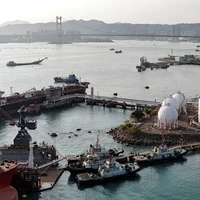
Bandar-Abbas is in the Strait of Hormuz—the slender channel connecting the Persian Gulf and the Gulf of Oman. On the north coast of the Strait of Hormuz lies Bandar-Abbas, and on the south coast, just 55 km across the shore, the Arabian Peninsula. According to The New York Times, twenty percent of all oil shipped globally passes through these waters, making it one of the world’s most strategic chokepoints, as it also has key military, economic, and political importance to the Middle East.
An Iranian tanker near loading port in the Persian Gulf. August 2021
The new Chinese consulate in Bandar-Abbas will share its home with The Islamic Revolutionary Guard Corps’ main naval base. Iran’s invitation of an emerging global superpower into their backyard could pose a threat to Iran, should regional disputes one day arise.China has already “attempted to claim more internal waters, territorial sea, exclusive economic zone, and continental shelf than it is entitled under international law.” says Commander Reann Mommsen, a spokeswoman for the US Navy’s Seventh Fleet. She describes China’s territorial claims as “excessive,” regarding the Paracel Islands, which are claimed by Taiwan and Vietnam.
In addition to opening the new consulate, according to a recently leaked 25-year ‘Cooperation Program’ between China and Iran—both countries under economic sanctions by the United States and the western world—China is investing in Iran’s cybersecurity, infrastructure, and energy sectors.
According to DW News, “China, the world'slargest public lender to developing countries, imposes unique conditions on borrowing nations which could be giving Beijing undue influence over their economic and foreign policies, according to a study from Germany's Kiel Institute for the World Economy (IfW).”
Mohammad-Hossein Malaek, former Iranian ambassador to China, told the Iranian Labor News Agency that Beijing is anticipating a leading role in developing the Makran region, the Southern coastal strip of Sistan-Baluchistan province, in Iran. Makran lies to the East of Bandar-Abbas. The move would create a clear geographical link from infrastructure developments China has made to gain regional influence in the South China Sea and would allow said influence deeper into the heart of the Middle East.
The move comes as China is competing with India for influence in the region, as both nations make efforts to become eminent world powers. India has made similar investments in Iran’s Chabahar port. Unlike China, however, India does not have a global strategy like China’s Belt and Road Initiative (BRI). The BRI, originally named, “One Belt, One Road,” is an international development strategy adopted by the Chinese government as China looks to expand its influence worldwide by improving trade routes. As of December 2021, China has expanded its’ BRI—which includes infrastructure developments across land corridors, in ports, across maritime routes, as well as over-land links (bridges, tunnels, etc.)—into 142 countries.Developing diplomatic relations with Iran is crucial to China’s ability to implement the BRI.
“Some believe China engages in ‘debt-trap diplomacy’ through the BRI, ensnaring developing countries with debt dependence and then translating that dependence into geopolitical influence,” says Paul Haenle, former U.S. government adviser and director at the Carnegie-Tsinghua Center, a joint U.S.-China research center based in Beijing.
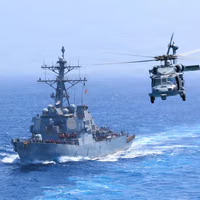
A US submarine in the Persian Gulf
To vividly illustrate what that looks like in practice, Haenle explains, “China acquired 99 years of operating rights for the Hambantota Port in southern Sri Lanka after costs for the project spiraled out of control, forcing the leaders in Colombo [Sri Lanka’s capital] to give up control of the port in return for a Chinese bailout.”
Despite Yi’s claims, the Cooperation Program comes hot off the heels of the US leaving a power vacuum in the Middle East after its withdrawal from Afghanistan, and an open shift in focus to the Asia-Pacific. The alliance between the US’ biggest economic rival, China, and their biggest antagonist in the Middle East, Iran, further weakens US’ foothold in the Middle East and undermines The United States’ interests in the region.
The 25-year Iran-China Cooperation Program comes at a time when US-Iran tensions are high, and relations strained. Following the United States’ killing of Quds Forces Commander, Qasem Soleimani, the Supreme Leader of Iran, Ayatollah Khamenei, vowed to deal America a “reciprocal blow.” Iran’s cooperation with China could well be a reaction to its bad relations with the US and not a calculated strategic move on Teheran’s part. Nevertheless, China’s foreign minister, Wang Yi says, “the China-Iran Cooperation Program does not target any country.”
Despite ‘maximum pressure’ sanctions introduced against Iran in 2018 by the US, Iran’s value of non-oil trade exchanges with China stood over $19 billion between March 2020 and March 2021. China is currently Iran’s top trading partner. However, out of the two, China alone has enjoyed a favorable trade partnership, while Iran has been isolated internationally by essentially only being able to trade with China, forcing Iran to trade its oil reserves at much lower prices than it would otherwise like, although no official figures are available.
To make matters worse for Iran, Beijing maintains good political and economic relationships with Saudi Arabia, Iran’s primary regional adversary. China is also Saudi Arabia’s top economic trading partner, and the biggest importer of Saudi oil. Unlike Saudi Arabia, however, China pays Iran below fair market rates per barrel, while the Saudis are given fair market prices. US intelligence officials have seen evidence of “multiple large-scale transfers” of sensitive ballistic missile technology being shipped from China to Saudi Arabia. Saudi Arabia is benefiting from having bilateral relations with the US and China, while Iran is getting raked over the coals by China alone, which is also enabling the military capabilities of Iran’s biggest regional rival.
The only shipments currently taking place between China and Iran are oil deliveries, from Iran to China, made at Iran’s expense—the compensation for which is being held as frozen assets by China (some estimate this is up to $20B). The only way Iran can get their undervalued payment for the oil is by purchasing Chinese goods and services. Additionally, any goods and services related to China’s BRI used or provided within Iran are required to use Chinese companies and labor, thus precluding Iran’s own people and companies’ ability to make any economic gain whatsoever during the BRI’s implementation.
A large majority of the 142 BRI partners are low- to middle-income developing countries. Poor nations make up 48% of the BRI partners, and high-income partners make up only 23%.
Although it is hard to say how China will enforce future cases of defaults on debt, the ‘maximum pressure’ sanctions currently in effect against Iran make it more likely they might default on a Chinese loan. Based on what China has done in Sri Lanka, it is not unreasonable that China would similarly try to take control of Bandar-Abbas, should Iran fall short on its’ loan obligations. If Iran had stronger diplomatic relationships with the West, it could keep China in check. However, Beijing’s critics argue China might swap debt for resources or diplomatic rights and/or obligations at later dates. The Middle East is home to several unstable governments, isolated by the West, and desperately in need of foreign investment, but at what cost?
Iran’s Foreign minister who is visiting China to follow up on a 25-year agreement with Beijing says bilateral cooperation is accelerating under the current administration.
Hossein Amir-Abdollahian arrived in China at the head of a high-ranking delegation at the invitation of his Chinese counterpart, Wang Yi, on Friday.
The pace of expanding bilateral ties has been accelerating during the administration of President Ebrahim Raisi as the governments of Iran and China “have made very good progress in various issues in line with the interests of both sides”, Amir-Abdollahian said.
After meeting with the Chinses foreign minister in the city of Wuxi in the eastern province of Jiangsu, the visiting Iranian diplomat tweeted in Chinese, saying that they discussed a wide range of topics such as the 25-year comprehensive cooperation plan and the Vienna talks to revive the 2915 nuclear deal.
Noting that Iran and China are in the 50th year of their diplomatic ties, Amir-Abdollahian expressed hope that the relationship between the two countries will leap forward in the new era.
Tehran and Beijing have signed a 25-year strategic cooperation agreement and Iran is hoping to get Chinese investments and more diplomatic support. However, Beijing so far has not seriously challenged US sanctions, as it has cultivated closer ties with the Gulf Arab countries and Israel.
Denmark says espionage threat from Iran, China and Russia is increasing against the country as well as the Arctic region where world powers are competing for resources and sea routes.
Anders Henriksen, head of counterintelligence at the Danish Security and Intelligence Service, said in a report on Thursday that "The threat from foreign intelligence activities against Denmark, Greenland and the Faroe Islands has increased in recent years.”
Copenhagen handles most of the security matters of Greenland and the Faroe Islands, which are sovereign territories under the Kingdom of Denmark as many countries are trying to get access to natural resources, sea lanes, research and militarily strategic areas in the Arctic region.
He added that Denmark's active international role as a NATO member, the openness of its society as well as technological prowess has made it "an attractive target of foreign intelligence activities" including from Iran, China and Russia.
The report said these foreign intelligence services were trying to make contact with students, researchers and companies to get formation about the Danish technology and research.
On Wednesday, the US military officially confirmed that Iran's intelligence ministry is connected to the cyber espionage group MuddyWater that steals data from computer networks around the world.