Despite a decade of fighting to save the Syrian government, Iran has a small share of Syria’s trade, and might lose out to financially stronger players .
The Revolutionary Guard, which usually tries to justify the high cost of involvement in the Syrian war, has been arguing that trade and investment in Syria will pay off and compensate billions of dollars Tehran has spent to support Bashar al-Assad.
Tasnim news affiliated with IRGC quoted Syria's economy and trade minister on Friday as saying that Syria's new investment law is very favorable to Iranian investors.
What Mohammad Samer al-Khalil said was that the law would offer benefits, tax exemption, and guarantees to all investors, including Iranian companies. Al-Khalil expressed hope for greater bilateral economic cooperation and trade.
The extent of Iranian military expenditures and financial aid to Syria to keep President Bashar al-Assad in power is not known. In May 2020 a member of the Iranian parliament's National Security and Foreign Policy Committee, Heshmatollah Falahatpisheh, made an unprecedented declaration that Iran has spent $30 billion in Syria and must recoup the loss.
Iran has also spent blood on top of treasure to defend Assad's government. No one knows how many servicemen have been killed in Syria, but Iran at one point was deploying 20-30 thousand fighters, mostly Afghan and other mercenaries and allies, but also some of its own troops.
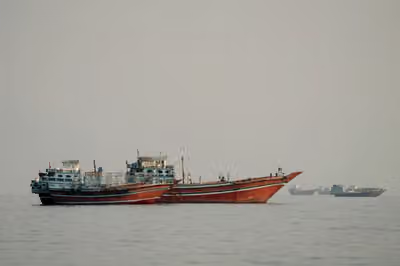
A program on Iranian national television Thursday highlighted obstacles to increasing trade. Keyvan Kashefi, chairman of the Iran-Syria chamber of commerce, highlighted the difficulties caused to both countries by US sanctions as well as the absence of safe land and maritime trade routes.
The director of the Trade Promotion Organization of Iran, Alireza Peymanpak, told the program that Iran's Trade Development Fund had allocated $50 million to supportIranian companies' exports to Syria.
The deputy chairman of Iran's Chamber of Commerce, Mohammad Amirzadeh, in November blamed the government for what he said was a low level of Iran’s exports to Syria, which make up 3 percent of Syria’s imports compared to 30 percent from Turkey. Some Iranian trade officials recently said Syria had completely stopped importing Iranian vehicles, which had been a major export item.
The odd thing is that Turkey has been supporting Assad’s Sunni opponents in Syria for years and is the protector of Idlib province where all the Sunni factions, defeated in the war, have found a relatively safe haven.
In early November, reports said that Syria had expelled top IRGC commander, General Seyyed Javad Ghaffar, a move that was seen as Assad’s attempt to improve ties with rich Sunni Arab states.
While Tehran has been portraying the development as an ordinary event, The Times of Israel on November 11 quoted Saudi sources as saying that Ghaffari was expelled from Syria as he was "accused of ‘major breach of Syrian sovereignty’ after attacking US forces, and deploying Iranian weapons to unapproved places."
However, Tasnim acknowledged in an earlier report that according to "foreign news sources," Ghaffari was forced by the Syrian government to leave Syria after a visit to Damascus by the Foreign Minister of the United Arab Emirates, Sheikh Abdullah bin Zayed Al Nahyan's on November 9.
Iranian state media have occasionally reflected dissatisfaction in recent years that Iran’s share of the Syrian economy is small and Russia, which intervened in the war decisively to save Assad, has more influence and more chance of benefitting from Syria’s reconstruction than Iran.