Economy Long Sacrificed To Nuclear Push, Says Iran Politician

The leader of a leading reformist group says Tehran is undecided between engaging with the West to save its ailing economy or pursuing its nuclear program.
The leader of a leading reformist group says Tehran is undecided between engaging with the West to save its ailing economy or pursuing its nuclear program.
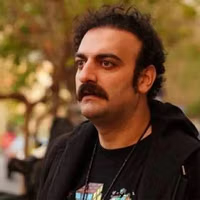
Hossein Marashi, the new leader of the centrist Executives of Construction party has told Etemad Online on Monday, that Iran's nuclear activities have turned into a crisis. Iran's nuclear negotiators will be waiting for orders from the top, Marashi added, meaning that it is Supreme Leader Ali Khamenei who makes the final decision to choose between improving the country's economy, or continuing his hardline stance.
Marashi, however, reiterated that he is not optimistic about Iran's renewed negotiations with the partners of the Joint Comprehensive Plan of Action (JCPOA), due to start next week.
Stressing on the importance of returning to the nuclear deal, he added that even the ongoing water crisis is an outcome of Iran's unresolved economic crisis that, in turn, is a product of paralyzing sanctions on the country's economy.
Marashi said that negotiations over Iran's nuclear program have been continuing for about two decades and this prolonged process has done irreparable damage to the country’s development. However, he reiterated that the West has the upper hand in the negotiations and Iran needs to find a way out of the crisis through negotiations.
"We all know that the West has double standards about Iran's nuclear program. The West is a liar. However, the West is also powerful," he maintained.
Marashi added that negotiations with the West should be resumed right from the point it was suspended. The talks should have a new momentum and continue with a quick pace so that problems could be solved quickly, he said and suggested that negotiators know the economy is more important than the nuclear program, but they are not the deciders.
Meanwhile, the IRGC-linked Fars news agency wrote in a commentary on Monday that having experienced the obstacles to an agreement with Iran within the US legal and bureaucratic framework, Iran should avoid relying on US laws and regulations in any upcoming agreement over its nuclear program.
The commentary said what those regulations say is the United States' problem and Iran should not be bothered with them. The commentary suggested that the Iranian side should not attach much weight to restrictions the US Congress could apply to any possible agreement.
The commentary further said that it is now clear the American side will offer no guarantees to Iran that would ensure continued commitment to an agreement between Iran and the Biden Administration unless it is endorsed by the Senate. However, the commentary stressed that such an endorsement is highly unlikely.
Meanwhile, the commentary suggested that "none of the solutions offered for the negotiations has any chance for success," and added that it appears that "Iran should solely rely on its own negotiating power and not count on its other partners as all the parties to the JCPOA are obviously united against Iran."
Regardless of this pessimistic outlook, in an interview with proreform agency ILNA, foreign policy analyst Amir Ali Abolfath opined that in the upcoming negotiations starting on November 29, "The United States has no other way but to come up with a common understanding with Iran." He further opined that if the JCPOA is not revived the IAEA will have no safeguards about inspecting Iran's nuclear establishments meaning that Iran will no longer abide by the Non-Proliferation treaty (NPT).
Abolfath also warned that accepting the demise of the JCPOA would mean an essential change to the balance of power in the Middle East, possibly meaning that Iran will continue its nuclear program and produce nuclear weapons.