Iran Minister Issues 'Inflation Roadmap' While Economic Crisis Worsens

Iran's economy minister has outlined what he called the country's "No-Inflation Roadmap" to deal with the current crisis, trying to ignore the impact of US sanctions.
Iran's economy minister has outlined what he called the country's "No-Inflation Roadmap" to deal with the current crisis, trying to ignore the impact of US sanctions.
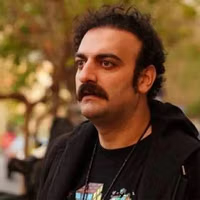
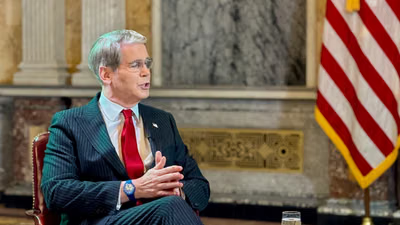
Iranian media described minister Ehsan Khanduzi’s plan as the administration's economic manifesto for the next two years.
Khanduzi said that President Ebrahim Raisi’s administration took office when the inflation rate was at its highest point and the per capita income was at its lowest point in the modern history of Iran.
He said that the country needs a macro-economic blueprint to curb inflation and boost productivity and economic growth. Khanduzi's reference to macroeconomics came one day after the Iranian state-run television's news channel quoted some Iranian lawmakers as having criticized the minister for lecturing them about macroeconomic models during his meetings in parliament, rather than offering a way out of the current economic crisis.
Lawmakers and commentators from across the political spectrum have criticized the Raisi government for lack of any plans or concrete action to deal with the current economic crisis. The minister’s economic blueprint was apparently published to quell criticism, but as a document without much detail and revenue-generating suggestions, it might lead to more questions than answers.
Khanduzi said economic growth is not feasible without controlling inflation and returning stability to markets in a way that economic trends would be predictable.
But Iran’s nearly 50-percent annual inflation is because of printing money in the absence of oil export revenues.
Iranian officials, almost without an exception, use formulaic statements about saving the economy from the abyss, but few openly say that the crisis is directly the result of Iran’s foreign policy and its nuclear program that have triggered US sanctions.
Khanduzi added that Iran should take measures in terms of monetary policy, forex policy and budget policies in order to control inflation. He offered a roadmap in two pages which some social media users pointed out he had already outlined in his plans when he offered them to the parliament in August. Twitter user Iman Karami, a graduate student of Economics in Iran pointed out that the two-page roadmap contains nothing but "slogans and general statements."
According to the roadmap, Khanduzi's plan to curb inflation and boost productivity includes "controlling fluctuations in exchange rates, frequently checking the balance sheets of banks, and controlling growth in government's expenditures by reducing them to one-third of the current amount."
However, Khanduzi warned that these policies should not weaken industrial production. One of his solutions is concentrating on super-projects that will be the main driving force in production.
Khanduzi suggested that the National Development Fund should be used to fund these projects. The NDF is Iran's foreign currency reserve, which is controlled non-transparently by Supreme Leader Ali Khamenei and no one knows how much is left there after the government kept withdrawing funds in the past three years of US sanctions.
He also suggested that the super-projects could be funded by selling bonds, attracting foreign investment and channelling funds from government and quasi-state banks.
The problem with Khanduzi's funding suggestions is that foreign investors have been avoiding Iran fearing US sanctions and that Iranian banks have been giving loans to the government to cope with a nearly 50 percent budget deficit and have very little to offer for super-projects as many of them are on the verge of bankruptcy.
Under the circumstances, his only solution might be to convince Khamenei to withdraw more funds from the NDF.