Husband Of British-Iranian Detainee Goes On Hunger For Her Release

The husband of Nazanin Zaghari-Ratcliffe, detained for more than five years in Iran, has gone on a hunger strike again after she received another sentence.

The husband of Nazanin Zaghari-Ratcliffe, detained for more than five years in Iran, has gone on a hunger strike again after she received another sentence.
Richard Ratcliffe started his protest action on Sunday outside the UK Foreign Office in central London.
He is camped in a tent outside the building's main entrance to pressure the government to secure the release of his wife and other detained dual British-Iranian nationals.
"Nazanin is threatened with prison any time soon so we're here just to make the point that the government needs to change its approach. I've had some meetings behind closed doors with the government, pushing them to do something different. They haven't been willing to, so here we are," Ratcliffe said.
Zaghari-Ratcliffe served five years in prison after being taken into custody at Tehran's airport in April 2016 and convicted of plotting the overthrow of Iran’s government, a charge that she, her supporters and rights groups deny.
In May, she was sentenced to an additional year in prison on charges of spreading “propaganda against the system”.
Ratcliffe went on a 15-day hunger strike two years ago outside the Iranian Embassy, a move he credits with getting their seven-year-old daughter Gabriella released.
Rights groups accuse Iran of holding dual-nationals as bargaining chips for money or influence in negotiations with the West, something Tehran denies.
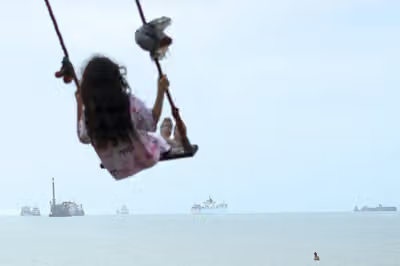

Foreign-based women journalists covering Iran face "increased and concerning levels" of online harassment and abuse, say Article 19 and Committee to Protect Journalists.
“The increasing trend of authorities and mobs harassing journalists outside the country is extremely disturbing,” said Quinn McKew, Executive Director of London-based Article 19. “Iranian journalists who face online abuse are not only seeing their work affected, it’s having a huge impact on their lives.”
McKew urged the “international community,” in which she included “technology companies,” to “do more to protect journalists around the world."
In collaboration with the New York-based Committee to Protect Journalists (CPJ), Article 19 interviewed journalists in March to investigate the "toxic and often violent space" surrounding women journalists reporting on Iran.
Article 19 cited smear campaigns and tactics to undermine the victims' credibility, sometimes launched by people who presented themselves as "opposition activists" who portrayed their targets as "agents" or "propagandists" for “the regime” in Iran.
"A lot of the women we spoke to described similar campaigns, seemingly led by the Islamic Republic of Iran, to delegitimize their critical reporting about Iranian institutions or the Iranian state," a briefing published by the two rights organizations said.
Testimonies in the briefing suggested that online attacks on women journalists were not limited to death threats against them and their families but also contained a "clear sexualized and gender-based pattern."
In July Iranian-American activist Masih Alinejad claimed she was the victim of an alleged plot by Iran’s Intelligence Ministry cited in an inditement by a federal court in New York. Alinejad, who has a high social-media profile and a popular memoir The Wind in My Hair, claimed she was to have been kidnapped from her New York apartment and whisked to Venezuela in a speed boat.
“Covering Iran, even from outside the country, can be a dangerous beat for any journalist,” said Sherif Mansour, CPJ’s Middle East and North Africa Program Coordinator. “For women journalists in exile, the burden of fearing for their lives is amplified by smear campaigns and relentless online abuse. Protection by law enforcement and support from social media platforms are critical for them to carry out their work with any sense of safety.”
The International Federation of Journalists last year condemned the “arbitrary raids” in Tehran in which journalists’ material was reportedly seized. The two rights organizations argued that while the severe conditions experienced by women journalists inside Iran were not comparable, the risks faced by women journalists outside Iran should be prevented.
The two organizations urged governments − naming including the United States, Canada, and those in the European Union − should acknowledge the severity of the problem and take specific measures to tackle this online abuse and harassment.
Sixty-six journalists were killed around the world in 2020, with highest total 14 in Mexico, 10 in Afghanistan, nine in Pakistan and eight in India.

A female Iranian political prisoner has told her family that she has been repeatedly subjected to strip-down searches in various detention centers.
Mozhgan Kavosi was first arrested in northern Iran during the November 2019 nationwide protests and sentenced to six months in prison by a local prosecutor. Later her sentence increased during an appeal to nearly seven years.
Kavosi, who is a 45-year-old mother of two daughters, belongs to a religious minority but she was charged with propaganda against the regime and an array of other vague political accusations.
Kavosi told her family that every time she was stripped-searched, she told prison guards that she is a political prisoner, not a common criminal and their intrusion into her privacy is simply a psychological pressure tactic.
In line with a recent policy of ‘exiling’ political prisoners to distant prisons, Kavosi is now serving her time in Karaj, near Tehran. The tactic is meant to make it harder for their families to visit them.
Kavosi has also been deprived of her lawyer, Mostafa Nili, who was arrested in August along with others for threatening to sue Supreme Leader Ali Khamenei for banning American and British Covid vaccines and causing thousands of more deaths.

An appeal court in Iran has upheld the verdict and one-year prison sentence of British-Iranian citizen Nazanin Zaghari-Ratcliffe, held on ambiguous charges.
The project manager for the Thomson-Reuters Foundation has also been barred from leaving Iran for a year, Hojjat Kermani, Zaghari-Ratcliffe's attorney, told Emtedad news Saturday.
In March Zaghari-Ratcliffe completed a previous five-year sentence, with eight months in solitary confinement, but a second trial convicted her of further charges, which related to
a protest at the Iranian embassy in London in 2009, which was judged punishable under the Iranian Penal Code.
“It seems that every time we dare to hope that Nazanin might soon be free, there is another dreadful setback that puts freedom out of sight," Zaghari-Ratcliffe's member of parliament in Britain Tulip Siddiq tweeted Saturday. "She could now be returned to prison at any time.”
Zaghari-Ratcliffe was arrested in April 2016 while visiting her family in Iran and convicted on espionage charges without due process of law.
Security charges in Iran are tried in closed-door courts, usually with limited representation. Her husband Richard Ratcliffe has repeatedly alleged that that Iran has taken his wife as a bargaining chip to encourage the British government to repay £400 million ($550 million) owed to Iran for Chieftain tanks that Tehran paid for in the 1970s but never received.
In September 2020, United Kingdom Defence Secretary Ben Wallace acknowledged the debt in a letter to lawyers representing Zaghari-Ratcliffe and relatives of ,dual nationals held in Iran. Wallace said he was seeking to make arrangements for repaying it.
“Iran conducts its diplomatic business through hostage-taking, in part because it is cost-free,” Richard Ratcliffe was quoted by the Guardian newspaper as saying on September 19. “British citizens will not be protected from hostage-taking by words and soundbites, but by actions that cause the perpetrators to reassess their calculations and consider the personal costs – for their role in what is a serial organized crime,”
Zaghari-Ratcliffe has been under house arrest at her parents' house in Tehran since March 2020 when she was given furlough from prison due to the Covid pandemic. Two forensic specialists produced a report in February 2021 after examining Zaghari-Ratcliffe by video-link that she suffered from post-traumatic stress disorder, depression, and obsessive-compulsive disorder due to her treatment in prison, house arrest, uncertainty, and separation from her family.

Based on figures published by Iran’s census registration bureau, 791 babies were born in the past six months from mothers aged 10-14 years-old.
The highest number of child mothers giving birth came from one of the poorest provinces, Sistan and Baluchistan in the southeast with 248 births.
Activists have said that poverty is big reason for child marriages as poor families receive a few hundred dollars to allow their young girls to marry with prospective grooms who are also often as young as 14. In other cases, young girls are wed to much older men.
Despite years of efforts by activists and some politicians to outlaw child marriage, the ruling clerics have opposed a legal ban, saying that in Islam it is up to the parents to decide if their child is ready for marriage. The minimum age according to Islamic tradition is nine.
A report earlier this year said there were up to 30,000 marriages of children younger than 14 in one year.

Tuesday’s World Cup qualifier between Iran and South Korea in Tehran was played without fans, thwarting women after earlier notice that they would be admitted.
After the Iranian Football Federation announced Sunday there would be no spectators, a federation official, Hasan Kamranifar, said Monday the decision reflected difficulty in carrying out PCR tests or checking fans had been vaccinated.
The John Hopkins Covid-19 tracker puts the number of deaths from the virus in Iran in the past week at 1,521.
Faezeh Hashemi, daughter of former president Akbar Hashemi Rafsajani, told Ensaf News on Monday that Covid was an excuse. “This is a trick”, she said. “I hope Iranian girls don't give up, go to the stadium gates like they have always done not to lose what is their right.”
Hashemi said she hoped that Fifa, the world governing body for soccer, would not be deceived. In the past few years, Fifa has called on Iran to allow women into stadiums to watch men’s games. In October 2019, the ban on women was lifted for one game, between Iran and Cambodia at the 100,000-capacity Azadi stadium.
On Tuesday, the day of the game, an official of the cinema-owners’ association told the media that some cinemas would show the game live. "Will the PCR test be given to those who go to the cinemas?" the Iranian Students News Agency (ISNA) asked. "Is a football match with 7,000 spectators at Azadi Stadium more dangerous than watching it in closed spaces of cinemas?"
The issue of women watching men’s soccer, where female attendance was restricted after the 1979 Revolution, flared up in 2006, when principlist president Mahmoud Ahmadinejad backed down under pressure from senior Muslim clergy after deciding to let them in.
In recent years, women activists have organized campaigns to gain access to men’s games and some have gone to prison for their protests. In 2019 a 19-year-old fan of Esteghlal FC self-immolated in front of a Tehran court after being told she could face a six-month prison sentence for attempting to enter Azadi stadium disguised as a man. She died in hospital a week later of her injuries.
Hashemi, who from 1990 to 2011 headed the Women's Sports Federation, criticized the state broadcaster (IRIB) for not airing women's sports. "It's disrespect and violation of women's rights," she said, suggesting authorities had a "political and security-oriented view" of women's athletics. "I see no positive prospects for women's sports during [President Ebrahim] Raisi's [Raeesi] presidency," she opined.
The Covid pandemic led to football being played without spectators, but authorities had earlier suggested 7,000 fans could watch the Iran-Korea match provided that they had proof they had received two doses of the Covid vaccine. The game finished in a 1-1 draw, with Iran equalizing late with a header from Alireza Jahanabkhsh to stay top of the group.