• العربية
  • فارسی
BrandBrand
  • Iran Insight
  • Politics
  • Economy
  • Analysis
  • Special Report
  • Opinion
  • Podcast
  • Live TV
  • Iran Insight
  • Politics
  • Economy
  • Analysis
  • Special Report
  • Opinion
  • Podcast
  • Live TV
  • Theme
  • Language
    • العربية
    • فارسی
  • Iran Insight
  • Politics
  • Economy
  • Analysis
  • Special Report
  • Opinion
  • Podcast
  • Live TV
All rights reserved for Volant Media UK Limited
volant media logo

Dispute over convicted hardline MP’s voting tablet divides Iran’s parliament

Nov 23, 2026, 18:08 GMT+0
A photo released by Fars News Agency in November 2025 shows hardline Iranian lawmaker Hamid Rasaei browsing his Telegram account on his tablet during a parliamentary session.

A dispute over a convicted lawmaker’s voting tablet has divided Iran’s parliament, with a news agency accusing ultraconservatives on Monday of forcing the cancellation of Sunday’s session and allowing a factional feud to halt the work of the legislature.

The dispute centered on Hamid Rasaei, a hardline Tehran MP and outspoken critic of Parliament Speaker Mohammad Bagher Ghalibaf. Rasaei had been granted temporary leave from Evin Prison, where he began serving a 10-month sentence in September over an article accusing Ghalibaf of tampering with parliamentary documents.

Rasaei arrived at parliament on Sunday to find his access to the tablet system lawmakers use to participate and vote remotely still blocked.

Several allies, including Tehran MPs Mehdi Kouchakzadeh and Ali Khezrian, demanded that his access be restored and threatened to disrupt proceedings once the session opened, ILNA reported.

Enough lawmakers were present in person or online for a quorum. After about 90 minutes of efforts to resolve the dispute, the parliamentary leadership, chaired that day by Deputy Speaker Ali Nikzad, canceled the sitting.

Rasaei gave a different account, accusing Ghalibaf of refusing to restore his access and saying the leadership called off the session because it feared what he might say on the floor.

Parliament’s media office said Rasaei was still serving his sentence and his leave had expired. Lawmakers had raised the issue the previous Wednesday, when Deputy Speaker Hamidreza Haji-Babaei said parliament had asked the judiciary whether Rasaei could exercise his parliamentary duties while on leave. By Sunday, it had received no reply.

In its Monday analysis, ILNA said Rasaei and his allies had grounds to seek a ruling on his voting rights. But by threatening to disrupt the sitting, lawmakers close to the ultraconservative Paydari Front had turned a legal question into a show of factional strength. The agency also faulted the leadership for giving a handful of MPs an effective veto over whether the rest could meet.

“Parliament must not be held hostage to factional sensitivities,” ILNA wrote. “Not today, not tomorrow, not over a tablet or anything else.”

Most Viewed

Truck drivers strike across Iran over economic hardship
1

Truck drivers strike across Iran over economic hardship

2

Iran signals readiness for Hormuz showdown despite US buildup

3

Trump threatens Iran strikes in new year, says blockade runners will be sunk

4

Inside Iran's online gun market, where a few messages can start a deal

5
EXCLUSIVE

Family source recounts Iranian girl's alleged killing by father

Banner

Spotlight

  • ‘The city smelled of blood’: Witness recalls Iran protest crackdown

    ‘The city smelled of blood’: Witness recalls Iran protest crackdown

  • Iran-linked hackers posed as US expert to target Australian broadcaster
    PODCAST

    Iran-linked hackers posed as US expert to target Australian broadcaster

  • Who gets to be a journalist? Iran seeks greater control over press
    INSIGHT

    Who gets to be a journalist? Iran seeks greater control over press

  • Iran hardliners push tanker convoy to defy US blockade

    Iran hardliners push tanker convoy to defy US blockade

  • War damage leaves Iran with few options to avert winter gas crunch
    ANALYSIS

    War damage leaves Iran with few options to avert winter gas crunch

Banner
Banner
Banner
Banner
Banner
Banner
•
•
•

More Stories

Iran’s internet bill targets anonymity by tying accounts to real identities

Nov 21, 2026, 11:16 GMT+0
•
Hooman Abedi
100%
A woman checks her smartphone on a street in Iran at night.

A bill before Iran’s parliament would require online service providers to verify their users’ identities, making it easier for the state to trace anonymous accounts in a country where social media posts have led to prison terms and even death sentences.

Under the Cyberspace Regulation Bill, which is still under review by lawmakers, providing a digital service to anyone whose identity has not been verified would become a violation.

Users would not have to show their real names in public. But accounts run under pseudonyms could be linked to real people through the data providers collect, and handed to regulators on request.

For Iranians who write under pseudonyms, the difference is between being anonymous to the public and being anonymous to the state. The bill would remove the second.

What the bill would change

Companies that offer services before verifying users would face penalties including advertising bans, a ban on registering new users, fines of up to 10 percent of annual revenue, and suspension or loss of their licenses, according to details published by the Shargh daily in late August.

Failing to hand over information requested by regulators would also count as a violation.

The bill would also strengthen the Supreme Council of Cyberspace, Iran’s highest internet policymaking body, and its executive arm, the National Cyberspace Center.

The latest draft drops an earlier clause that would have made using a VPN a crime, though the state’s powers to block content remain.

‘James the Faithless’

The case of Amirhossein Mousavi shows what can happen once the state puts a name to an account.

  • Iran sentences activist to death over X posts, lawyer says

    Iran sentences activist to death over X posts, lawyer says

Mousavi ran an account on X called James Bidin, a play on the name of the American actor James Dean. In Persian, “bidin” means “faithless” or “without religion.”

A Revolutionary Court sentenced him to death for “corruption on earth” over his online activity, his lawyer, Reza Shafakhah, said on November 4. He also received five years in prison for insulting religious sanctities.

Mousavi, held since December 2024, faced several charges over posts attributed to his account, including national security offenses and alleged cooperation with Israel.

In a letter from Tehran’s Evin prison, he rejected the charges and said his televised confessions had been extracted under pressure from interrogators.

The new bill played no part in his case. It would make the first step, identifying the person behind the account, routine.

100%
Two men use their smartphones on a street in Iran.

A long line of controls

  • Iran withdraws cyber bill after outcry over free speech

    Iran withdraws cyber bill after outcry over free speech

  • Iran restores internet after 88-day blackout, keeps social media blocked

    Iran restores internet after 88-day blackout, keeps social media blocked

  • Iranians report SIM cards blocked over political posts and likes

    Iranians report SIM cards blocked over political posts and likes

  • Iranians told to post pro-government content to regain internet access

    Iranians told to post pro-government content to regain internet access

The bill follows earlier attempts to tighten state control of the internet. The Internet Protection Bill, known in Iran as the Sianat plan, sought more control over foreign platforms and online communications but stalled after widespread opposition.

The government of President Masoud Pezeshkian withdrew a separate bill on “combating the dissemination of false content in cyberspace” in July 2025 after criticism.

Iran has repeatedly cut off the internet during unrest and war, including during the January massacre and for 88 days after the US and Israel launched their war on Iran on February 28, cutting millions of Iranians off from independent news and from the outside world.

Major international platforms remain blocked, and many Iranians rely on VPNs to get online.

Iran International has documented cases of people whose SIM cards were blocked after political posts or interactions on social media.

Some who tried to have their service restored were asked for personal details, home addresses and the names of their social media accounts.

Who gets to be a journalist? Iran seeks greater control over press

Nov 21, 2026, 06:01 GMT+0
•
Behrouz Turani
100%
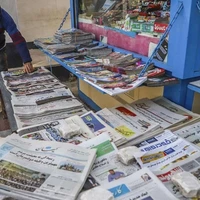
File photo: A man browses newspapers at a newsstand in Iran.

Iran is moving to tighten controls on journalists at home while threatening to pursue exiled media figures abroad, as lawmakers revive a controversial licensing proposal and the judiciary seeks to enlist Interpol in its crackdown on dissidents.

The proposed legislation would require journalists to obtain government-approved licenses to work, potentially placing their professional credentials under direct state oversight.

The proposal, first introduced in 2014, was shelved following strong opposition from journalists and media professionals. Hardliners in parliament revived it last week.

Babak Negahdari, head of the Majles Research Center, was quoted by the hardline news outlet Young Journalists Club as saying the proposal "has been finalized as a bill" and would be brought to a parliamentary vote within the next three months.

The legislation calls for the creation of a "Journalism Organization" modelled on the Iranian Medical Council, which regulates the licensing and professional practice of physicians.

Critics argue that the proposed body would undermine press freedom by placing journalists' professional credentials under state control.

Media lawyer Kambiz Nowrouzi said this week that the bill remains "the same 2014 draft with the same serious problems and fundamental flaws."

In an editorial in the moderate daily Shargh, he argued that the proposed Journalism Organization would effectively function as a government body, creating "a double filter for greater control over professional press organisations."

When introduced in 2014, the proposal was described as "abnormal" and "catastrophic" by journalism professor Hassan Namakdust, who warned it would leave "nothing of journalists' independence, status, and dignity."

Public reaction to its revival has so far been muted, possibly because of the intense security pressures facing journalists today.

The political environment has also changed. Parliament is dominated by hardliners, and the latest proposal originates from lawmakers rather than a government ministry.

Chasing exiled dissidents

Meanwhile, Iran's judiciary has announced efforts to pursue the arrest and extradition of dissidents and media figures living abroad through Interpol, alongside the confiscation of their assets inside Iran.

At a November 17 press briefing, Judiciary Spokesman Asghar Jahangir said authorities had confiscated assets belonging to a number of Iranians living abroad whom Tehran accuses of "treason" and other offences.

He said the judiciary was working through Interpol and its International Affairs Department to secure their arrest and extradition.

Although Jahangir did not release a full list of names, state television and affiliated outlets have repeatedly singled out exiled journalists working for Persian-language broadcasters such as Iran International, BBC Persian and VOA Persian when threatening asset confiscation, consular restrictions and Interpol Red Notices.

However, Article 3 of Interpol's Constitution prohibits the organisation from undertaking activities of a political, military, religious or racial character.

An Interpol Red Notice is also not an international arrest warrant, and Western host countries routinely reject extradition requests based on political or speech-related charges.

Nevertheless, the announcement has heightened concerns among Iranian journalists in Europe and the United States, some of whom fear questioning or delays at border crossings and airports when travelling internationally.

Other restrictive bills

The revived Journalism Organization Bill is the third in a series of legislative initiatives that critics say are intended to restrict freedom of expression and tighten state control over information.

The first two were the Foreign Influence Bill and the Bill to Organise Cyberspace.

The Foreign Influence Bill, which would criminalize interviews and other forms of contact with foreign-based media outlets, received initial parliamentary approval on August 16 by 183 votes to four, with five abstentions.

President Masoud Pezeshkian's cabinet formally opposed the legislation on August 23, but the government has no veto over parliamentary bills. The measure still requires a final parliamentary vote and Guardian Council approval.

The Bill to Organise Cyberspace, also known as the Protection (Sianat) Bill, was submitted to parliament on August 26.

Critics have described it as a rebranded version of the previously shelved Sianat internet bill. Among other measures, it would require internet service providers to identify and verify their users.

The legislation must undergo review by parliament's Social Commission before a floor vote and final consideration by the Guardian Council.

Together, the three proposals would expand state oversight of traditional and digital media, while the judiciary's latest announcement signals continued pressure on Iranian journalists abroad. Whether the revived licensing bill becomes law remains uncertain, but it is now being considered by a hardline-dominated parliament alongside other measures aimed at tightening controls on information.

Iran hardliners push tanker convoy to defy US blockade

Nov 21, 2026, 02:29 GMT+0
•
Maryam Sinaiee
100%
An illustration published by the Revolutionary Guards-affiliated Fars News Agency depicts the mythical Persian hero Fereydoun leading a convoy of Iranian oil tankers escorted by warships

Iranian hardliners are calling for a convoy of oil tankers to challenge the US naval blockade, threatening military retaliation against regional energy infrastructure if Washington attempts to stop the vessels.

The proposal, published Thursday by the Revolutionary Guards-affiliated Fars News Agency, calls for tankers to sail to China and threatens strikes on oil facilities in the United Arab Emirates, Saudi Arabia and Qatar if the US intervenes. It emerged shortly after reports that an unsanctioned tanker had been loaded at Iran's Kharg Island oil terminal.

Fars dubbed the plan “Operation Fereydoun,” after a legendary hero in the Persian epic Shahnameh.

No official plans for a convoy have been announced, although Foreign Minister Abbas Araghchi said Friday that Iran would break the blockade.

“A blockade is a military action. A military action also has a military response,” political and military analyst Nima Akbarkhani said during a Thursday night discussion on Iranian state television.

Akbarkhani described a previously discussed scenario in which Iranian tankers would sail individually with their Automatic Identification System (AIS) signals switched on and Iranian flags displayed, while Tehran announced in advance which regional facilities it would target if any vessel were attacked.

During the Be Vaght-e Iran program, host Ruhollah Razavi suggested placing media teams, members of the public and international anti-war activists aboard the tankers to increase the political and media costs of any US intervention.

Akbarkhani endorsed the idea, arguing that unlike vessels sent to Gaza, which Israel prevented from reaching their destination despite extensive media coverage, Iran could deter attacks on blockade-breaking tankers by threatening military retaliation.

Support for confrontation grows

Political analyst Mostafa Najafi, recently described in Iranian media as an adviser to Supreme National Security Council Secretary Mohsen Rezaei, wrote on X that Supreme Leader Mojtaba Khamenei had ordered an end to the “neither war nor peace” situation some time ago.

Najafi suggested that the effort extended beyond diplomacy, with military options also under consideration.

“Apparently, Tehran no longer wants to sit back and watch the blockade and threats,” he wrote.

Majid-Reza Hariri, president of the Iran-China Chamber of Commerce, called on Iranians across the political spectrum to support efforts to break the blockade.

“After months of pursuing negotiations in various ways, every Iranian patriot, regardless of political outlook, should support the government in breaking the naval blockade imposed by the aggressive United States by any means possible,” he wrote Friday.

Media analyst Alireza Shiva argued that Iran was signaling that energy security in the Persian Gulf could not be defined unilaterally.

“You cannot target Iran's oil exports while expecting the energy exports of others to continue in complete security,” he wrote on X.

A high-risk strategy

Hardline journalist Parisa Nasr argued that Iran had made a strategic mistake by treating the blockade as a negotiating issue rather than a wartime measure intended to weaken the country and force its surrender.

She advocated a strategy of “bringing the crisis to the brink” to pressure Washington into easing the blockade while strengthening Iran's deterrence against attacks on its tankers.

Energy analyst Abdullah Babakhani offered a more cautious assessment, suggesting that US forces might initially allow some Iranian tankers through before pursuing and potentially seizing them in international waters.

He compared the scenario to operations involving the pursuit and seizure of tankers linked to Venezuela last year, saying Iran's response to such an eventuality remained unpredictable.

China, Iran's largest oil buyer before the blockade, has been identified as the intended destination for the proposed convoy. Whether Beijing would accept the shipments remains unclear.

The proposal therefore presents Tehran with a potentially consequential choice: continue seeking a negotiated end to the blockade or test Washington's willingness to enforce it at the risk of a wider military confrontation.

Ideology or history? Analysts clash over the roots of Iran’s enmity with the US

Nov 20, 2026, 09:35 GMT+0
•
Maryam Sinaiee
100%
A screenshot from the debate between Shahram Ettefagh and Jafar Shiralinia, published by Azad on November 18, 2026.

Is Iran’s four-decade confrontation with the United States a product of the Islamic Republic’s ideology, or of an older conflict over Iran’s place in the world? Two Iranian analysts clashed over the question in a debate published online on Wednesday.

Political researcher Shahram Ettefagh, whose views are close to liberalism and free-market economics, argued that the hostility is rooted in the ideology of the state founded after the 1979 revolution.

Historian Jafar Shiralinia, who studies Iran’s contemporary history, said it reflects a longer struggle between Iran and Western powers that began well before 1979. The prerecorded debate was released on the YouTube channel of Azad, a popular online political debate and talk show.

‘A system of beliefs’

Anti-Americanism became inseparable from the Islamic Republic’s political ideology after the revolution, Ettefagh said, first shaped by leftist ideas and then built into the state’s founding paradigm.

He pointed to the attacks on the United States, Israel and Arab governments in the revolution’s first months, the creation of an annual Quds Day for Jerusalem, calls for people across the region to rise against their rulers, and the seizure of the US Embassy in Tehran, where diplomats were held hostage for 444 days.

That framework would block any real change in relations with the West, he said, even if the two sides reached a deal to end the current war.

“Any reflection on the present moment in Iran, or on Iran’s future, is undoubtedly dependent on this paradigm, this system of beliefs and ideas that still governs the Islamic Republic,” he said.

The ideology was also an obstacle to Iran’s development, Ettefagh said. Iran had worked with the West at various points in its history, and its troubles with Western countries should not be blamed on a permanent hostility toward Iran.

‘An issue involving Iran, not the Iranian government’

Shiralinia rejected the idea that the conflict should be read mainly through the events of 1979. “I see this as an issue involving Iran, not the Iranian government,” he said.

Iran’s efforts to industrialize, build national power and develop strategic technologies had long met resistance from major powers, including the United States, he said, rooted in a strategic and civilizational outlook toward non-Western societies rather than in disagreement with any one government’s policies.

He cited moments when Tehran had sought to ease tensions and relations soured anyway: Iran’s cooperation with the United States in Afghanistan after the September 11 attacks, which was followed months later by President George W. Bush naming Iran part of an “axis of evil,” and the outreach of President Mohammad Khatami’s government.

Iran’s own mistakes, including the embassy seizure, should not be defended, Shiralinia said, but they had to be weighed alongside Washington’s military, political and economic policies, which he said many analyses overlook.

The 1953 coup

The sharpest disagreement was over 1953, when Prime Minister Mohammad Mossadegh, who had nationalized Iran’s oil industry, was removed from power.

Shiralinia called the US-backed coup a turning point that turned clerics, leftists and nationalists alike against Washington. “Before the coup, public opinion and even intellectuals did not view America as negatively as they did afterward,” he said.

Ettefagh rejected that account. “I do not accept the idea that America came and carried out a coup in Iran,” he said.

“The coup that took place was Mossadegh’s coup against the Shah, and the Shah, as the higher authority, had the right under the constitutional monarchy to dismiss him.”

The Shah did issue a decree dismissing Mossadegh in August 1953. The operation to remove him was organized by American and British intelligence, a role the CIA acknowledged in documents declassified in 2013.

The debate left the two men divided on whether the confrontation would outlast the Islamic Republic. For Ettefagh, it is the product of the state’s ideological choices. For Shiralinia, it is a conflict involving Iran as a country, one that could survive a change of government.

A test of power: Who will control Iran's state TV?

Nov 19, 2026, 17:27 GMT+0
•
Behrouz Turani
100%
File photo: The headquarters of Iran's state broadcaster IRIB in northern Tehran

Nearly two months after the expiration of Iranian state broadcaster chief Peyman Jebelli's term, it remains unclear whether he will stay in office or be replaced, fueling speculation about a struggle over control of one of the country's most influential institutions.

His five-year term, which began in September 2021, ended on September 29 amid criticism over declining audiences, political imbalance and the perceived domination of the broadcaster by figures associated with the ultrahardline Paydari Front.

The eventual appointment, which must be made by Supreme Leader Mojtaba Khamenei, could signal whether the leadership intends to curb the influence of hardline factions associated with Saeed Jalili or preserve their dominance over the Islamic Republic of Iran Broadcasting (IRIB), which holds a constitutional monopoly over domestic radio and television broadcasting.

Jalili, who has promoted the idea of a “shadow government,” is a key member of the Supreme National Security Council. His brother, Vahid Jalili, serves as the broadcaster's deputy chief and oversees much of its content.

Several other figures associated with the hardline faction were appointed to senior positions across the broadcaster's channels after 2021.

IRIB is a central instrument for agenda-setting, elite messaging and crisis management, and one of the principal platforms through which the Supreme Leader's office communicates with the public.

Its leadership also controls a vast patronage network encompassing thousands of managerial, editorial and production appointments.

How an IRIB chief is selected

Unlike ministers or executives of state-owned companies, the head of IRIB is not selected by parliament, the government or the broadcaster's supervisory council.

Under Article 175 of the Iranian Constitution, the head of IRIB is appointed directly by the Supreme Leader.

The six-member supervisory council, whose members are drawn from the executive, legislative and judicial branches, oversees the organization but does not choose its chief executive and generally exercises little influence over day-to-day management.

In practice, informal consultations take place among key political, security and cultural actors. The Supreme Leader's office assesses potential candidates, while factional lobbying emerges through media leaks and elite networks.

Ultimately, the Supreme Leader issues a decree either appointing a new chief or extending the incumbent's term.

Why the appointment remains unresolved

The political realignment following the crises of 2025–26 has made the succession unusually consequential.

In mid-October, Jomhouri Eslami, citing unofficial sources, reported that the decision to replace Jebelli had already been made and that several names were under consideration. Yet no announcement has followed.

One possible explanation is factional deadlock. Reappointing Jebelli would likely upset parts of the establishment that have criticized his tenure, while removing him could provoke resistance from Jalili's supporters.

Another factor may be uncertainty over decision-making authority under Mojtaba Khamenei. More than eight months after becoming Supreme Leader, he has made no public appearance, and no authenticated audio or video recording of him has been released. Whether this has contributed to the delay remains unclear.

Delays in senior appointments also occurred under Ali Khamenei. Yet the contrast with other recent decisions is notable. Mojtaba Khamenei reappointed Judiciary Chief Gholamhossein Mohseni-Ejei in June, just three days after the expiration of his previous term.

A similar institutional limbo has surrounded the Intelligence Ministry for more than eight months since the death of former Intelligence Minister Esmaeil Khatib.

The prolonged silence over IRIB may therefore reveal something about the new Supreme Leader's authority and decision-making style, particularly his ability or willingness to resolve competing demands within the political establishment.

What the appointment could signal

Under Jebelli, the broadcaster became a stronghold of the anti-negotiation camp. For years, hardline factions skeptical of engagement with the United States have used IRIB as a platform to undermine pragmatic efforts to improve relations with Washington.

The next appointment could therefore serve as an early indicator of the postwar balance between advocates of confrontation and supporters of diplomacy, as well as the new leadership's broader orientation toward negotiations with the United States.

Other factors heighten the importance of the decision, including significant audience erosion and IRIB's strained relationship with President Massoud Pezeshkian's administration.

Several senior officials, including Pezeshkian, have publicly criticized aspects of its coverage, while critics argue that IRIB has increasingly functioned as a platform for specific ideological factions rather than a genuinely national broadcaster.

Although Iranian media outlets have identified several potential successors, most speculation remains tentative. Few observers have a clear understanding of Mojtaba Khamenei's views, making predictions particularly difficult.

Three scenarios

Broadly speaking, three scenarios could shape the broadcaster's future.

The first is that Jebelli remains in office, suggesting that the leadership is broadly satisfied with the current direction despite mounting criticism.

The second involves appointing a successor from the Jalili network. Selecting someone already serving within IRIB's senior leadership would signal continuity with the ideological transformation that began after 2021.

The third is the emergence of a consensus candidate with a more institutional profile. Appointing someone such as former IRIB Deputy Chief Ali Darabi, a pragmatic conservative, or another veteran administrator could indicate an effort to broaden the broadcaster's appeal, reduce factional tensions and address audience decline.

Such a move would not necessarily represent liberalization, but it could signal a managerial recalibration.

Ultimately, the most important question is not which individual prevails, but which political tendency does. The succession has become a proxy struggle over control of the Islamic Republic's most influential domestic media institution.

One particularly useful indicator may be the subsequent selection of key deputies and channel heads.

Positions such as the political and cultural deputies, the heads of prominent channels One and Three and the news network IRINN may provide a clearer indication of IRIB's future editorial direction than the formal appointment decree alone.

Historically, these secondary appointments have often revealed more about the broadcaster's strategic trajectory than the choice of chief executive itself.