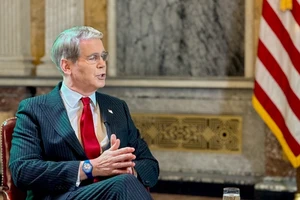
Speaking to Fox News, Bessent predicted that Iran's rial would lose 25% of its value between March 2026 and March 2027, comparing the pace of the decline with the economic turmoil that followed the Soviet Union's collapse.
"To put that in perspective, the Russian economy went down 22% over three years when the Soviet Union collapsed," Bessent said. "So this is one of the fastest collapses in history."
Bessent argued that the deteriorating conditions were putting increasing pressure on Iran's political and military establishment, even as senior officials remained insulated from the consequences.
"A lot of the leadership, they're like rats in a sewer pipe," he said. "They are in underground bunkers, and they don't see how bad it is up top."
He also said US restrictions had severely limited Iranian officials' ability to travel abroad.
"And we have them completely isolated. We have an airline quarantined," Bessent said.
"They can't fly to London to see their family, Paris to see their girlfriends, Geneva to visit their money."
Bessent suggested that the economic pressure was beginning to cause concern within the Islamic Republic's leadership.
"We could see from the public statements, the public statements from the politicians began in the summer. Now we're seeing the IRGC get worried," he said, referring to Iran's Revolutionary Guards.
US expands blockade to target Iran's land routes
Bessent's remarks came just over a week after the US military announced Task Force Iron Gate, an initiative designed to expand Washington's economic pressure campaign beyond its existing naval blockade.
Announced by US Central Command on November 7, the task force aims to disrupt the movement of advanced weapons, dual-use technologies, sanctioned materials and illicit revenue across Iran's land borders and the Caspian Sea.
The 20-member team, based in Tampa, Florida, will coordinate with US government agencies to restrict Tehran's access to military supplies and financial resources.
"The establishment of Task Force Iron Gate reinforces the success of our ironclad blockade against Iran at sea," CENTCOM commander Admiral Brad Cooper said.
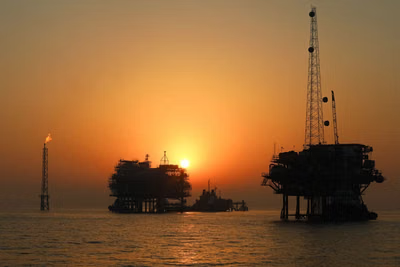
The US military said its naval blockade had prevented Iran from exporting more than $25 billion worth of crude oil, an estimate that could not be independently verified.
President Donald Trump declared the new task force operational on November 8, saying it would further restrict Iran's access to international trade.
"Task Force Iron Gate is in full force and effect in the Islamic Republic of Iran," Trump wrote on Truth Social. "Coupled with history's greatest Naval Blockade, very little gets into, or out of, Iran!"
Pence says ending military campaign was a mistake
Former Vice President Mike Pence said on Sunday that the United States had halted its military campaign against Iran too soon and disputed Vice President JD Vance's assessment of why Republicans suffered losses in the midterm elections.
"Vice President Vance is wrong," Pence said on NBC's Meet the Press.
Pence argued that American forces had achieved substantial military successes during Operation Epic Fury, including destroying much of Iran's navy, establishing air superiority and attacking thousands of military targets.
He criticized the administration's decision to suspend operations after five weeks, describing the move as an embrace of the "politics of appeasement."
"There's an old saying that you don't make peace with your enemy, you make peace with your defeated enemy," he said.
Pence pointed to continued Iranian military activity in the Persian Gulf as evidence that Tehran remained willing to confront Washington.
Vance has attributed Republican electoral losses to the Iran war and its economic consequences, including higher fuel prices. President Donald Trump, meanwhile, said on Thursday that Washington no longer needed a deal with Tehran and directed Vance to shift his attention from Iran diplomacy to domestic corruption investigations.
Bahrain reports fresh attacks as Iran vows retaliation
The dispute over Washington's strategy came as Bahrain reported intercepting further Iranian aerial attacks on Sunday, highlighting the continuing risk of military escalation despite the suspension of large-scale US strikes.
Bahrain's military said its air defenses destroyed several aerial threats before they reached their targets, following the interception of two drones Friday.
The country's Foreign Ministry condemned the attacks as violations of its sovereignty and urged the UN Security Council to take action against Tehran.
"These attacks constitute a blatant aggression against Bahrain's sovereignty and territorial integrity," the ministry said.
Iranian Foreign Ministry spokesperson Esmaeil Baghaei, asked about the strikes, said Tehran would continue responding to attacks against it.
"We have previously said that we will not leave any attack unanswered, and we will continue this approach from now on," Baghaei said on Sunday.