Russia's Rosatom says it will increase staff at Iran's Bushehr nuclear plant in November
Russia's state nuclear corporation Rosatom plans to increase the number of construction workers at Iran's Bushehr nuclear power plant to 200 in November, as it seeks to restore staffing levels after evacuations during the US-Israeli war on Iran.
Rosatom chief Alexei Likhachev said on Wednesday that the workforce would reach the level needed to keep construction on schedule in early 2027.
"Of course, a possible escalation in the military situation could have an impact. We are preparing for that, but for now we are proceeding on the basis of an optimistic scenario," Likhachev told reporters.
Rosatom evacuated hundreds of workers from Bushehr, Iran's only operating nuclear power plant, after the US and Israel launched their war against Iran in February.
The Russian company is building two additional nuclear reactor units at the site.
Iranian President Masoud Pezeshkian meets Qatar’s Emir Sheikh Tamim bin Hamad Al Thani on the sidelines of the 8th Gas Exporting Countries Forum summit in Moscow, October 27, 2026.
A senior Iranian official said on Wednesday that Qatar had presented Tehran with ideas that were unacceptable rather than a new peace proposal, casting doubt on diplomatic efforts to end the US-Israeli war on Iran as Washington weighs further military action.
The unnamed official told Reuters that Tehran would show no flexibility on the nuclear issue, a key point of dispute in efforts to reach an agreement.
The remarks came hours after Reuters cited another unnamed official briefed on the negotiations as saying that Qatari mediators had presented Iran with a new draft agreement in Tehran on Sunday, with a response expected by the end of the week.
Qatar pushes seven-day agreement
According to the official briefed on the negotiations, the draft sets out a seven-day timeline to address concerns on both sides, requiring each side to take daily confidence-building steps.
The process could begin early next week, while several countries would act as guarantors of the agreement. The official also said there had been concerns ahead of Sunday's meeting in Tehran that Israeli Prime Minister Benjamin Netanyahu could resume attacks on Iran this week.
US President Donald Trump on Wednesday declined to rule out further strikes on Iran after the November 3 US midterm elections, saying "anything is possible."
"I can't tell you that," Trump told reporters at Joint Base Andrews in Maryland when asked whether he planned to attack Iran after the elections. "But anything is possible."
Trump said Iran wanted an agreement and might be waiting until after the elections, but warned that delaying a deal "is not going to help."
"We've decimated their military. We've decimated the finances. They have no money. They have inflation the highest in the world, 300 percent. The government is gone. But we'll see what happens," Trump said.
His remarks came as the Wall Street Journal reported that Washington had warned several Arab states in the Persian Gulf to prepare for a possible short, intense military campaign against Iran after the elections.
US and Israel prepare for possible strikes
The United States has sent warnings through diplomatic and military channels as Washington and Israel prepare for a possible new round of attacks aimed at weakening Tehran and pushing it toward negotiations, the Journal reported, citing people briefed on the discussions.
The US military is moving a Patriot missile defense system from Texas to strengthen regional defenses and has relocated troops from vulnerable bases in preparation for a possible escalation, according to the report.
US forces have also been replenishing munitions, while bombers and fighter jets are being prepared for potential operations.
An additional aircraft carrier strike group and a Marine expeditionary unit are expected to join roughly 20 US warships in the Middle East next month, although some vessels could rotate out, the Journal reported.
Trump has not made a final decision but is leaning toward a large-scale attack after the elections that could target Iranian infrastructure and nuclear facilities, the newspaper said, citing people familiar with his thinking.
Israel has also prepared plans and identified targets for possible strikes, while Netanyahu has pushed for renewed military action against Iran, according to the report.
The White House declined to comment on "sensitive military plans that may or may not exist," but said Trump "keeps all options on the table to ensure that Iran can never have a nuclear weapon."
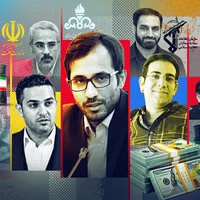
An illustration of the networks controlling Iran’s sanctioned oil trade.
Documents reviewed and information obtained by Iran International indicate that the IRGC Intelligence Organization orchestrated a quasi-coup to revive its corruption network and take control of Iran's sanctioned oil trade.
On Monday, October 26, Hossein Ghorbanzadeh, a board member of Persian Gulf Petrochemical Company and a figure close to Parliament Speaker Mohammad Bagher Ghalibaf, told Fars News Agency that the dismissal of Oil Minister Mohsen Paknejad, who left office three weeks earlier, had originally been planned for March.
He said Masoud Pezeshkian had told a cabinet meeting that Ali Khamenei, the Islamic Republic’s then-leader, had asked him to dismiss the oil minister over his inability to manage the crisis involving the trustees. However, Khamenei’s killing and the outbreak of the 40-day war delayed the change.
Shamkhani’s secret letter to Khamenei
But according to a document reviewed by Iran International, it was Ali Shamkhani, Khamenei’s political adviser, who asked him in a confidential letter to dismiss the oil minister.
In a confidential report submitted to Khamenei in late 2025, Shamkhani wrote that Pezeshkian’s government was selling oil at a discount of $6 a barrel, compared with a discount of 50 cents under Ebrahim Raisi’s government.
Khamenei’s political adviser claimed that oil sales under the current government were far below production levels and that the Oil Ministry had stopped accepting gold in exchange for oil.
A source familiar with the matter at the Oil Ministry and another at an oversight body told Iran International that the main reason for Shamkhani’s anger with the ministry was the exclusion of Hossein Shamkhani, owner of a 51-vessel “ghost fleet” used to circumvent sanctions, from sanctioned oil sales.
How the trustee network took shape
Beginning in 2018, following US President Donald Trump’s decision to withdraw from the nuclear deal and impose a policy of maximum pressure, the Islamic Republic entrusted sanctioned oil sales to the Supreme National Security Council’s so-called “Cover Committee,” which operated under Ali Shamkhani’s supervision. The justification was to prevent the emergence of major debtors such as Babak Zanjani.
Representatives of the IRGC Intelligence Organization were supposed to work alongside Intelligence Ministry representatives on the committee to prevent corruption in sanctioned oil sales. The committee decided which oil shipments would be entrusted to the government’s trusted oil brokers, known as trustees.
The key decision-makers were Shamkhani and Mohammad Javad Bavand, the IRGC Intelligence Organization’s representative on the committee. Bavand served as deputy head of the organization’s economic directorate under Mostafa Ahadi, sources familiar with the matter told Iran International.
Their decisions made Hossein Shamkhani one of the main trustees handling Iranian oil sales, among intermediaries who failed to return hundreds of millions of dollars in oil proceeds.
According to a confidential document reviewed exclusively by Iran International, a unit of the IRGC Intelligence Organization wrote to Tehran’s revolutionary prosecutor in 2021, requesting the arrest of Ali Akbar Pour-Ebrahim, then managing director of the Oil Trading Company, and a ban on his leaving the country. The large volume of customers’ outstanding debts and the creation of preferential arrangements for trustees were among the issues raised against him.
After Ebrahim Raisi took office, Bavand became a special aide to then-Oil Minister Javad Owji, while Mostafa Ahadi took charge of the Supreme National Security Council's economic directorate, helping maintain the IRGC Intelligence network's role in oil sales.
In an interview with the Iranian Labour News Agency, Ali Akbar Pour-Ebrahim confirmed that trustees had failed to return $11 billion in oil revenues during this period.
But after Masoud Pezeshkian won the election in 2024, Bavand was removed, and the oil minister handed oil sales to another security network: an Intelligence Ministry corruption network headed by a man known as Shayan, the ministry’s former director general for petroleum products.
IRGC Intelligence moves against the new oil-sales network
Starting in October 2025, after trustees failed to return a substantial portion of oil revenues, the IRGC Intelligence Organization, working with Ali Shamkhani and Mohammad Javad Bavand, also blamed the Pezeshkian government’s Oil Ministry for $11 billion in missing proceeds dating from Raisi’s presidency, two informed sources told Iran International.
IRGC Intelligence then infiltrated Shayan’s network by pressuring Mohammad Hadi Momenin, a former IRGC trustee who had since joined it, according to a source at an oversight body. Momenin was detained for a period but released after cooperating with IRGC Intelligence and subsequently went to China.
The Revolutionary Guards sought to conceal the identities of several key members of the Oil Ministry network who were relatives of senior Islamic Republic officials.
However, Iran International reported in an exclusive investigation that a child of current Supreme National Security Council Secretary Mohsen Rezaei, as well as the son and son-in-law of two former intelligence ministers, were among the trustees who had failed to return $11 billion in oil revenues.
Paknejad seeks a lifeline; Bavand steps in
Oil Minister Mohsen Paknejad faced pressure to leave office over the scale of the corruption. He brought Mohammad Javad Bavand back to the Oil Ministry and appointed him as his aide for oil sales on 8 June. At the same time, Mostafa Ahadi was appointed to IRGC Intelligence's Directorate 600 to control the media narrative.
In late July, Shayan was removed as director general of the Intelligence Ministry’s petroleum products unit. A month earlier, at Paknejad’s request, Hamid Bovard, managing director of the National Iranian Oil Company and the ministry’s current acting head, had appointed Ali Akbar Pour-Ebrahim as acting head of NICO.
According to a document first published by Iran International, Bavand and Pour-Ebrahim entrusted the sale of 86 million barrels of Iranian oil, at a substantial discount of $8 a barrel, to four trustees in mid-2026, all of whom had failed to return billions of dollars in oil revenues. The shipments had left the Persian Gulf during the implementation of the Islamabad memorandum of understanding. Hossein Shamkhani and Mohammad Hadi Momenin were two of those trustees. The move, according to Iran International's investigation, marked the full revival of the IRGC Intelligence-linked corruption network in oil sales.
The final step: Pour-Ebrahim returns to NICO
The final figure in the network was Ali Akbar Pour-Ebrahim, who returned as NICO's managing director after three years. Many conservatives portrayed him as a protégé of Bijan Zanganeh, the oil minister under Hassan Rouhani, and as affiliated with moderate and reformist political factions. But according to Iran International’s sources, he took charge of the Oil Trading Company at the age of 31 on the orders of IRGC Intelligence and subsequently retained the position under Raisi despite multiple corruption cases against him.
According to a confidential document obtained by Iran International, he was one of the main suspects in corruption involving the barter of two oil and gas shipments with Venezuela’s government.
A General Inspection Organization report found that NICO, under Pour-Ebrahim’s management, bartered two shipments of Iranian gas condensate and crude oil worth about $3 billion with Venezuela, but more than $1 billion of the difference in the cargoes’ value was never recovered.
Another section of the report stated that Venezuela did not deliver the replacement cargoes to Iran, and the tankers that had carried gas condensate and crude oil to Caracas returned empty.
The Oil Ministry’s trustees in the deal were Mohammad Hadi Momenin, who Iran International previously reported had failed to return $2 billion in oil revenues, and Hossein Shamkhani, known as Hector.
Venezuela’s oil minister was arrested in connection with the deal, but in Iran, Pour-Ebrahim, Shamkhani and Momenin continued their work.
A suspicious ship deal and a $550 million loss
Iran International has obtained a confidential document showing that, in the spring of this year, Pour-Ebrahim submitted a report to a security agency accusing the former head of the Oil Trading Company and the Oil Ministry of negligence that led to sanctions on 12 Iranian tankers and losses of $900 million for Iran.
However, an expert assessment by the oversight body found that Pour-Ebrahim himself had ordered the purchase of the 12 vessels even though they were expected to be sanctioned. The Islamic Republic uses chartered vessels to avoid that risk. The deal resulted in a $550 million loss for Iran.
The sellers and intermediaries in the 12-vessel deal were all trustees belonging to Bavand and Pour-Ebrahim’s network. One was a Chinese national known as William, whose real name is Wang Zhijing, a 65-year-old broker sanctioned by the United States.
According to a source at the Oil Ministry and another at an oversight body, Pour-Ebrahim arranged the ship purchases with several trustees and received a substantial percentage of the deal’s value in bribes.
Iran International's investigation indicates that, following Pour-Ebrahim's return to NICO's management, he and Mohammad Javad Bavand took control of Iranian oil sales to restore the IRGC Intelligence-linked trustee network.
The quasi-coup resulted in the dismissal of an oil minister, the removal of an Intelligence Ministry director general and responsibility for sanctioned oil sales being handed to Hossein Shamkhani, Mohammad Hadi Momenin and other IRGC-trusted intermediaries.
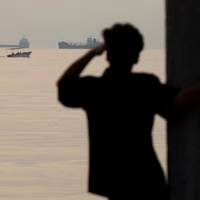
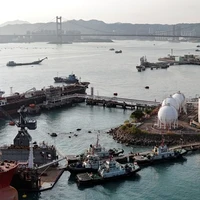
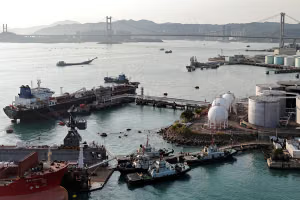
A man looks out at ships off the coast of Bandar Abbas, near the Strait of Hormuz, October 24, 2026
Iran’s budget planners are considering oil at $130 per barrel for the next Iranian year even as the conflict driving global prices higher has severely restricted Tehran’s ability to export crude.
The scenario, reported by the IRGC-linked Fars News Agency, would put the assumed price at more than twice the $55 used in the previous budget and highlights an increasingly difficult calculation for Tehran.
Plan and Budget Organization chief Hamid Pourmohammadi said Sunday that Iran’s Economic Council had approved the directive for drafting the budget for the year 1406, which begins in March 2027, and that the bill would be submitted to parliament within a month.
He did not disclose the baseline oil price the government intends to use. Fars reported separately that the PBO was considering a scenario based on oil reaching $130 per barrel.
An agreement with Washington could ease restrictions on Iranian exports but push global oil prices lower. Continued conflict could keep prices elevated while making Iranian oil even harder to sell.
A $130 scenario
Global oil prices have risen sharply since the war involving Iran, the United States and Israel and the regional conflicts that followed, climbing from around $70 to roughly $117 per barrel.
Some Iranian oil-market commentators say prices could reach $130 if the conflict continues and Tehran and Washington fail to reach an agreement.
But Iranian budgets have traditionally used more conservative oil-price assumptions to reduce the risk of revenues falling short.
Tehran’s Haft-e Sobh newspaper described the $130 figure as a “shock,” while the economic news website Faraz Energy also reported that it was under consideration.
Iran’s ability to sell crude has been severely constrained by the US naval blockade and sanctions. The higher global price therefore does not necessarily translate into higher revenues for Tehran.
Disputed export figures
Iranian officials insist that oil continues to leave the country despite US efforts to stop exports.
Mohsen Zanganeh, a member of parliament’s Planning and Budget Committee, said Iran earned more than $11.5 billion from oil during the first four months of the year and achieved 85% of its projected oil revenue.
He also claimed that Iran continued to export at least 600,000 barrels of crude per day despite the blockade and sanctions.
The US military’s Central Command presents a sharply different picture, saying its blockade of Iranian ports has prevented at least $25 billion in crude exports and that no goods other than humanitarian supplies have moved by sea.
The competing claims from parties to the conflict have not been independently verified.
Iran’s oil infrastructure has also suffered serious damage during the war, while the government has resorted to rationing and other austerity measures to curb domestic energy consumption.
Risk of a shortfall
Hossein Selahvarzi, a former head of Iran’s Chamber of Commerce, warned in comments published by the economic daily Donya-ye Eghtesad that the greatest danger would be to prepare the 1406 budget as though Iran were facing a normal year.
Such an approach, he argued, could combine optimistic revenue forecasts with existing spending commitments, producing a deficit that would fuel inflation and discourage investment.
The uncertainty surrounding both prices and export volumes makes the eventual assumptions particularly important.
If $130 becomes the government’s baseline rather than merely one scenario, and either prices or export volumes fall short, Tehran would have to find other ways to close the revenue gap.
Those could include borrowing from the National Development Fund, selling government bonds or relying indirectly on financing from the Central Bank—measures that could add to inflationary pressure and further weaken the rial.
The government has yet to disclose which oil price or export volume it will ultimately use. But the $130 scenario illustrates the unusual calculation facing Tehran: the conflict that has made oil more valuable has also made Iran’s considerably harder to sell.
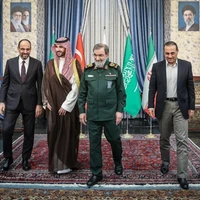
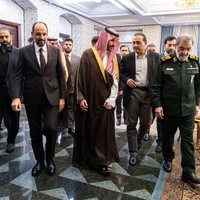
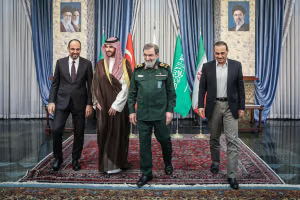
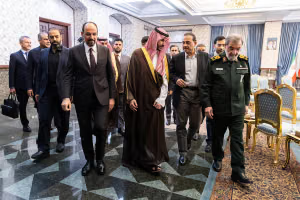
Turkish intelligence chief Ibrahim Kalin, Saudi Defense Minister Prince Khalid bin Salman, Iran’s Supreme National Security Council Secretary Mohsen Rezaei, and Pakistan’s Chief of Defense Forces Field Marshal Asim Munir pose for a photograph during a meeting in Tehran, Iran, October 26, 2026. IRNA
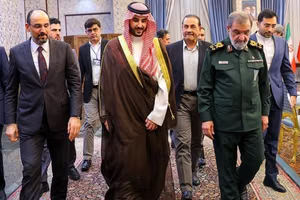
A visit to Tehran by senior Saudi, Turkish and Pakistani officials has exposed divisions among Iranian commentators, with some hailing it as recognition of Iran's influence and others warning that the visitors may be seeking concessions over Yemen and in talks with Washington.
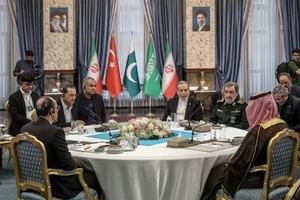
The four-way meeting ended with a cautious statement committing the participants to continued dialogue on regional peace and security, without announcing specific agreements on the war involving Iran, the United States and Israel, the Strait of Hormuz or Iran's nuclear program.
Reuters reported, citing a Pakistani official, that Pakistan's army chief, Asim Munir, had presented Tehran with a proposal to end hostilities that had the approval of US President Donald Trump.
According to the official cited by Reuters, Pakistan, Turkey, Saudi Arabia and Qatar would act as guarantors if Iran accepted the proposal.
The prospect of regional powers helping broker an agreement has raised a question among Iranian commentators: whether the visitors came to offer Tehran a way out of the confrontation or to press it into concessions.
Recognition or pressure?
The state-run Iran newspaper chose the headline "Without Iran, Never" for its Tuesday report on the meeting, arguing that the presence of senior officials from three major regional powers demonstrated that no regional security order could be established without Tehran.
Abdollah Ganji, a hardline commentator and former editor of the IRGC-affiliated Javan newspaper, went further, describing Iran as the center of an emerging regional security arrangement.
"Iran is the axis of security creation in West Asia," he wrote on X, adding that a new "anti-Zionist bloc" was taking shape.
Former Foreign Minister Mohammad Javad Zarif proposed a broader West Asian security network based on non-aggression, confidence-building and shared prosperity.
"Regional security cannot be imported; it must be built together by the people of this region," he wrote.
But many hardliners were considerably less enthusiastic.
"It is far too early to judge the results of this meeting, but it does not seem that trust has replaced mistrust or cooperation has replaced competition," hardline commentator Mostafa Najafi wrote on X.
"In today's Middle East, meetings are more about managing crises and tensions, or avoiding their consequences, than resolving them."
Heshmatollah Falahatpisheh, a former chairman of parliament's National Security and Foreign Policy Committee, argued that Yemen remained a more immediate concern for the visiting countries than Iran's confrontation with Washington.
"As long as the Yemen issue remains unresolved, the Iran issue will not be put on the agenda," he told Khabar Online.
Yemen at the heart of the mistrust
The Houthis' attacks on Saudi Arabia and regional shipping have made Yemen a major security concern for Riyadh. But Tehran's relationship with the group is also regarded by hardliners as an important source of Iranian influence.
Hossein Shariatmadari, managing editor of the hardline Kayhan newspaper, questioned the purpose of the meeting in a commentary titled "Tehran Summit: Water or Mirage?"
He warned that cooperation with countries involved in the Mecca defense pact could lead to pressure on Iran to distance itself from the Houthis, insisting that Tehran would not abandon the group.
Hardline lawmaker Mahmoud Nabavian portrayed Saudi Arabia's difficulties in confronting the Houthis as a reason for Riyadh's participation in the talks.
"Let the Saudis know that as long as the unjust blockade against the oppressed people of Yemen continues, Ansar Allah's attacks will continue, and assistance from other countries will be of no benefit to them," he wrote on X, using the Houthis' official name.
Hardline journalist Fereshteh Sadeghi was equally suspicious, interpreting the visit as an attempt to warn Tehran over Yemen.
"Iran would have to be foolish to accept their words and warnings," she wrote, arguing that the Houthis would continue acting independently even if Tehran came under pressure.
The disagreement illustrates a central obstacle to regional diplomacy: measures Saudi Arabia might seek to protect itself from Houthi attacks could be viewed by Iranian hardliners as concessions that undermine Tehran's regional influence.
Can regional powers guarantee a deal?
Beyond Yemen, the meeting has also prompted debate over whether Saudi Arabia, Turkey, Pakistan and Qatar could help provide assurances against another US or Israeli attack on Iran.
Tehran has sought guarantees that any agreement with Washington would prevent renewed hostilities, an issue that has become central to discussions about reviving diplomacy.
Maryam Salari, diplomatic editor of the state-run Iran newspaper, argued that the possibility of regional guarantees showed that the principal issue was no longer simply what Iran might concede over its nuclear program.
"The question is not whether Iran should make concessions on the nuclear issue now," she wrote. "It is what guarantee there is that war will not break out again if it makes concessions."
She suggested that the visiting officials had come to Tehran to address that concern.
Reformist journalist Farid Modarresi also saw an opportunity for diplomacy, arguing that Saudi Arabia and Turkey could bring greater regional influence to mediation efforts previously led by Pakistan and Qatar.
But the contrasting reactions among Iranian hardliners show how difficult that effort could prove.
For some Iranian hardliners, the visit signals recognition of Tehran's regional influence. For others, it raises the prospect of being asked to surrender some of that influence in exchange for peace.
Court sketch from Woolwich Crown Court. Credit: SWNS/Julia Quenzler
Two men accused of assisting Iranian intelligence knowingly helped prepare attacks on Iran International journalists, a prosecutor told a London court on Tuesday, citing photographs and videos of addresses linked to them.
At Woolwich Crown Court, prosecutors alleged that Shapoor Qalehali Khani Noori, 57, and Farhad Javadi Manesh, 46, knowingly assisted Mostafa Sepahvand, 41, in targeting Iran International journalists Mojtaba Pourmohsen and Kambiz Hosseini.
All three defendants deny the charges brought under Britain's National Security Act. Prosecutors allege they gathered information for Iranian intelligence to prepare for serious violence against at least one target, with Sepahvand expected to carry out an attack.
Prosecutor Bill Emlyn Jones accused Noori of being a trusted member of Sepahvand's surveillance team, citing photographs, messages and mobile phone location data. Noori denied knowingly participating in the alleged plot, saying he had taken photographs and videos at Sepahvand's request without understanding their purpose.
Late-night filming and repeated visits
Jones questioned Noori about a video filmed on St Dunstan's Avenue, an address linked to Hosseini, and sent to Sepahvand via WhatsApp at 11:56 p.m. on December 12, 2024.
Noori acknowledged taking the video but said they had gone for a drive because they were bored. He said Sepahvand asked him to film near a park, send the recording and delete it.
Jones challenged that account, suggesting the camera had deliberately focused on a particular house rather than randomly filming the area.
The prosecutor also cited phone and vehicle location data indicating repeated visits to the Malthouse Court area, linked to Pourmohsen, arguing that the movements were part of coordinated surveillance.
Noori said he did not know the significance of the locations and believed the recordings might have been connected to Sepahvand's business activities.
Jones also questioned him about four videos recorded over more than three hours in Kingston upon Thames on March 4, 2025, near premises associated with a business called Need a Fixer.
The prosecutor cited messages discussing recordings at hourly intervals to demonstrate Sepahvand's presence at a location, suggesting Noori knowingly participated in reconnaissance intended to help identify and ultimately attack targets.
Noori denied the allegation, saying he had never suspected Sepahvand of planning violence.
Prosecutor challenges Noori over police interviews
Jones questioned why Noori had not identified Sepahvand as a friend or explained the recordings during police interviews following his arrest in May 2025.
The prosecutor suggested Noori had remained silent because he had not yet developed an innocent explanation for his activities.
Noori said he had followed his solicitor's advice and was distressed by accusations that he had assisted a government he had fled.
He told the court he had been imprisoned three times in Iran and fled the country in 2019 because he feared for his life. During questioning by his defense lawyer, the court heard that Noori was granted asylum in Britain in 2024.
Earlier hearing examined £150,000 payment for alleged attack
During Monday's hearing, prosecutors challenged Sepahvand's claim that he had been deceiving the Revolutionary Guards, arguing that he was motivated by money and assistance with a criminal case in Iran.
Sepahvand acknowledged that a proposed £150,000 payment was conditional on harming a journalist but maintained that he demanded the sum to deter the IRGC and never intended to carry out an attack.
Noori and Javadi Manesh accept visiting locations and taking photographs or videos but deny knowing they were assisting Iranian intelligence.