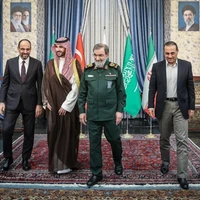
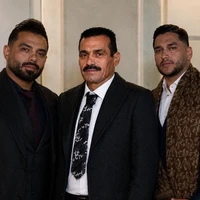
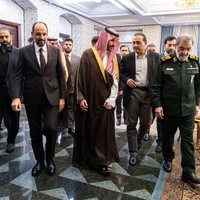
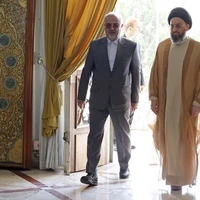
The four-way meeting ended with a cautious statement committing the participants to continued dialogue on regional peace and security, without announcing specific agreements on the war involving Iran, the United States and Israel, the Strait of Hormuz or Iran's nuclear program.
Reuters reported, citing a Pakistani official, that Pakistan's army chief, Asim Munir, had presented Tehran with a proposal to end hostilities that had the approval of US President Donald Trump.
According to the official cited by Reuters, Pakistan, Turkey, Saudi Arabia and Qatar would act as guarantors if Iran accepted the proposal.
The prospect of regional powers helping broker an agreement has raised a question among Iranian commentators: whether the visitors came to offer Tehran a way out of the confrontation or to press it into concessions.
Recognition or pressure?
The state-run Iran newspaper chose the headline "Without Iran, Never" for its Tuesday report on the meeting, arguing that the presence of senior officials from three major regional powers demonstrated that no regional security order could be established without Tehran.
Abdollah Ganji, a hardline commentator and former editor of the IRGC-affiliated Javan newspaper, went further, describing Iran as the center of an emerging regional security arrangement.
"Iran is the axis of security creation in West Asia," he wrote on X, adding that a new "anti-Zionist bloc" was taking shape.
Former Foreign Minister Mohammad Javad Zarif proposed a broader West Asian security network based on non-aggression, confidence-building and shared prosperity.
"Regional security cannot be imported; it must be built together by the people of this region," he wrote.
But many hardliners were considerably less enthusiastic.
"It is far too early to judge the results of this meeting, but it does not seem that trust has replaced mistrust or cooperation has replaced competition," hardline commentator Mostafa Najafi wrote on X.
"In today's Middle East, meetings are more about managing crises and tensions, or avoiding their consequences, than resolving them."
Heshmatollah Falahatpisheh, a former chairman of parliament's National Security and Foreign Policy Committee, argued that Yemen remained a more immediate concern for the visiting countries than Iran's confrontation with Washington.
"As long as the Yemen issue remains unresolved, the Iran issue will not be put on the agenda," he told Khabar Online.
Yemen at the heart of the mistrust
The Houthis' attacks on Saudi Arabia and regional shipping have made Yemen a major security concern for Riyadh. But Tehran's relationship with the group is also regarded by hardliners as an important source of Iranian influence.
Hossein Shariatmadari, managing editor of the hardline Kayhan newspaper, questioned the purpose of the meeting in a commentary titled "Tehran Summit: Water or Mirage?"
He warned that cooperation with countries involved in the Mecca defense pact could lead to pressure on Iran to distance itself from the Houthis, insisting that Tehran would not abandon the group.
Hardline lawmaker Mahmoud Nabavian portrayed Saudi Arabia's difficulties in confronting the Houthis as a reason for Riyadh's participation in the talks.
"Let the Saudis know that as long as the unjust blockade against the oppressed people of Yemen continues, Ansar Allah's attacks will continue, and assistance from other countries will be of no benefit to them," he wrote on X, using the Houthis' official name.
Hardline journalist Fereshteh Sadeghi was equally suspicious, interpreting the visit as an attempt to warn Tehran over Yemen.
"Iran would have to be foolish to accept their words and warnings," she wrote, arguing that the Houthis would continue acting independently even if Tehran came under pressure.
The disagreement illustrates a central obstacle to regional diplomacy: measures Saudi Arabia might seek to protect itself from Houthi attacks could be viewed by Iranian hardliners as concessions that undermine Tehran's regional influence.
Can regional powers guarantee a deal?
Beyond Yemen, the meeting has also prompted debate over whether Saudi Arabia, Turkey, Pakistan and Qatar could help provide assurances against another US or Israeli attack on Iran.
Tehran has sought guarantees that any agreement with Washington would prevent renewed hostilities, an issue that has become central to discussions about reviving diplomacy.
Maryam Salari, diplomatic editor of the state-run Iran newspaper, argued that the possibility of regional guarantees showed that the principal issue was no longer simply what Iran might concede over its nuclear program.
"The question is not whether Iran should make concessions on the nuclear issue now," she wrote. "It is what guarantee there is that war will not break out again if it makes concessions."
She suggested that the visiting officials had come to Tehran to address that concern.
Reformist journalist Farid Modarresi also saw an opportunity for diplomacy, arguing that Saudi Arabia and Turkey could bring greater regional influence to mediation efforts previously led by Pakistan and Qatar.
But the contrasting reactions among Iranian hardliners show how difficult that effort could prove.
For some Iranian hardliners, the visit signals recognition of Tehran's regional influence. For others, it raises the prospect of being asked to surrender some of that influence in exchange for peace.