Lithuania says two citizens detained in Iran

Two Lithuanian women reported missing earlier this month have been detained in Iran, Lithuania’s Foreign Ministry said on Tuesday, according to LRT, the country’s public broadcaster.
Two Lithuanian women reported missing earlier this month have been detained in Iran, Lithuania’s Foreign Ministry said on Tuesday, according to LRT, the country’s public broadcaster.
LRT’s report was based on reporting by the Baltic News Service (BNS).
“The Ministry of Foreign Affairs received official information from Iran on October 26 regarding the detention of Lithuanian citizens,” the ministry told BNS.
The ministry did not disclose the reason for the detentions but said it was working to provide the women with consular assistance.
Lithuanian police had been searching for Daiva Zakažauskaitė, born in 1992, and Erika Šlimaitė, born in 1983, after relatives lost contact with them on October 11. The women had travelled to Iran from Turkey for tourism, according to LRT.
Prime Minister Mindaugas Sinkevičius said diplomatic efforts were under way to secure their release.
“Active diplomatic work is currently under way to clarify the situation and secure the release of our citizens,” he said.
Sinkevičius said he had additional information about the grounds for their detention but would not make it public, saying doing so could undermine efforts to secure their release.
Iran has detained a number of foreign and dual nationals in recent years, often in cases involving national security or espionage accusations. UN experts and some Western governments have criticized Iran over the detention of foreign and dual nationals, while Tehran has rejected accusations that it detains foreigners for political leverage.








Iran could lose up to 1.4 million jobs this year if its economy contracts by seven to eight percent, a senior Labor Ministry official said on Tuesday, estimating that around 2.5 million people are already unemployed.
Malek Hosseini, deputy minister for entrepreneurship and employment development, said Iran's economy contracted by 10 percent excluding oil and 4.6 percent including oil in the spring, citing official figures in an interview with labor-focused ILNA news agency.
According to two decades of Labor Ministry research, every one-percentage-point decline in economic growth corresponds to an average loss of 170,000 jobs, Hosseini said.
“If negative growth of seven to eight percent is recorded by the end of the year, around 1.2 million to 1.4 million people will have completely left the labor market” over the course of the year, he said.
The warning follows remarks by Ali Babaei Karnami, head of parliament's Social Affairs Committee, who said on October 23 that more than 1.7 million Iranian workers had lost their jobs since the start of the 12-day war.
Economist Ahmad Alavi told Iran International on October 18 that poverty, unemployment and declining purchasing power had existed before the war but had since worsened, attributing the country's economic difficulties to the Islamic Republic's policies.
More than one million leave insurance rolls
Around 1.15 million people were removed from Iran's compulsory social insurance rolls between March and August, although further analysis is needed to distinguish retirements, disabilities and new registrations, Hosseini said.
Another 300,000 people joined the unemployment benefits system by the end of August.
Iran's formal labor market recorded a net loss of approximately 500,000 workers during the Iranian year ending March 2026, according to Hosseini.
The official estimated that informal employment accounts for 54 percent of Iran's workforce, compared with 46 percent in formal employment.
“Our labor market suffers from chronic and structural problems,” Hosseini said, adding that the balance had shifted further toward informal and underemployed work since the war.
Government proposes jobs without insurance coverage
The Labor Ministry is developing a public employment program for unemployed people and informal workers affected by the economic crisis, offering short-term construction and service-sector work.
“There is absolutely no social security insurance under the public employment program,” Hosseini said.
Participants will also fall outside the protections of Iran's labor law, although existing employers and workers in registered businesses will remain subject to those regulations.
Hosseini said the ministry was working with the Central Bank to identify informal workers through banking transactions, distinguishing wage income from investment returns.
The official also warned that if raw materials are not adequately supplied, Iran's garment production and distribution chain could suffer losses equivalent to about 60 percent of its pre-war workforce, potentially affecting up to 750,000 jobs.
Workers, retirees and employees across Iran have repeatedly staged protests in recent months over low wages, unpaid salaries, rising living costs, dismissals and job insecurity.
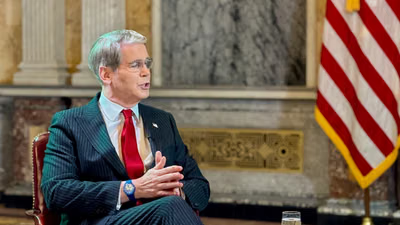
US Treasury Secretary Scott Bessent's advice to stop paying taxes and stockpile fuel drew mixed reactions on Iran International's Instagram page, with commenters debating its practicality and the role of public resistance against the Islamic Republic.
The responses followed Bessent's interview with Iran International, in which he urged Iranians to prepare for severe fuel shortages and forecast a contraction of more than 25 percent in the country's economy in the year ending March 2027.
“My advice to the Iranian people would be: don't pay your taxes because you're not going to get anything back from the government,” Bessent told Iran International's Kambiz Tavana on Monday.
Bessent also urged households to stock up on heating fuel and fill their gasoline tanks, warning that Washington's Operation Economic Outcast would intensify over the next eight weeks.
The interview prompted a discussion among Iranians commenting on Iran International's Instagram post, with responses ranging from support for economic noncooperation to questions about how individuals could implement the recommendations.
Tax boycott prompts questions over implementation
Several commenters pointed out that income taxes are deducted automatically from salaries, leaving employees with little control over whether they pay them.
“We don't voluntarily pay taxes; they take them from us. Other deductions are made too, and whatever salary remains is paid late,” one commenter wrote.
Others noted that taxes are also included in the prices of goods and services, making them difficult to avoid through individual action.
“To avoid paying taxes, we'd have to stop eating because they're built into essentials. We'd starve if we didn't pay. And what fuel are we supposed to store, and how?” another wrote.
Some business owners and other respondents raised concerns about the consequences of withholding taxes, including potential restrictions on bank accounts and payment terminals.
“If you fail to pay taxes, your card terminal and bank accounts can be blocked. A shopkeeper's livelihood depends on them. We know this route; if it worked, we'd have tried it. Why not listen to people about practical solutions?”
Others questioned how much a boycott of individual tax payments would affect the Islamic Republic's finances.
Fuel recommendations draw questions
Bessent's recommendation to stockpile gasoline and heating fuel also generated discussion about household infrastructure, storage capacity and costs.
Several commenters noted that many Iranian homes use piped natural gas for heating and hot water, rather than fuel that can easily be stored.
“Where am I supposed to store fuel? I live in a 74-square-metre apartment with no balcony or storage. There's barely room for me. Even if I had fuel, how would I use it in my gas heating system?”
Another asked how households could prepare for shortages of piped gas or gasoline.
“How exactly should we stockpile fuel? How can we store the piped gas supplied to our homes, or gasoline for our cars?”
Financial considerations were another recurring theme, with some respondents describing difficulties setting aside money for additional supplies.
“A week after my salary arrives, only a small portion remains in my account, and I have to live on that until the end of the month. How am I supposed to stockpile fuel?” one wrote.
Others responded with humor, including suggestions about filling balloons with gas or storing kerosene in apartments.
Some urge collective action against the Islamic Republic
Not all responses focused on the practical challenges. Some supported Bessent's broader message, arguing that Iranians should take an active role in increasing economic pressure on the Islamic Republic.
“People of Iran, we should act too; we cannot expect the US to do everything. Let's start by not paying water, electricity and gas bills, and shopkeepers should withhold taxes.”
The suggestion also prompted questions about possible consequences, including the disconnection of essential services for nonpayment.
Others raised concerns about the wider impact of Washington's pressure campaign, including the possibility of military action and its consequences for civilians.
“Are Iranians supposed to do everything – take to the streets, risk their families and lives – only for the US to bomb Iran, divide its territory and take its oil? Ordinary Iranians would be worse off,” one commenter wrote.
Bessent said the US campaign was intended to pressure Iran's leadership rather than its population, forecasting further economic deterioration and serious fuel shortages this winter.
Talks involving Saudi Arabia and its defense partners in Tehran may offer a final diplomatic opportunity before a collective military response, a regional affairs analyst said Monday, amid attacks on Saudi territory and threats of renewed US-Iran fighting.
Mohamed Fahmy, a journalist and regional affairs analyst, described the visit as an exercise in "coercive diplomacy," arguing that the alliance was combining negotiations with preparations for a possible military response.
"This may be the last chance before a collective imminent military action," he told Iran International.
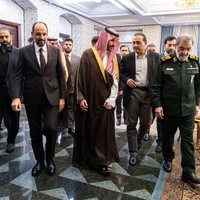
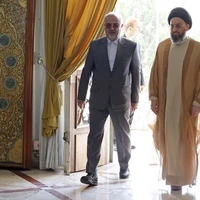
Saudi Defense Minister Khalid bin Salman, Pakistani army chief Asim Munir and Turkish intelligence chief Ibrahim Kalin met Iranian President Masoud Pezeshkian and Supreme National Security Council Secretary Mohsen Rezaei, with Rezaei hosting the four-way talks.
Riyadh said the visit by representatives of the Mecca Joint Defense Agreement was part of efforts to reduce tensions and promote dialogue.
The attacks on Saudi Arabia have presented the first major test of the agreement, signed by Saudi Arabia, Turkey and Pakistan in August, which pledges collective action when a member comes under attack.
Iranian state television reported that the four countries agreed to continue discussions on regional peace and security. No agreement to halt the Houthi attacks was announced.
The talks also unfolded against renewed threats of military action between Washington and Tehran. President Donald Trump has kept open the possibility of renewed strikes, while Iranian officials have warned of retaliation.
"The main objective is pressure," Fahmy said.
He said Saudi Arabia and its partners were attempting to exhaust diplomatic options while demonstrating that continued Houthi attacks could bring a collective response.
Professor Saad bin Tefla al-Ajmi, a former Kuwaiti information minister, told Iran International that the seniority of the delegation demonstrated the lengths to which Iran's neighbors were prepared to go to prevent another war.
He described the visit as an extraordinary diplomatic effort to prevent renewed hostilities, but said it could be interpreted in sharply different ways within Tehran, either as evidence of Iranian strength or as an opportunity to pursue a diplomatic settlement.
Iranian hardliners, he said, could portray the arrival of senior Saudi, Turkish and Pakistani officials as evidence that the Islamic Republic had gained the upper hand, forcing its neighbors to seek accommodation on Iranian territory.
A more pragmatic interpretation would see the visit as an opportunity for Tehran to demonstrate a willingness to cooperate with neighboring countries and pursue a diplomatic settlement, while portraying Washington and Israel as responsible if negotiations failed.
"It depends on whose mind you are reading in Tehran now," al-Ajmi said.
Attacks test the Mecca pact
Al-Ajmi also pointed to a hardening Saudi position toward the Houthis, arguing that Riyadh had exhausted its attempts to accommodate the group.
"I think that they have made their mind that the Houthi will have to go and they can't take it anymore," he told Iran International.
Al-Ajmi said Saudi Arabia was seeking international diplomatic and political support while demonstrating that it had been the target of aggression by the Houthis and their Iranian backers.
The urgency of the talks follows a series of deadly attacks on Saudi civilian and strategic infrastructure.
The Houthis claimed fresh attacks Monday on Saudi oil infrastructure and Riyadh airport, although Saudi authorities did not immediately confirm those claims.
The Saudi-led coalition also reported destroying Houthi missile infrastructure in Yemen, while Egypt's parliament authorized military support to help defend Saudi Arabia, potentially drawing another regional power more directly into the confrontation.
Egypt's decision, Fahmy argued, adds another dimension to the confrontation, with potential consequences for the country's already vulnerable economy.
The diplomatic effort may also involve financial concessions.
Israel Hayom reported Monday, citing unnamed Persian Gulf diplomatic sources, that Saudi Arabia was discussing a possible $1 billion payment to the Houthis through Iran as part of a ceasefire arrangement.
The Israeli newspaper said a Saudi official did not confirm any transfer but acknowledged that earlier understandings with the Houthis included financial assistance for public-sector salaries and reconstruction in exchange for an end to attacks.
Iran International could not independently verify the reported $1 billion proposal.
The possibility of a negotiated settlement comes as the Mecca pact's ability to fulfill its military commitments faces growing scrutiny.
Historian and political analyst Dr. Shahram Kholdi told Iran International that the alliance had failed to deliver the protection promised to its members.
"The Mecca Pact has effectively been a paper tiger," Kholdi said.
He argued that despite military cooperation among the three countries, Saudi Arabia remained vulnerable to Houthi missile and drone attacks.
Obstacles to a lasting settlement
Kholdi believes the delegation's principal objective is to persuade Tehran to restrain the Houthis, potentially in exchange for efforts to convince Washington to reconsider some of the conditions preventing renewed US-Iran negotiations.
He said Turkey and Pakistan were reluctant to confront the Houthis directly because of the risk of Iranian retaliation, leaving Saudi Arabia pursuing diplomacy while continuing to face attacks.
Even securing Tehran's cooperation, however, may not produce a lasting settlement.
Kholdi argued that the Houthis could demand political guarantees amounting to the effective partition of Yemen before agreeing to stop their attacks.
Such an arrangement could leave Saudi Arabia facing an entrenched hostile entity along its southern border, an outcome Riyadh has so far resisted.
Other regional diplomatic efforts have focused on the US-Iran standoff. Qatari officials visited Tehran on Sunday, while Pakistan has continued to serve as an intermediary between the United States and the Islamic Republic.
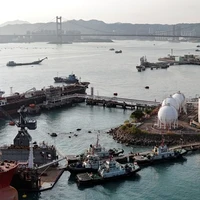
Disagreements remain over the US naval blockade of Iranian ports, access through the Strait of Hormuz and the terms of a broader settlement addressing Iran's nuclear program.
Kholdi expects the diplomatic effort could produce a temporary reduction in hostilities, but doubts it will deliver a lasting ceasefire. He warned that even a brief lull could unravel through miscalculation.
The Mecca pact was established to provide collective security. Continued attacks on Saudi Arabia are now testing that commitment while its members pursue talks with Iran.
With no announced agreement to halt the Houthi attacks and the US-Iran standoff unresolved, the risk of a military confrontation extending well beyond Yemen remains.
Two retired employees of Iran's national airline died after being forced to abandon medical treatment they could not afford, the semi-official ILNA news agency reported on Monday, citing the head of the airline's retirees' association.
Jalal Hashemi, chairman of the Iran Air Retirees Association, said the deaths occurred over the past two to three weeks amid worsening financial and healthcare problems affecting around 13,000 retirees and pensioners of the airline, also known as Homa.
"The situation has become so catastrophic that in just the past two or three weeks, two of our retired colleagues were forced to abandon treatment because they could not afford hospital expenses, and unfortunately lost their lives," Hashemi told ILNA.
Iranian households face mounting economic hardship after years of inflation, sanctions and economic mismanagement, compounded by two rounds of war with the United States and Israel.
Iran Air retirees have staged repeated protests over pension payments, healthcare coverage and the management of their retirement fund.
In August, retirees gathered outside the airline's headquarters in Tehran to demand improvements to healthcare services and the reinstatement of suspended welfare payments.
Hashemi said Iran Air had paid only two of 12 installments owed to Iran Insurance Company under its insurance contract for the Iranian year ending in March 2026, prompting the insurer to suspend inpatient hospital coverage for retirees.
According to Hashemi, Iran Air retirees receive an average monthly pension of around 270 million rials (about $100), while approximately 5,600 receive minimum pensions of just over 180 million rials (about $66).
He estimated the shortfall in the airline's healthcare insurance fund at 4 trillion rials (about $1.5 million), saying no institution had accepted responsibility for covering the deficit.
Recent reductions in government-subsidized foreign currency for medicine imports, drug price increases and rising out-of-pocket healthcare costs have further strained the fund.
Hashemi also said Iran Air management had suspended a monthly welfare allowance of 60 million rials (about $22), citing financial losses from the war and reduced flights.
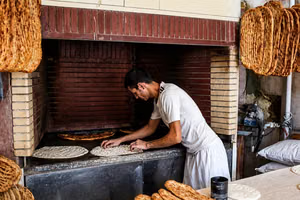
Flour shortages have forced bakeries to close in several Iranian cities and pushed up bread prices, with residents and bakers reporting disrupted supplies, falling purchasing power and growing uncertainty over their businesses.
Residents in Tabriz, Karaj, Kerman and Hamedan told Iran International that interruptions and delays in flour deliveries had disrupted independent bakeries and producers of various types of bread.
Several bakeries on a street in Tabriz have shut down, a resident said.
“I asked why, and they told me they weren't receiving flour. They keep promising that the flour quotas will be replenished today or tomorrow, but nothing happens.”
Previous reports have also documented flour shortages and bakery closures, with residents describing bread shortages and interruptions to production caused by electricity outages.
Flour supply disruptions shut bakeries and sandwich shops
Independent bakers have reported that difficulties obtaining flour have forced businesses to suspend operations.
A citizen of Hamedan in western Iran said flour shortages and rising prices had affected not only bakeries producing specialty bread but also sandwich shops.
Flour prices have risen, and suppliers are now saying there is no flour available at all, the resident said.
“Our bakery is closed because we have no flour, and nobody is taking responsibility,” a independent baker told Iran International.
The shortages have coincided with declining purchasing power, leaving bakeries struggling to secure supplies as customers struggle to afford bread.
“They don't have flour to give us, and I swear to God, people don't have money to buy bread either. Our economic situation has become critical,” another baker said.
Iran's flour distribution system distinguishes between subsidized bakeries and independent bakeries, which face different purchasing prices and supply arrangements.
Flour allocations to certain independent bakeries had been reduced, Bagher Khodadadi, head of supervision and inspection at the Khorasan Razavi provincial agriculture department, confirmed on October 21.
Khodadadi said the shortages in flour distribution had been addressed.
Bakeries reducing their operating hours because of flour shortages would be committing a violation and could face enforcement measures, he added.
Rising prices disrupt food retailers
The flour supply problems have also affected food retailers that depend on bakeries for their products, according to messages.
Two bakeries supplying bread to a supermarket in Kerman said they no longer had enough flour to continue production, the store's owner said.
“Two of the bakers who supply me called and said there was no flour left and they couldn't bake and deliver bread tomorrow. A famine has officially begun.”
A resident of Karaj also described a sharp increase in bread prices.
“I bought two baguettes and they cost 800,000 rials. The price of flour has also tripled.”
Iran International previously reported on October 8 that residents had described unannounced increases in bread prices and flour shortages in several areas.
Bread prices in Tehran province had risen by as much as 100% for certain varieties by June 23.
The increases have added to the financial pressure on households already struggling with declining purchasing power.
Uncertainty over flour quotas and pricing
The disruption has raised further questions about how flour quotas are allocated and priced for independent bakeries and producers of larger and semi-industrial bread varieties.
Flour allocations to these businesses were suspended about two weeks ago, according to another message received by Iran International.
The sender said suppliers had attributed the suspension to the government's failure to announce new flour prices, leaving bakeries uncertain about when deliveries would resume.
The resident also said certain flour mills were selling supplies on the black market without issuing invoices specifying prices.
Comments by provincial grain officials about flour allocations have added to questions over the distribution system and the availability of supplies.