Saudi Arabia is taking a harder military posture after efforts to defuse tensions with Tehran stalled. Riyadh had sought de-escalation, wary that a wider conflict could threaten the regional stability on which its economic ambitions depend.
A meeting planned for Monday between Iran and several Persian Gulf states over arrangements for the Strait of Hormuz was postponed after Saudi Arabia requested a delay, amid Riyadh’s growing frustration over attacks by Iran-aligned groups.
That leaves Riyadh with options, none of them ideal.
Saudi Arabia does not want an all-out war. But the Houthis may be testing how long the kingdom can afford to avoid one.
Saad bin Tefla Al Ajmi, Kuwait's former information minister, said Saudi Arabia has so far exercised patience but its military options remain open.
That restraint reflects what the kingdom has at stake. Saudi Arabia has spent years trying to avoid being dragged back into direct conflict with the Houthis, while its economic transformation depends heavily on regional stability.
"There is no stability, there is no development. There is no stability, there is no prosperity," Al Ajmi told Iran International.
But Houthi attacks on Saudi territory and advances along Yemen’s Red Sea coast are making that restraint increasingly difficult to maintain. The Saudi-led coalition said Houthi missile and drone attacks on Khamis Mushait, Abha and Taif on Monday injured 13 civilians.
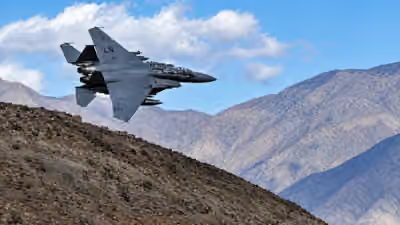
Al Ajmi believes some of the Houthis' recent territorial gains could be reversed, particularly if Saudi Arabia decides to deploy its overwhelming advantage in air power. He described Houthi forces operating along the flat Tihamah coastal plain as "sitting ducks."
Saudi Arabia led a military intervention against the Houthis beginning in 2015, with direct hostilities largely subsiding after a UN-brokered truce began in 2022. Years of bombardment failed to eliminate the movement, and Riyadh subsequently spent years trying to avoid being pulled back into a full-scale Yemen war.
The question now is whether the Houthis are pushing that restraint too far.
Houthis risk overplaying their hand
The battlefield in Yemen remains fluid. The Houthis have seized Mokha, Dhubab and Perim Island and expanded their control along Yemen’s Red Sea coast, while Saudi-backed government forces have regrouped and vowed to retake lost territory. That leaves open the question of how durable the Houthis’ gains will prove.
"The Houthis fought the Saudis and the Saudi militias for years. They also have a history of being overextended," Alberto Fernandez, a former senior US diplomat, told Iran International.
Fernandez said the Houthis may have pushed too far.
"I think we could see them lose some of the territory that they've gained," he said.
"They're arrogant. Yes, they're motivated by ideology. And when you're motivated by ideology and you're arrogant, you tend to sometimes overextend," Fernandez said.
But the Houthis are also betting on reluctance from both Saudi Arabia and the United States to become drawn more deeply into the conflict.
Saudi Arabia's attempt to remain outside the wider Iran war has already "certainly backfired on them," Fernandez said.
The uncertainty over how much the kingdom can rely on its allies only complicates its options.
Fernandez described the relationship between Washington and Riyadh as increasingly complicated. The Saudis, he said, felt blindsided by the United States launching the Iran war, while Washington in turn felt unsupported by Riyadh.
That strain has become more visible as Crown Prince Mohammed bin Salman sought direct US military action against the Houthis, while Trump declined requests for US strikes and Washington limited its support to intelligence and targeting assistance.
That uncertainty also extends to the Makkah Joint Defense Agreement, signed by Saudi Arabia, Turkey and Pakistan on August 7. The pact says an armed attack against any one of the three countries will be regarded as an attack against all.
"So far [it] has turned out to be a paper tiger," Fernandez said, joking that the arrangement appeared to have the equivalent of a health insurance "pre-existing condition clause."
Saudi Arabia looks elsewhere for help
As Washington hesitates, Saudi Arabia is looking elsewhere.
British Prime Minister Andy Burnham is considering Saudi requests for diplomatic and military support to counter the Houthis, Bloomberg reported Monday, as London grows increasingly concerned about the economic consequences of another expanding front in the Iran war.
The requests come as Britain has backed Saudi Arabia’s right to defend itself against Houthi attacks and stressed the importance of protecting freedom of navigation and global trade through the Red Sea.
The widening conflict has raised the stakes beyond Yemen. Houthi gains along the Red Sea coast and around Bab el-Mandeb, combined with attacks on Saudi energy infrastructure, are putting pressure on westward export routes that have become more important while shipping through the Strait of Hormuz remains constrained.
The Houthi offensive and attacks on Saudi energy infrastructure have added further pressure to oil markets already strained by the Iran war. Brent crude climbed above $108 a barrel Monday after attacks shut down Saudi Arabia’s East-West pipeline, a crucial alternative export route while shipping through the Strait of Hormuz remains constrained.
"It gets to push up oil prices a little more," Fernandez said.
"For them, every dollar that prices go up, for them they see that as a plus for the regime, putting a little more pressure on the Americans and the Europeans."
The paradox for Tehran is that the greater the disruption caused by the widening conflict, the stronger the incentive may become for governments outside the region to help Saudi Arabia contain the threat.
Iran does not need to control the Houthis
"The broader strategic danger is that Iran does not need to control the Houthis completely to benefit from their actions," Mohamed Fahmy, a journalist and Middle East political analyst, told Iran International.
"It only needs the movement to retain sufficient military capability, autonomy and motivation to pressure critical maritime routes while Tehran maintains distance from the confrontation."
Fahmy cautioned against reducing the Houthis to an Iranian proxy.
They are "an intensely nationalist movement with their own domestic agenda and deeply rooted local interests," he said.
Their relationship with Tehran is nevertheless exceptionally close. Iran has provided weapons, military technology, intelligence and other support, Fahmy said, while the strategic interests of the two sides increasingly converge.
That convergence has become particularly consequential around the Red Sea and Bab el-Mandeb.
"One of the Houthis' strategic objectives is to exert control over Yemen's Red Sea coast and the northern Red Sea, where they can increasingly influence who is permitted to transit and who is not," Fahmy said.
For Tehran, the Houthis therefore provide an additional source of pressure on its adversaries without requiring direct Iranian military involvement.
But Saudi Arabia's military answer is not straightforward.
Fahmy pointed to Saada, the Houthis' traditional stronghold and geographical heart of their power, which has been repeatedly targeted by Saudi forces since the intervention began in 2015. Despite years of Saudi-led bombardment and military pressure, the Houthis survived and retained significant military capabilities.
"A limited campaign of additional strikes is therefore unlikely to fundamentally diminish their ability to threaten shipping or project power across the Red Sea," Fahmy said.
That leaves Saudi Arabia confronting a difficult choice.
Continued restraint risks allowing the Houthis to impose greater costs on the kingdom and giving Tehran additional leverage. But a renewed military campaign carries risks Riyadh knows well after years of fighting failed to eliminate the movement.
Iran has gained leverage as the war reaches Saudi Arabia. But the more Houthi attacks raise the costs for Riyadh, the greater the risk that Tehran’s leverage provokes the response that ultimately erodes it.