• العربية
  • فارسی
Brand
  • Iran Insight
  • Politics
  • Economy
  • Analysis
  • Special Report
  • Opinion
  • Podcast
  • Live TV
  • Iran Insight
  • Politics
  • Economy
  • Analysis
  • Special Report
  • Opinion
  • Podcast
  • Live TV
  • Theme
  • Language
    • العربية
    • فارسی
  • Iran Insight
  • Politics
  • Economy
  • Analysis
  • Special Report
  • Opinion
  • Podcast
  • Live TV
All rights reserved for Volant Media UK Limited
volant media logo

IRGC chief says Israeli military would collapse quickly without US support

Sep 12, 2026, 10:55 GMT+1

IRGC commander Ahmad Vahidi said Israel's military would collapse in a very short time without US support.

“The Israeli army would collapse in a very short time without the support of the United States,” Vahidi said during a meeting with Iranian army commander Amir Hatami.

He added that US and Israeli officials had underestimated Iran's military capabilities during the war.

Most Viewed

Heavy fighting spreads in southeastern Iran, with security force casualties reported
1

Heavy fighting spreads in southeastern Iran, with security force casualties reported

2

Blogger sentenced to death in Iran on security-related charges

3

Mideast oil flows recover while Iran exports vanish, tracker says

4

Fall of Hezbollah heights ignites blame game in Tehran

5

Iraqi groups deny Saudi pipeline strike, say ‘would be proud if we did it’

Banner
Banner
Banner

Spotlight

  • Rushed trials, public hangings: Iran courts race to crush dissent
    INSIGHT

    Rushed trials, public hangings: Iran courts race to crush dissent

  • Israeli envoy says no victory until Islamic Republic falls

    Israeli envoy says no victory until Islamic Republic falls

  • Russia may fill Iran gap if support for Yemen Houthis falters
    ANALYSIS

    Russia may fill Iran gap if support for Yemen Houthis falters

  • Bid to oust Pezeshkian exposes rift among Iran conservatives
    INSIGHT

    Bid to oust Pezeshkian exposes rift among Iran conservatives

  • Iran’s hardliners bet on escalation as options narrow
    ANALYSIS

    Iran’s hardliners bet on escalation as options narrow

•
•
•

More Stories

Trump again tells Iranians to take their government. This time nobody blinked

Sep 12, 2026, 10:13 GMT+1
•
Negar Mojtahedi
100%
US President Donald Trump

US President Donald Trump this week repeated the boldest promise of the Iran war, that when Washington is "finished," Iranians should take over their government. In February the sentence stunned. On Wednesday it barely registered, and the silence is the story.

"To the great, proud people of Iran, the hour of your freedom is at hand," Trump says in a video posted on X, drawing on remarks he first delivered on February 28, the day the US campaign began. "When we are finished, take over your government. It will be yours to take."

Six months ago, that was an extraordinary signal from an American president at the opening of a war with the Islamic Republic. This time there was no accompanying policy, no explanation of what "when we are finished" means, and no sign that Washington is preparing to help Iranians seize anything.

"I don't think the Iranian regime is going to care," Eric Mandel, founder of the Middle East Political Information Network, told Iran International's Eye for Iran podcast, whose conversation with him forms the basis of this analysis. "I think they've heard these messages before."

A war shaped by a calendar

Trump said this week that Iran was "limping along" and predicted the conflict would end "immediately after" November's midterm elections. He also acknowledged, in the same week, that electoral considerations may be influencing decisions about whether to escalate military action against Iran.

That is an American president saying, in public, that the pace of a war is being set partly by a domestic election.

His own senior advisers appear to be planning for something very different. Vice President JD Vance, Secretary of State Marco Rubio and others have privately discussed the possibility that Tehran could withstand US pressure and that the conflict could run through the end of Trump's presidency in January 2029, according to the Wall Street Journal.

So the same week produced three incompatible timelines: freedom "at hand," an end "immediately after" the midterms, and a war that may outlast the administration. If Trump is again telling Iranians their government will soon be theirs to take, what has changed since he first said it? Mandel's answer was blunt: "I haven't heard a new policy."

The gap between the promise and the means

For Mandel, the problem is not the stated objective but the distance between the promise and any way of achieving it.

"They can't ask the Iranian people to go out again into the streets and be slaughtered," he said. The last time people came out in their millions, in January, security forces killed tens of thousands in two days.

If Washington genuinely wants the Islamic Republic to fall, Mandel argued, it would have to go far beyond encouragement: bring together Iran's fragmented opposition, finance strike funds so workers can stay home rather than face security forces in the street, tighten secondary sanctions on the countries helping Tehran evade pressure, and give material support to parts of the opposition.

"The Iranian people can't take over if they're unarmed and they are not having coordination," he said. "If we're saying to the Iranian people to take over at that point, that just doesn't make any sense to me."

The operation that lost its name

Trump's original February message came as the White House described Operation Epic Fury as an effort to destroy Iran's nuclear and missile capabilities, degrade its proxy network and cripple its navy, and tied the campaign to decades of confrontation between the two countries.

Even the name has since receded. The Pentagon said Epic Fury officially ended on May 5, and military personnel were later told to stop using it for the continuing operations against Iran. The war did not end with the name.

Nearly seven months on, oil is back above $100 a barrel, the political cost of the conflict is increasingly visible ahead of the midterms, and Trump's advisers are contemplating a far longer confrontation than the president publicly predicts. That is what makes the decision to resurrect the February message striking, and it raises the question Mandel kept returning to: who was it for?

Not Tehran, he thought, which he described as in "survival mode" and betting it can outlast the administration. Not a weary American public either. "If it is for the American people, to my mind, it's the wrong way to present this," he said.

Trump would need to explain why bringing down the Islamic Republic serves US security and why Americans should prepare for a long campaign, and he has not.

Without that, ever more dramatic language loses its force. "To the regime, it's like the boy who cried wolf," Mandel said. "He keeps saying this every month."

The video appeared deliberately produced, he noted, which makes it hard to dismiss as an impulsive post. But he could not say what new message it carried. "I don't get the message yet of what it is."

That may be why an extraordinary sentence received such an ordinary response. A US president once again told more than 90 million Iranians that their government may soon be theirs to take. What remains unclear is whether Washington was announcing an objective, offering encouragement, applying pressure, or repeating a promise the world has heard before.
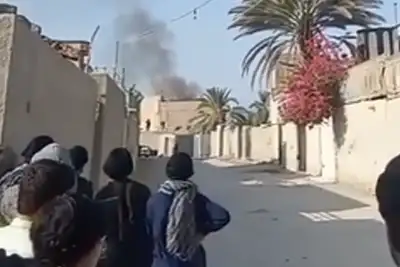

Heavy fighting spreads in southeastern Iran, with security force casualties reported

Sep 12, 2026, 09:04 GMT+1
100%
A screengrab from videos of clashes in Saravan, Sistan-Baluchestan province, September 12, 2026

Heavy fighting between Iranian security forces and unidentified gunmen spread across parts of Saravan in southeastern Iran on Saturday, with reports of attacks on military vehicles and dozens of security personnel killed or wounded, the rights group Haalvsh reported.

The clashes began around a residential property in the Bakhshan area before dawn and were still continuing nearly eight hours later, extending to the vicinity of the Madani Grand Mosque and parts of Jahadabad, according to the group’s updates.

Local sources cited by Haalvsh said gunmen attacked at least three vehicles carrying military and security personnel, as well as two locations where forces had gathered. The reported casualty figures have not been independently confirmed.

Sources described sustained gunfire, repeated explosions and the use of heavy weapons, with fighting resuming after brief pauses. Haalvsh said it had not independently established the precise locations of all the exchanges.

  • Iran's forces beat Baluch women protesting over mines and local resources

    Iran's forces beat Baluch women protesting over mines and local resources

  • Armed group claims deadly attack on Guards members in southeast Iran

    Armed group claims deadly attack on Guards members in southeast Iran

Several ambulances were reportedly stationed nearby. Local sources said wounded personnel and bodies had been removed by other security forces, with some transported by ambulance to medical facilities. The identities and exact number of those killed or wounded remained unknown.

Roads blocked around residential area

Security forces blocked streets and access routes around the Madani Grand Mosque, roughly 200 meters from the house targeted in the initial operation, local sources said. A substantial deployment remained in the area, restricting movement around the fighting.

Gunmen inside the house exchanged fire with security personnel, some of whom were wearing traditional Baluch clothing, according to the sources. The property was described as belonging to a local resident, but the reports did not establish his connection, if any, to the gunmen.

Haalvsh reported civilians close to some of the clashes. Their situation remained unclear as fighting continued and roads were blocked, with no confirmed information on civilian casualties.

The gunmen’s identities and affiliations, the reason for the initial operation and any casualties among the armed group were also unknown. Military and security authorities had not issued an official account by the time of its latest update.

Saravan is in Sistan and Baluchestan, a southeastern province bordering Pakistan and Afghanistan and home to Iran’s mainly Sunni Muslim Baluch minority. The province has a long history of armed insurgency, although the reports provided no established link between Saturday’s gunmen and any known group.

Saudi Arabia squeezed from Iraq and Yemen ahead of GCC talks with Iran

Sep 11, 2026, 22:00 GMT+1
100%
A satellite image shows black smoke rising from an area of Saudi Arabia’s East-West oil pipeline south of Medina, Hejaz Region, Saudi Arabia September 10, 2026. European Union/Copernicus Sentinel-3/Handout via REUTERS

Saudi Arabia faced growing pressure on two fronts Friday as drones launched from Iraq struck its East-West oil pipeline, prompting fresh Iraqi security measures, while Iran-aligned Houthis tightened their grip on Yemen’s Red Sea coast ahead of regional talks in Oman.

Saudi Arabia’s Foreign Ministry said several drones launched from Iraqi territory targeted the pipeline in the Riyadh and Medina regions, causing injuries and damage.

Riyadh said it had given the Iraqi government an opportunity to take sufficient measures to prevent attacks launched from its territory and had exercised restraint while Baghdad acted. It added that the kingdom reserved the right to take all necessary steps to protect its sovereignty, security and critical infrastructure.

Iraq welcomed Saudi Arabia’s decision to hold off on retaliation and condemned any attack threatening the kingdom’s security. Prime Minister Ali Falih al-Zaidi ordered an investigation into those responsible, according to a statement from the Iraqi armed forces.
Baghdad later dismissed a military commander responsible for operations in southern Maysan province after investigations confirmed that the latest drone attacks on Saudi Arabia originated from Iraq. Iraq also ordered the closure of the Shalamcheh border crossing with Iran as a precautionary measure, while security forces launched a wide-scale operation to pursue those responsible.

Saudi Arabia has not publicly identified the group behind the attack, but the incident adds to concerns over Iran-backed Shiite militias operating in Iraq and their potential role in a broader network of pressure on Iran’s regional adversaries.

Iran-aligned Iraqi factions have developed increasingly sophisticated drone and missile capabilities, while several maintain close ties with Tehran and other members of its regional network.

Houthis tighten grip on Yemen’s Red Sea coast

The pipeline strike comes as the Houthis have made major territorial gains in Yemen, expanding their control along the Red Sea coast and strengthening their position around the Bab el-Mandeb Strait, another of the Middle East’s most important shipping chokepoints.

The advance gives the Iran-backed group control over virtually all of Yemen’s Red Sea coastline, increasing its ability to threaten shipping and infrastructure along a route that has become even more important amid disruption in the Strait of Hormuz.

That poses a particular concern for Saudi Arabia.

The kingdom’s East-West pipeline carries crude from oilfields in the east to the Red Sea port of Yanbu, allowing Saudi exports to bypass the Strait of Hormuz. Any sustained threat to the pipeline or the Red Sea route could therefore squeeze Riyadh from both sides.

The Gulf Cooperation Council condemned the pipeline attack as a dangerous escalation and urged Baghdad to take “necessary, decisive measures” to prevent Iraqi territory from being used as a launchpad for further attacks. Qatar separately condemned the strike and expressed full solidarity with Saudi Arabia.

The developments come just days before foreign ministers from Iran, Iraq and Persian Gulf Arab states are expected to gather in Oman for talks focused partly on regional security and navigation through the Strait of Hormuz.

Iranian Foreign Ministry spokesman Esmail Baghaei said Iran and Oman would brief the participants on their discussions over mechanisms for safe passage through the strait.

He said the goal was to establish regional arrangements that would safeguard the shared security and interests of neighboring states without the involvement of outside powers.

Baghaei also portrayed the willingness of Arab governments to attend the meeting despite months of Iranian strikes and regional escalation as evidence that Tehran’s military power had strengthened its diplomatic position.

He said Iranian diplomacy, backed by military strength, had persuaded neighboring states that the solution to regional security was to sit down with Tehran rather than rely on foreign powers.

The meeting comes as the Trump administration is providing Saudi Arabia with intelligence and targeting assistance but has no current plans to launch direct US strikes against the Houthis, ABC News reported. Saudi Crown Prince Mohammed bin Salman sought direct US military intervention in calls with Trump, according to the report, while Riyadh has signaled it could undertake a major operation on its own.

It remains unclear whether Monday’s Oman talks will stay focused on the Strait of Hormuz or also take in the Houthis, Bab el-Mandeb and attacks from Iraq.

Israeli attacks on Hezbollah fuel hardline calls for Iran to escalate

Sep 11, 2026, 20:14 GMT+1
•
Behrouz Turani
100%
Huge fires rise over Ali al-Taher ridge in southern Lebanon following airstrikes that Israel said targeted

Iranian hardliners are demanding that Tehran abandon restraint and restore deterrence through military confrontation following the latest Israeli attack on Hezbollah sites in southern Lebanon.

On Thursday, Israel said it destroyed a major underground Hezbollah complex, adding to pressure on one of Iran’s most important regional allies, which has been severely weakened over the past two years.

Ultraconservative MP Mohammad-Taghi Naqd-Ali blamed what he called Iran’s “non-confrontational stance,” arguing that Tehran’s failure to respond more forcefully to Israeli threats had placed southern Lebanon and Hezbollah “in serious danger.”

“We must carry out a preemptive strike,” he said.

His warning reflects a broader argument among Iranian politicians and media over whether restraint reduces the risk of a wider war or instead encourages Iran’s adversaries to escalate.

The debate encompasses Tehran’s support for regional allies, its confrontation with the United States and, increasingly, its nuclear policy.

Hassan Ghashqavi, spokesperson for parliament’s National Security and Foreign Policy Committee, said on Thursday that “until Iran reaches complete and total deterrence, the probability of an attack exists at every single moment.”

The same argument has surfaced in the nuclear debate, where hardline lawmakers and commentators have called for suspending cooperation with the IAEA or even withdrawing from the Nuclear Non-Proliferation Treaty.

‘Meydan’ vs diplomacy

The dispute echoes an older fault line in Iranian politics between meydan — literally “the field,” shorthand for military power and Iran’s regional armed network — and diplomacy.

The distinction became particularly contentious during Hassan Rouhani’s presidency, when then-Foreign Minister Mohammad Javad Zarif publicly complained about diplomacy being subordinated to military priorities.

President Masoud Pezeshkian’s government has not renounced Iran’s regional alliances, and some of the sharpest disputes over military strategy now take place within the conservative establishment itself.

But the underlying argument has resurfaced: whether Iran is safer when diplomacy is accompanied by restraint, or when its adversaries believe Tehran is prepared to escalate.

The disagreement has become more consequential as Iran faces the combined pressures of war, sanctions and a weakened network of regional allies.

The Houthi example

Unlike Hezbollah, which has suffered heavy losses in its conflict with Israel, the Iran-backed Houthis in Yemen have continued to expand their military campaign and made new territorial gains in recent days around the Bab el-Mandeb Strait.

The Houthis could nevertheless bolster the hardline argument that an allied force can continue imposing costs on its adversaries rather than pulling back under military pressure.

But the comparison also exposes the risks facing Tehran. Greater Iranian identification with Houthi attacks on shipping could deepen its confrontation with the United States and regional powers at a time when Iran is already under intense military and economic pressure.

That tension goes to the heart of the disagreement over Iran’s regional network.

Hardliners have traditionally regarded Hezbollah and other allied armed groups as an outer defensive perimeter, allowing Tehran to deter or confront adversaries before threats reach Iranian territory. From that perspective, the weakening of those groups does not make disengagement more attractive but makes restoring their deterrent power more urgent.

The counterargument is that Iran’s own economic vulnerability and the danger of further regional escalation require greater restraint.

The argument has acquired greater urgency as Hezbollah comes under renewed Israeli attack while Iran itself faces direct confrontation with the United States.

Russia may fill Iran gap if support for Yemen Houthis falters

Sep 11, 2026, 17:05 GMT+1
•
Kambiz Tavana
100%
People participate in a parade after attending a Houthi military training as part of a mobilization campaign, in Sanaa, Yemen December 18, 2024

Russia could help sustain Yemen’s Houthis if Iran’s ability to support the group is weakened, providing a lifeline as the group expands its reach around a second crucial Middle Eastern shipping route, according to Anna Borshchevskaya, a senior fellow at the Washington Institute.

Borshchevskaya said Moscow has already provided intelligence and other assistance to the Iran-backed group, making the Houthis the clearest example of how Russia could help sustain parts of Tehran’s regional network if Iranian resources come under greater strain.

“With the Houthis in particular, there were reports in previous years that Russia also provided them with intelligence… details aside, it’s clear that Russia has been supporting the Houthis,” she told Iran International.

The Houthis reached the strategic island of Perim on Friday after Yemeni government forces withdrew, while the group also took the nearby mainland town of Dhubab, tightening its grip on a vital shipping route as disruption continues in the Strait of Hormuz.

Since late 2023, the group has repeatedly attacked shipping in the Red Sea, while previous reporting has indicated that Russia provided targeting data and satellite intelligence used in attacks on Western vessels.

Iran has also brokered secret talks between Russia and the Houthis over the possible transfer of advanced anti-ship missiles, while Russian actors have reportedly explored weapons sales to the group.

Asked whether Iran could effectively delegate some of the burden of sustaining its regional network to Russia if its own resources were depleted, Borshchevskaya said: “Yes, and that’s not just in Syria; that’s in other parts of the Middle East.”

She argued that Moscow could provide a lifeline without crossing what remains an important Russian red line: direct military confrontation with the United States.

“Russia would do a lot to support this regime. I don’t think they would go far enough to risk a direct military clash with the United States… But they’re not going to sit idly by either.”

A weakened network

Iran’s regional network faces some of its most severe pressure in years. The fall of Bashar al-Assad in December 2024 deprived Tehran of a key regional ally and ended its overt military presence in Syria.

Hezbollah has also suffered heavy losses in its conflict with Israel, which said on Thursday it had destroyed a major underground Hezbollah complex in southern Lebanon.

Iran itself is meanwhile under mounting military and economic pressure from the United States, raising questions about how much support it can continue to provide allied armed groups across the region.

The Houthis stand out in that landscape. Their latest offensive has brought them to the Bab el-Mandeb, on the opposite side of the Arabian Peninsula from Hormuz, potentially giving Iran and its allies leverage over another of the world’s most important maritime chokepoints.

For Borshchevskaya, Russia’s previous assistance to the group provides a model for how Moscow could help keep an Iranian ally operational even if Tehran’s own resources diminish.

“I think we can count on Russia to continue to provide this type of support to Iran—that is, support that stops short of putting Russia in a direct military confrontation with the United States.”

A broader Russia-Iran partnership

The relationship with the Houthis sits within a broader pattern of military and technical cooperation between Moscow and Tehran.

Since Russia’s invasion of Ukraine in 2022, Iran has supplied Shahed drones and production know-how to Moscow, while Russia has provided Iran with military technology and equipment.

More recently, Russia has secretly helped Iran develop supersonic cruise missile technology that could give Tehran another means of threatening US naval vessels in the Middle East.

Borshchevskaya said the partnership is driven by a broader convergence of interests, particularly their shared desire to reduce US influence.

For Moscow, she argued, the worst outcome would be an Iran that moved decisively toward the West, depriving Russia of an important partner in its wider confrontation with Washington.

That does not mean Russia would assume responsibility for Iran’s regional strategy wholesale. But it gives Moscow a strong incentive to prevent Tehran and its allies from being weakened beyond recovery.

100%

Syria shows limits—and opportunities

Syria illustrates both the limits of Iranian influence and Russia’s ability to preserve its own position after a major regional upheaval.

Iran lost its overt military presence after Assad’s fall, while Moscow has maintained relations with the government of President Ahmed al-Sharaa and negotiated to preserve a reduced Russian footprint.

“There are no Iranian bases. There are no open talks with the Iranian government the way there are with Russia,” Borshchevskaya said, while cautioning that Iran’s exclusion should not necessarily be assumed to be permanent.

Whether Moscow might eventually use its remaining position in Syria to assist Iranian-linked groups is, she said, “an open question.”

For now, the Houthis provide a more concrete test. Their advance around the Bab el-Mandeb comes as Iran is struggling to maintain pressure around Hormuz and its other regional allies face growing military pressure.

There is little evidence so far that Moscow is assuming the financial burden of Iran’s regional network wholesale. But Borshchevskaya argues that the support already provided to the Houthis offers a model for how Russia could help keep parts of that network operational if Tehran’s resources diminish.

Any such support could complicate Washington’s efforts to weaken Iran by squeezing its ability to finance and supply its regional allies.