• العربية
  • فارسی
Brand
  • Iran Insight
  • Politics
  • Economy
  • Analysis
  • Special Report
  • Opinion
  • Podcast
  • Live TV
  • Iran Insight
  • Politics
  • Economy
  • Analysis
  • Special Report
  • Opinion
  • Podcast
  • Live TV
  • Theme
  • Language
    • العربية
    • فارسی
  • Iran Insight
  • Politics
  • Economy
  • Analysis
  • Special Report
  • Opinion
  • Podcast
  • Live TV
All rights reserved for Volant Media UK Limited
volant media logo

Iran lawmaker says Oman deal depends on lifting US naval blockade

Aug 28, 2026, 17:24 GMT+1

Any agreement with Oman over the Strait of Hormuz depends on the lifting of the US naval blockade against Iran, lawmaker Esmail Kowsari said Friday, according to Didban Iran.

“If not, the strait will remain blocked and offensive actions will be carried out wherever necessary,” said Kowsari, a member of parliament’s National Security and Foreign Policy Committee.

He said the United States was not present even in the Gulf of Oman, “let alone the Persian Gulf,” adding that “the entire region is within range of Iranian missiles and drones.”

Kowsari also said US messages had reached Tehran through Qatar, Oman and Pakistan, but that Iran would move to an operational stage only after provisions 1, 4, 5, 10 and 11 of the Islamabad MoU were implemented.

Most Viewed

Iran sentences woman detained during January protests to death
1

Iran sentences woman detained during January protests to death

2

Iran's Bank Melli remains open in Germany despite sanctions

3

Man from Supreme Leader's empire takes the helm of Iran’s biggest online retailer

4
INSIGHT

Who is Abolfazl Shekarchi, the Iranian general calling journalists military targets?

5
INSIGHT

Tehran debates austerity as US targets sanctions lifelines

Banner
Banner
Banner

Spotlight

  • Iran or the dollar? US makes an example of Banque Misr
    ANALYSIS

    Iran or the dollar? US makes an example of Banque Misr

  • War or deal? Rezaei begins to define Iran’s price
    ANALYSIS

    War or deal? Rezaei begins to define Iran’s price

  • Three mediators in three days seek path back to Iran-US talks
    INSIGHT

    Three mediators in three days seek path back to Iran-US talks

  • ‘State-sponsored theft’: UN representative calls out rising seizures from Iran’s Bahá’ís

    ‘State-sponsored theft’: UN representative calls out rising seizures from Iran’s Bahá’ís

  • Will Mojtaba Khamenei's absence help the Islamic Republic survive?
    ANALYSIS

    Will Mojtaba Khamenei's absence help the Islamic Republic survive?

•
•
•

More Stories

Iranians are selling their own graves to pay for living

Aug 28, 2026, 13:58 GMT+1
•
Saman Rahmatian
100%
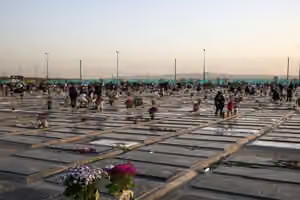
A view from Tehran's Behesht-e Zahra cemetary

Dying has become one of the costs Iranians can no longer meet. Burial plots are advertised at years of wages, families are selling the graves they had reserved for themselves, and some are taking their dead to villages where burial is still free.

A review of grave listings in Tehran found a three-tier plot in sections 39 and 72 of Behesht-e Zahra, the vast cemetery on the southern edge of the capital where Iran's war dead and the founder of the Islamic Republic are buried, offered at 30 billion rials, about $15,000. Tiered graves are stacked burials sold as a single right, allowing several family members to be interred in one plot over time.

The official 2026 tariff for reserving the same three tiers in that part of the cemetery is 3.47 billion rials, roughly $1,740. The asking price in the listings is more than eight and a half times the state rate.

Set against wages, the figures become clearer. Iran's minimum base wage is about 166 million rials a month, around $83. The advertised grave is equivalent to more than 180 months of that wage: a worker on the minimum would have to save every rial for more than fifteen years, spending nothing at all, to reach the asking price. Even the official tariff comes to nearly 21 months of wages.

The market is not confined to the capital. At the Bagh-e Ferdows cemetery in Kermanshah, listings reach 34 billion rials, about $17,000. Two-tier graves at the Saheb al-Zaman cemetery in Kerman are advertised at up to 20 billion rials, some $10,000, and plots at 10 billion rials, around $5,000, appear in Karaj and Yazd.

In Mashhad, family tombs at Behesht-e Reza are priced at up to 18 billion rials, roughly $9,000, and published reports have put burial inside the shrine of Imam Reza, the holiest Shia site in Iran and a place many families regard as a religious privilege, at as much as 14 billion rials, about $7,000.

The bill for a last farewell

A grave is only one of the costs of dying. Transporting the body, ritual washing and the shroud, the burial itself, the headstone, a mosque, flowers, catering and the ceremonies each carry a separate charge.

Under Tehran's official 2026 tariff, basic services run from hundreds of thousands to several million rials. A private hearse costs 50 million rials, about $25, for the first three hours.

Adding the grave, cemetery services, a temporary headstone, a mosque or hall, flowers, catering and other costs, a burial and urban funeral for around 100 people can come to between 1.2 and 1.8 billion rials, roughly $600 to $900. A more expensive plot, a costlier stone, a full meal or several ceremonies can push it far higher.

For many families, though, the question is not whether to buy an expensive grave or an elaborate headstone. It is how to pay for an ordinary burial at all, a cost that pushes them to shrink the ceremonies, drop the traditional third-day and seventh-day gatherings, or find somewhere cheaper to bury their dead.

What has actually changed

Prices inside Behesht-e Zahra vary by zone and section, and the state rates rise every year. In rials the climb is steep: three tiers in the older sections cost 825 million rials in 2022 against 3.47 billion today, a fourfold increase.

Measured in dollars, though, the official price has barely moved. It was worth about $1,700 in 2022 and about $1,740 now, because the city council raises the tariff by a fraction of what the currency loses each year. What has collapsed is the ability to pay: Iran's minimum wage has fallen from more than $230 a decade ago to around $83.

  • Names of some Iran protest victims vanish from Tehran cemetery database

    Names of some Iran protest victims vanish from Tehran cemetery database

That gap between a suppressed official price and what the market will bear is where the private trade lives. The cemetery's managing director said in 2023 that grave sales are the organization's main source of income, that capacity was running out and three new cemeteries were planned, and that each national identity number was now limited to a single plot, a rule introduced to stop what he called brokering and the emergence of "grave sultans." Such brokering, he acknowledged, exists.

Cemetery officials also dispute the highest figures in circulation. A previous managing director said the most expensive grave ever sold there had gone for a fraction of the sums now advertised. The listings reviewed for this report are advertisements placed by private sellers, not transactions recorded by the cemetery.

When a burial right becomes an asset

Iran International contacted three people who had advertised graves for sale in Tehran and Kermanshah, presenting itself as a prospective buyer. None is named here.

One, in Tehran, was selling an unused tier of his father's grave, a space the family had kept for his mother.

"Thank God our mother is alive, and right now we need this money more," he said.

In Kermanshah, another seller had listed his mother's grave, in Bagh-e Ferdows for about 40 years. He counted its position near the car park among its advantages, and said that whenever a buyer needed it, he would come to complete the transfer once the money had been paid, so that the grave could be given to them as a "gift."

  • Iran crackdown reaches cemeteries as graves of slain protesters defaced

    Iran crackdown reaches cemeteries as graves of slain protesters defaced

A third seller in Kermanshah had bought a plot beside his brother's years earlier, intending to be buried next to him. He has put it up for sale. Finding a grave in Bagh-e Ferdows has become difficult, he said, but the money matters more for now: he is still alive, and he would rather use it for what his children need than worry about how easily they will be able to visit him later.

In this market, even a place kept to lie beside a father, a mother or a sibling can lose out to something more urgent: the money a family needs today.

Graves at auction

Burial rights are not only offered as assets in private listings. Court enforcement records show they can be seized and auctioned to settle debts.

In 2022, a single tier of a grave in section 36 of Behesht-e Zahra was put up for auction. In June 2025, so was a grave in section 62 of Bagh-e Ferdows in Kermanshah.

Open trade in graves is not permitted in many Iranian cemeteries, and transfers of burial rights are supposed to go through official channels. In Tehran, the right of use must be registered through the Behesht-e Zahra organization.

The restrictions have not ended the market. Listings continue to appear, and some transfers are dressed as gifts, as the Kermanshah seller described.

The result is a market with almost no transparency: there is no comprehensive official record of how many such deals are done, no clarity on the prices finally paid, and no certainty that a right advertised in a listing can lawfully be transferred at all.

The migration of the dead

Another consequence is visible in the villages around some Iranian cities.

Reports from areas near Mashhad and Gorgan describe urban families moving the bodies of relatives to village cemeteries, where burial is free or cheap, to reduce costs.

One described a rise in city families turning up at rural graveyards. In another village, residents built a fence around the cemetery to stop outsiders being buried there.

Similar accounts have emerged from other cities. There are no official figures, but the cases suggest the price of a grave is now capable of redrawing the geography of burial.

Prices are not driven by inflation alone. Older cemeteries are running short of capacity, families want to be buried alongside relatives, and the religious standing of certain sites carries a premium of its own.

The pressure works in both directions at once: one family drives a body out of the city to save money while, in the same period, a burial plot in an old cemetery becomes an asset worth the equivalent of years of work.

Mourning under financial and security pressure

For some families the difficulty of burial is not only economic.

Reporting on those killed in protests and on people executed in Iran shows that the release of a body, the place of burial and even the holding of a funeral can fall under the control of security institutions. In some cases that pressure has come with a demand for money.

  • Pay for bullets: How Iran pressures families after killing protesters

    Pay for bullets: How Iran pressures families after killing protesters

The family of Babak Pourmazaheri, a 37-year-old protester killed in Alborz province, received his body after three days and a payment of 4 billion rials, about $2,000.

In the case of Jamshid Momeni, 16 billion rials, roughly $8,000, was demanded for the return of his body; when the family said they could not pay, they were asked instead to present him as a "martyr of the state."

In the case of Esmail Fekri, the family was not told where he had been buried, and a security officer demanded 1.5 billion rials, some $750, to reveal the location of the grave.

Here the cost of death is no longer the price of a plot and a ceremony. Money has become entangled with control over the body, the burial and the right to grieve.

Two sides of the market

In a market where a burial right can be worth years of wages and can be auctioned to settle a debt, some families are selling the very place they had kept for themselves or their relatives, in order to pay for living.

In Kermanshah, a man bought a grave beside his brother's years ago. He has now put it up for sale.

He says he needs the money for his children more than he needs somewhere to be buried.

Iranian banks and businesses remain open in Dubai despite Trump’s D-Day - WSJ

Aug 28, 2026, 12:14 GMT+1
100%

Iranian banks and businesses continue to operate in Dubai despite Washington’s demand that countries sever their remaining economic links with Tehran, exposing the difficulty of isolating Iran from one of its most important commercial hubs, the Wall Street Journal reported.

The activity is an early test for Operation Economic Outcast, the Trump administration’s campaign to cut Iran off from global finance, trade, aviation and shipping. Treasury Secretary Scott Bessent has warned that foreign entities continuing to deal with Tehran could face US penalties, while Washington has initially given governments and companies a short period to wind down ties.

Yet the Journal found little visible change in Dubai this week.

Bank Melli Iran, which Bessent specifically called on foreign governments to close, was still operating its two Dubai branches. At its multistory Deira location, about a dozen tellers continued serving Persian-speaking customers after the US announcement.

Employees said they had received no order to close. Bank Melli has operated in the UAE since 1969, before the country was established, and Dubai’s ruler inaugurated its first branch.

  • Iran's Bank Melli remains open in Germany despite sanctions

    Iran's Bank Melli remains open in Germany despite sanctions

“We put our trust in God on what happens next,” one employee told the Journal.

Iranians in Dubai said they were preparing alternatives if banks eventually close, including the centuries-old hawala system, which moves money through trusted intermediaries without conventional cross-border transfers. So far, they said, that has not been necessary.

The situation contrasts with a crackdown earlier in the war, when the UAE closed the Iranian Hospital and Iranian Club, temporarily barred Iranian passport holders from entering or transiting the country and canceled some visas, including those of long-term residents traveling abroad.

The hospital and club remain closed, but Iranians told the Journal that widespread visa cancellations appear to have stopped and some visas have been restored.

Iranian airlines also continue regular direct flights to the UAE. Emirates, Etihad and FlyDubai are not flying directly to Iran, although some services use Iranian airspace. Iranian restaurants and cafes in Dubai remain open.

That activity sits uneasily with the UAE Foreign Ministry’s announcement last week that it was halting trade, commercial exchanges and financial transactions with Iran.

The UAE was Iran’s second-largest trading partner before the war, with bilateral trade of around $27 billion annually, about 80% of it Emirati exports to Iran.

The relationship extends far beyond official trade. Hundreds of thousands of Iranians live in the UAE, particularly Dubai, gaining access to global finance and freedoms unavailable under the Islamic Republic while bringing billions of dollars in Iranian capital into the Emirates.

Those links have survived despite Iran firing more than 2,800 missiles and drones at the UAE during the war, according to the Journal.

Chatham House associate fellow Neil Quilliam told the Journal that UAE economy is ”so closely integrated and intertwined with the Iranian economy, you can’t just simply sever economic trade and activity overnight.”

The US has long focused on Dubai’s role in Iranian finance. Former Treasury official Matthew Levitt said the UAE has the second-largest number of US-sanctioned individuals and companies linked to Iran after China.

  • What Operation Economic Outcast means for Iran, and for everyone trading with

    What Operation Economic Outcast means for Iran, and for everyone trading with

A US Treasury Financial Crimes Enforcement Network study cited by the Journal found Dubai-based companies moved $6.4 billion in potential Iranian shadow-banking funds in 2024, accounting for 71% of the global total identified.

The first Operation Economic Outcast sanctions targeted nearly 60 Iran-linked people, companies and vessels operating across countries including the UAE, China, Singapore and Switzerland.

Washington nevertheless faces its own dilemma. The UAE is a major US security partner, provides military basing access, invests heavily in sectors including artificial intelligence and was a principal Arab signatory of the Abraham Accords with Israel.

Dubai, unlike oil-rich Abu Dhabi, also depends heavily on trade, finance and foreign capital.

“There will be some in the UAE who say, ‘Whatever the price of calm, that is what we need to do,’” Levitt told the Journal, suggesting some officials may regard continued Iranian access to banking and supply chains as preferable to greater confrontation.

Iranians in Dubai also fear the prolonged war could weaken the UAE economy, cost them their jobs and force them back to Iran. Some have already moved to third countries.

Iran threatens US economic interests if maritime blockade continues

Aug 28, 2026, 03:27 GMT+1
100%
An Iranian missile system is displayed in Azadi Square in Tehran, Iran, July 30, 2026.

Iran will target US economic interests if Washington maintains its maritime blockade, Supreme National Security Council Secretary Mohsen Rezaei said Thursday, as the Trump administration steps up efforts to tighten Iran’s economic isolation.

“If the blockade continues, we will target US economic interests 100 percent, with intensity and force,” Rezaei told Lebanon’s Al-Manar television.

Rezaei also warned Israel against resuming the war, saying any new conflict would be different from previous rounds.

“We will send Netanyahu to hell,” he said, adding that the Israeli prime minister had made “major mistakes” that had brought Israel closer to its end.

Tehran has taken a tougher stance since a ceasefire agreed in June failed to produce a broader agreement and the subsequent MoU expired, despite mounting economic problems and Washington’s recent announcement of an “economic D-Day” against Iran.

US Treasury Secretary Scott Bessent is preparing to press G20 finance ministers next week to comply with Washington’s sanctions on Iran, according to AFP.

President Donald Trump said Thursday that Tehran was “begging to make a deal,” declaring that “Iran Is a Failing Nation!” in a social media post.

Rezaei shrugged off Trump’s Operation Economic Fury, claiming Iran had already “broken the maritime blockade” during the ceasefire and exported between 70 million and 80 million barrels of oil.

He said oil sales had returned to pre-sanctions levels and that Tehran had established new export routes that were gradually expanding.

The US military rejected that claim hours later.

“Iran has exported zero oil from its shores since we resumed the naval blockade in mid-July,” US Central Command said, adding that other countries in the region had exported 750 million barrels of oil from the Persian Gulf during the same period.

Rezaei also said Iran and Oman had agreed on a shipping corridor running partly through Omani and partly through Iranian waters.

Commercial vessels would be allowed through a designated central channel in the Strait of Hormuz if the United States met Iran’s conditions, he said.

Rezaei added that mediators had asked Tehran to set out its conditions for reopening the strait and that Iran was preparing a list of demands, including an end to the war in the region.

Tehran debates austerity as US targets sanctions lifelines

Aug 28, 2026, 00:58 GMT+1
•
Behrouz Turani
100%
A motorcyclist checks his phone on a street in Tehran, with a banner depicting Iran’s slain Supreme Leader Ali Khamenei visible in the background, August 26, 2026

As Washington targets the financial and trading networks Iran has used to withstand years of sanctions, economists and analysts in Tehran are debating how much more economic hardship the country can absorb to survive a prolonged economic war.

The latest US pressure goes beyond broad restrictions on oil exports, increasingly targeting middlemen, front companies, financial channels and other mechanisms Tehran has relied on to keep foreign currency and goods flowing under sanctions.

Ehsan Movahedian, an international affairs analyst, described the approach as an attempt to choke Iran’s access to foreign currency, fuel inflation and deepen internal economic instability.

Other analysts writing in the moderate outlets Fararu and Donya-ye Eghtesad argue that with those traditional workarounds under growing pressure and no comprehensive alternative in place, Tehran may increasingly be forced to turn inward: tightening budgets, reducing subsidies, rationing scarce resources and curbing consumption.

But austerity presents the government with its own political dilemma. Measures that conserve resources and help Iran withstand sanctions would also transfer more of the cost of the confrontation to a population already struggling with inflation and utility shortages.

Iranian governments have long been wary of abruptly reducing subsidies for precisely that reason. A sudden increase in gasoline prices in November 2019 triggered nationwide protests that were met with a deadly crackdown, leaving authorities acutely aware of the political risks attached to measures that sharply increase household costs.

President Donald Trump and Treasury Secretary Scott Bessent have made clear that economic pressure will remain central to Washington’s Iran strategy.

In Tehran, the campaign is broadly perceived as an attempt to force capitulation rather than genuine negotiations, even though President Masoud Pezeshkian has repeatedly said the two sides must eventually resolve their differences through talks.

Former diplomats Fereydoun Majlesi and Jalal Sadatian describe the current trajectory of Iran-US relations as one of strategic ambiguity and economic attrition, with neither an imminent diplomatic breakthrough nor a clear route out of the confrontation.

That uncertainty has sharpened disagreement over whether diplomacy can relieve the economic pressure before Tehran is forced to impose still greater costs at home.

Former ambassador Mohsen Pakaeen argued that the recent stream of regional mediators visiting Tehran was focused on the wrong capital.

The obstacle, he said, was Washington’s insistence on Iranian capitulation without offering credible concessions, meaning mediators seeking a breakthrough should concentrate their efforts on the United States.

Hardline voices, including the editor of the ultraconservative daily Kayhan, reject talks under economic pressure and push for a more confrontational posture capable of raising the costs for the United States and its regional partners.

The disagreement leaves Tehran confronting two related calculations: whether it can economically outlast Washington’s pressure campaign, and how much domestic hardship it can impose in doing so.

For advocates of greater economic resilience, austerity could preserve scarce government resources while buying Tehran time. But analysts also warn that the same measures could weaken domestic stability and ultimately undermine the negotiating position they are intended to protect.

China offers Iran its most important external economic lifeline, but also an uncertain one.

Majlesi and other observers argue that intensified US enforcement against buyers of Iranian goods increasingly overlaps with Washington’s wider economic competition with Beijing.

China remains crucial to Iranian trade, but Tehran cannot determine how much economic or political risk Beijing will ultimately accept on its behalf.

That leaves Iran with few easy alternatives. Informal trading networks can soften sanctions, regional diplomacy may eventually produce negotiations and austerity can stretch limited resources, but none provides a clear exit from a prolonged economic confrontation.

Austerity may therefore buy Tehran time, but not necessarily leverage. But the question is not only how long Iran’s economy can withstand Washington’s pressure, but how much more pressure its government believes Iranian society can bear.

Three mediators in three days seek path back to Iran-US talks

Aug 27, 2026, 22:01 GMT+1
•
Maryam Sinaiee
100%
Qatar’s Prime Minister and Foreign Minister Mohammed bin Abdulrahman Al Thani shakes hands with Iran's President Masoud Pezeshkian in Tehran. August 27, 2026

Three regional mediators have visited Tehran in three days in an intensifying diplomatic push to revive Iran-US talks, even as the two sides remain deeply divided over the Strait of Hormuz and Washington’s economic pressure campaign.

Qatar’s Prime Minister Mohammed bin Abdulrahman Al Thani arrived on Thursday, following Omani Foreign Minister Badr Albusaidi on Tuesday and Pakistan Army Chief Field Marshal Asim Munir on Monday, as regional powers seek to create a path toward de-escalation and renewed negotiations.

Al Thani’s visit, his first to Iran since the war began in late February, came after days of diplomacy focused partly on finding an arrangement over Hormuz that could provide an opening for broader talks.

He met President Masoud Pezeshkian, Foreign Minister Abbas Araghchi, Parliament Speaker and senior negotiator Mohammad-Bagher Ghalibaf and security chief Mohsen Rezaei.

The messages he received reflected the competing currents shaping Tehran’s response to the diplomatic push.

Pezeshkian praised efforts by Qatar, Pakistan, Oman and other countries to promote peace and security in the region. He also pointed to factions in the United States, Israel and Iran that he said were trying to prevent agreements from taking shape, urging US officials to ignore voices opposed to a return to stability.

Ghalibaf told Al Thani that an economic blockade of Iran would be ineffective and said Washington should implement commitments made under the Islamabad memorandum.

Rezaei struck a more confrontational tone, warning that Iran would target US military and economic interests if Washington sought to “commit mischief” against Iran. He reiterated that the Strait of Hormuz would remain closed unless the United States met Tehran’s conditions.

Qatar’s Foreign Ministry said Al Thani discussed regional developments, efforts to reduce tensions and creating conditions for the resumption of dialogue between Tehran and Washington.

Mediators push for talks

The flurry of diplomatic activity has fueled speculation in Iranian media that Tehran and Washington could return to negotiations, although there is little indication that a breakthrough is imminent.

Iran Nuances, an English-language outlet apparently linked to Iran’s Foreign Ministry, argued that the succession of visits reflected concern among regional states that intensified economic pressure could produce wider instability rather than force Iran to capitulate.

The Iranian news agency ILNA was more cautious. In a commentary headlined “Can Qatar Unlock the Negotiations?”, it said the gap between Tehran and Washington remained too wide for Qatar’s mediation to be certain of success.

“If Iran considers lifting economic pressure and ending the blockade a precondition for any opening, while the United States continues to insist on increasing pressure, even activating Qatar’s mediation channels will not necessarily lead to the resumption of negotiations,” it said.

ILNA suggested that Doha could instead begin by mediating over de-escalation and freedom of navigation in the Strait of Hormuz, potentially creating an opening for wider negotiations.

Economic daily Donya-ye Eqtesad described the succession of regional visits as a form of “multi-layered diplomacy” aimed at developing a phased roadmap involving Iran, the United States and regional mediators, with maritime arrangements providing an initial route toward de-escalation.

But optimism in parts of the Iranian media contrasts sharply with Washington’s public posture.

US President Donald Trump told Al Jazeera on Wednesday that he was “not in a hurry” to resume negotiations with Iran and had set no timetable for ending the war. He said economic pressure and military action were proving effective.

White House spokeswoman Karoline Leavitt said Thursday that there were currently no negotiations between the United States and Iran and that all options remained on the table.

Fate of missing Iranian pilots

Al Thani’s visit also brought renewed attention in Tehran to the fate of Iranian pilots who went missing in March after their Sukhoi fighter jets were shot down over Qatar.

Iranian officials say three pilots survived after ejecting from their aircraft, were captured by Qatari forces and have been held there since.

Qatar strongly rejects that account. Doha says its search-and-rescue teams found the remains of one pilot and handed them to Iran, but that it has no information about the fate of the others.

Iran has requested that an Iranian Air Force expert team and the International Committee of the Red Cross become involved in determining their fate.

Iranian army spokesman Mohammad Akraminia said Wednesday that if Qatar genuinely did not know what had happened to the pilots, it should make greater efforts to establish their whereabouts.

Fada-Hossein Maleki, a member of parliament’s National Security Commission, said Thursday that the lack of clarity over the pilots remained a source of tension with Doha and warned that any evidence they had been mistreated would affect bilateral relations.

Hardliners also seized on the issue during Al Thani’s visit, accusing Iranian officials of failing to press Qatar publicly over the pilots’ fate.