Iranian rapper sentenced to death over January protests, source says


Mahnam Navab Safavi, a 22-year-old Persian-language rapper arrested during Iran’s January protests, has been sentenced to death by a Revolutionary Court in Isfahan, a source familiar with the case told Iran International.
The sentence was issued by Branch 5 of the Isfahan Revolutionary Court, presided over by Judge Hemmatinejad, on the charge of “waging war against God through participation in the destruction of public property,” as well as “propaganda against the establishment” and “assembly and collusion,” according to the source.
The source said Navab Safavi had two lawyers, but neither was granted access to the case file or given an opportunity to defend him. His trial was also held in absentia.
Navab Safavi was arrested during the January protests in Isfahan and is currently being held at Dastgerd Prison in the city.






Ukraine's attack on an Iranian merchant ship has sparked a debate in Tehran over whether retaliation would restore deterrence or draw Iran into a broader confrontation involving Europe and NATO.
One sailor was killed and three others wounded when the vessel was struck on Saturday near Russia’s Astrakhan port in the Volga Delta.
While Iranian officials condemned the strike as an act of aggression and vowed it “will not go unanswered,” commentators remain divided over how Tehran should respond and whether opening a new front would strengthen or further strain Iran’s position.
Conservative newspapers portrayed the attack as part of a coordinated Western and Israeli effort to widen the conflict and divert Iran’s attention from the Strait of Hormuz.
The hardline daily Kayhan described the strike as a “strategic warning,” arguing that its purpose was to draw Iran into a new northern front.
“It is not impossible that Ukraine’s serious entry into this arena could ignite another world war, because all the signs of a global war are visible,” the newspaper warned.
Farhikhtegan argued that Zelensky would not have authorized the operation without European backing.
“Tehran knows Kyiv is not the principal actor but Europe’s and NATO’s proxy for testing the battlefield,” the conservative newspaper wrote, adding that the attack could not have taken place without Washington’s knowledge.
Military analyst Nima Akbarkhani went further, arguing that Tehran should retaliate against Ukraine’s European supporters rather than Kyiv itself.
“The strategic and precise response is to target European interests, not an emotional action,” he told state broadcaster IRIB. “The only people who can restrain Zelensky are those financing his war.”
Tehran-based journalist Afifeh Abedi also called for a “proportionate response,” describing the strike as an attempt to expand both the geography and nature of the Russia-Ukraine war.
She suggested Ukraine may be acting under Israeli pressure to bring European and US positions closer together and “merge the two wars” against Iran and Russia.
“Ukraine’s action against Iran was entirely deliberate and intended to raise tensions,” she told ISNA.
Warnings against a new northern front
Other Iranian commentators warned that retaliation could bring far greater risks than benefits.
Conservative political activist Ali Gholhaki, who is close to Parliament Speaker Mohammad-Bagher Ghalibaf, cautioned that direct action against Ukraine could mobilize European governments alongside the United States.
“Iran must ensure that any response to Ukraine does not mobilize all of Europe alongside America against Iran,” he said.
Former diplomat Kourosh Ahmadi warned that the emergence of a northern front could force Iran to redeploy military assets toward the Caspian region, creating new vulnerabilities elsewhere.
He also questioned how the United States, Europe, Turkey and Russia would react if Iran attacked targets in the Black Sea region or inside Ukraine.
Military analyst Mohsen Reyhani highlighted the practical obstacles facing Tehran. In a post on X, he said drone strikes on Odesa from the Caspian would require Russian cooperation, while missiles launched from northwestern Iran could have to cross Turkish airspace, risking NATO involvement.
He said strikes on cities such as Kyiv would require missiles with ranges of about 1,700 to 2,500 kilometers.
Political analyst Maziar Aghazadeh argued that missile or drone attacks on Ukraine would offer little deterrent value while exposing Iran to a prolonged conflict.
Such retaliation, he wrote in Asr-e Iran, could open “a futile and exhausting new front” in which Iran would bear far greater costs than Ukraine.
Diplomats try to de-escalate
The Iranian and Ukrainian foreign ministers spoke on Tuesday in an effort to contain tensions. Abbas Araghchi said Andrii Sybiha had assured him the strike was unintentional and that Kyiv did not seek escalation.
Araghchi said Iran also sought to avoid escalation but demanded restitution for the loss of life and damage.
Sybiha said in a post on X that Ukraine had not intended to target civilians or civilian vessels and urged Tehran to refrain from escalating and end its support for Russia’s war.
Hostile ties shaped by the Russia war
Relations between Tehran and Kyiv were already deeply strained before the ship attack.
The Revolutionary Guards’ downing of a Ukrainian passenger jet over Tehran in 2020 caused a lasting rupture. Tensions later deepened over Iran’s transfer of Shahed drones and production technology to Russia.
Kyiv considers Tehran a direct contributor to Moscow’s war effort. Zelensky has argued that Iran effectively entered the conflict by supplying drones, transferring technology and enabling their production inside Russia.
Tehran denies being a formal military ally of Moscow, although Iranian officials have acknowledged earlier drone transfers and technology cooperation. The two countries’ comprehensive strategic partnership, signed in January 2025, does not include a mutual defense clause.
The relationship deteriorated further after Ukraine offered to help counter Iranian drones during Iran’s confrontation with Israel and the United States, reinforcing Tehran’s perception that Kyiv had aligned itself with Iran’s regional adversaries.
Russia, meanwhile, strongly backed Tehran after the ship strike.
Foreign Ministry spokeswoman Maria Zakharova said the incident demonstrated “the clear threat Ukraine poses to the regional security of Caspian littoral states,” while Kremlin spokesman Dmitry Peskov said an attack on the Iranian vessel was “like an attack on Iran itself.”
The debate in Tehran now centers less on whether the attack requires a response than on what form that response could take without pulling Iran into an expanding conflict stretching from the Persian Gulf to the Black Sea.
The execution of two more protesters early Tuesday triggered widespread grief, anger and defiance across Iran, with many saying the hangings had strengthened, rather than broken, their resolve to oppose the Islamic Republic.
People in Isfahan and cities across Iran described staying awake through the night in the hope that the executions would be halted, mourning the two men after dawn and praising those who gathered despite a heavy security presence around the execution site.
Amirhossein Safari and Abolfazl Sepahi were among 12 young men sentenced to death in what became known as the Alikhani Square case, stemming from clashes during nationwide protests in Isfahan on January 8.
Iranian authorities accuse the defendants of killing four security personnel, as well as arson and vandalism. Rights groups and United Nations experts have questioned the fairness of the proceedings, citing allegations of coerced confessions, closed court hearings and the defendants' young ages.
Iran's judiciary news agency Mizan said Safari and Sepahi were executed early Tuesday, bringing the number of people put to death in the case to four after Golmohammad Mohammadi and Erfan Esfandiari were executed on July 19. Eight other defendants remain under sentence of death.
"They chased people through the alleyways of Isfahan last night," one witness said. "People were running through the streets, and the officers followed them. They did not even spare a thought for those mothers."
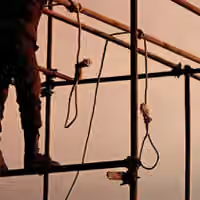
Witnesses said security forces maintained a heavy presence around Alikhani Square throughout Monday night after reports that an iron scaffold had been erected there. Social media accounts described confrontations between officers and people who had gathered in the hope of preventing the executions.
Iranians in London also gathered outside the Iranian embassy Monday night to protest the executions, extending demonstrations over the hangings beyond Iran's borders.
'We stayed awake until morning'
Many of the messages focused on the hours before dawn, describing a night spent waiting for news from Isfahan.
"We wished until sunrise that morning would never come to Isfahan," one person wrote.
Another summed up the night in historical terms: "Write in history that people in Iran fought with their bare hands until 5 a.m. to save two of their fellow citizens."
Messages from Bandar Abbas, Pardis, Khomein and other cities suggested many people viewed the gatherings in Isfahan as a sign that opposition to the executions had spread well beyond the city.
"The people of Isfahan showed that when the next call comes, millions across the country will return to the streets," one resident of Bandar Abbas said. "We fight for freedom even with empty hands."
Another resident of Bandar Abbas added: "Thank you to the people of Isfahan for gathering and showing that we are still standing together and still remember everyone who has been executed."
One student said news of the executions overshadowed an examination.
"I did not even know what I was writing during my exam," the student said. "All I could think about were the young men who were executed in Isfahan last night."
Grief turns to defiance
Many reactions expressed sympathy for the families of the two men while arguing the executions would intensify rather than suppress dissent.
"My heart breaks for the families of those two young men who watched them being executed," one message said.
Others said the executions had strengthened their determination.
"We are saddened by these executions, but we are not afraid," one resident of Pardis, near Tehran said. "We have become angrier. We will return to the streets soon."
Another reaction echoed that sentiment: "Did you think executing our brothers and sisters would make us retreat or become afraid? It has only made us more determined."
Several people criticized governments engaged in diplomacy with Tehran for failing to do more to stop the executions.
"Countries that have influence over the authorities, why do they do nothing to stop these executions?" one message asked.
Others addressed US President Donald Trump directly, questioning why preventing executions had not featured more prominently in negotiations with Iran.
International pressure
The public reaction followed an appeal by United Nations experts led by Special Rapporteur Mai Sato, who urged Iranian authorities on Monday to halt the executions of the remaining defendants.
"Sentencing 12 people to death in one hearing, in a closed courtroom and without clarity as to each defendant's individual responsibility violates established fair trial standards," the experts said.
The experts said the convictions relied heavily on confessions broadcast on state television, while Revolutionary Court hearings were held behind closed doors and the judgments were never made public.
They also said several defendants had reportedly been subjected to arbitrary detention, enforced disappearance and, in some cases, ill-treatment.
I wrote what follows just after midnight, unable to sleep at the thought of more executions at dawn. It is now early morning. The news has hit hard. I can't rewrite these words now. They belong to the hours before that hope disappeared. I leave them as they are.
It is three o'clock in the morning and I am trying not to fall asleep. By the time the dawn call to prayer reaches my window, three young Iranians may be dead.
I know there is nothing I can do. Still, sleep feels like a kind of surrender. So I keep refreshing whatever scraps of internet still work, hoping to see a message saying the executions have been postponed, that the rumours were wrong, that someone, somewhere, changed their mind.
The three young men have spent weeks waiting for this night. Convicted over their alleged role in the January protests, they now face the possibility of being taken to the gallows before most of Iran has opened its eyes.
Their names are spreading quickly, far beyond their hometown of Isfahan. That is why so many of us are awake.
Videos circulating online show heavy security around Isfahan's Alikhani Square, where scaffolding has been erected ahead of the possible public hangings. Small groups of people hover nearby despite the risks. They know they are unlikely to stop anything, but they go anyway.
There is something profoundly human about it: standing in the darkness simply because another person should not have to die alone.
The authorities would probably describe it as law enforcement. Most people I know call it something else: state killing. The only thing in Iran that never pauses.
War or peace, summer or winter. Presidents come and go, mediators arrive and leave. Bombs fall. Ceasefires are declared. The scaffold remains.
That continuity has become its own form of terror. Executions are part of our lives because the state has made them part of our lives. Deliberately.
Tonight feels different only because people know where to look. Some are watching the square from nearby streets. Others, like me, stare at flickering phone screens. We tell ourselves that daylight would make it harder.
As if numbers could somehow interrupt a machinery that has spent decades perfecting itself. It is an irrational hope. But hope often is.
People outside Iran often ask why sanctions, assassinations or bombs have not broken this system. Well, perhaps look at Alikhani Square.
Bombs can destroy buildings. They cannot, on their own, dismantle a system that has learned to absorb them. Ordinary people are different. They are the only force capable of challenging it from within. So the regime continues to reserve its greatest brutality for us.
The call to prayer will come soon. I still do not know whether I will sleep before then. I tell myself that once the sun is up there will be more eyes on the streets, more phones recording, more people standing nearby.
I convince myself that staying awake might help. I know it won’t. But tonight it feels unbearable not to try.
Two protesters were executed early Tuesday amid heavy security deployment around Isfahan's Alikhani Square, where an scaffold had been erected and witnesses reported clashes between guards and people who gathered overnight amid fears of further executions.
Iran's judiciary news agency Mizan identified the men as Amirhossein Safari and Abolfazl Sepahi, saying the sentences were carried out early Tuesday local time.
The executions followed hours of growing concern after reports that an iron scaffold had been erected in Alikhani Square, where protests erupted on January 8.
Witness accounts circulating on social media described the area as being under heavy security throughout Monday night, with some reporting brief confrontations between security forces and people gathered near the square. Iran International could not independently verify the reports.
Twelve young men convicted in what became known as the Alikhani Square case were sentenced to death. Two of them—Golmohammad Mohammadi and Erfan Esfandiari—were executed on July 19.
Before the executions, a source close to Safari's family told Iran International that relatives had been summoned to Isfahan Central Prison for what they believed could be a final visit.
Iranian authorities accuse the defendants of involvement in the killing of four security personnel, as well as arson and vandalism during the January protests. Officials say four members of the Basij militia and Special Unit forces were killed during clashes in the area.
UN had urged halt to executions
Earlier on Monday, UN experts led by Mai Sato, the UN Special Rapporteur on the situation of human rights in Iran, urged the authorities to halt the executions of the ten remaining defendants.
"Sentencing 12 people to death in one hearing, in a closed courtroom and without clarity as to each defendant's individual responsibility violates established fair trial standards," the experts said.
They said the defendants, aged from their late teens to their early twenties, were reportedly subjected to arbitrary detention, enforced disappearance and, in some cases, ill-treatment.
According to the experts, the convictions relied heavily on confessions broadcast on state television, while Revolutionary Court hearings were held behind closed doors and the judgments were never made public.
Among those still facing execution is Shervin Bagherian Jebeli, who turned 18 only days before his arrest.
Iran's state television broadcast footage of Jebeli confessing to violence against security officers within a week of his detention and before any trial, the experts said.
The executions bring the number of people put to death in the Alikhani Square case to four, leaving eight others still under sentence of death despite mounting international calls for Iran to halt the executions.
The pause in US airstrikes has opened a new debate in Tehran over whether the military lull should be used to revive diplomacy or intensify pressure on Washington before another round of fighting begins.
Hardline commentators argue the United States paused its campaign because military pressure and disruptions to regional energy supplies have exposed American vulnerabilities.
Moderate and pragmatist voices, meanwhile, see a narrow window to pursue indirect diplomacy before renewed fighting further weakens Iran's economy.
The debate comes as indirect diplomacy appears to be regaining momentum after three nights without direct US or Iranian attacks.
President Donald Trump told supporters in Michigan on Monday that "very friendly negotiations" with Tehran were underway, while warning that "you got to beat them, and we'll beat the hell out of them" if diplomacy failed.
Tehran, however, has continued to portray the lull as temporary. Iran's joint military command said the US naval blockade amounted to an expansion of the conflict, accusing Washington of threatening Iranian commercial vessels and oil tankers in Iran's territorial waters over the past three days.
Outside political circles, public reactions have been more cautious than optimistic. Many Iranians reportedly interpret the sudden quiet as evidence of behind-the-scenes diplomacy rather than a genuine breakthrough, with some saying they remained unable to sleep despite the absence of airstrikes.
Official statements have also avoided describing the lull as a "ceasefire," instead referring to it as a "pause" or "hold," reflecting Tehran's continued distrust of US intentions.
For hardliners, that makes negotiations even more dangerous.
The conservative newspaper Kayhan urged the Foreign Ministry to "formally declare the end of all indirect diplomatic communications and backchannel negotiations," arguing that nearly three weeks of fighting had shown Washington only moderates its military pressure when global energy supplies come under threat.
The paper argued the pause reflected dwindling US precision-guided munitions rather than any diplomatic opening.
"The brief pause in nighttime airstrikes is not a signal of American goodwill or diplomatic flexibility—it is a tactical breathing space meant to allow the enemy to replenish depleted precision munitions and distract Tehran from exercising its strategic leverage."
The IRGC-linked newspaper Javan advanced a similar argument, saying US offensive capabilities were showing signs of "structural fatigue" and warning that any hesitation would allow Washington to rebuild regional air-defence networks and supply lines.
It also called for a forceful response to what it described as attempts to expand pressure into the Caspian Sea through recent attacks on Iranian shipping.
Moderate outlets drew almost the opposite conclusion.
Government-aligned Etemad argued that every night without airstrikes represented a crucial opportunity to prevent further deterioration in municipal services, inflation and currency markets, urging officials to make full use of regional mediation efforts, particularly those led by Oman.
Economic daily Donya-ye-Eghtesad likewise described the lull as an opportunity for indirect de-escalation that could help stabilise foreign exchange and gold markets.
Moderate Shargh, meanwhile, warned against opening a new maritime front following the reported attack on Iranian shipping in the Caspian Sea, arguing that escalating the confrontation northwards would only deepen Iran's economic isolation and threaten critical trade corridors.
Perhaps the mood was best captured by Etemad, whose front-page headline distilled both the opportunity and the uncertainty confronting Iran's leadership: "Diplomacy in the enclosure of distrust."