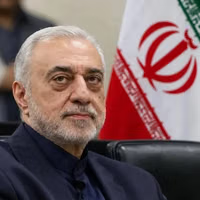
Iranian interior minister Eskandar Momeni meets Pakistan's prime minister, Shehbaz Sharif, in Islamabad. July 21, 2026
Pakistan and Qatar are pressing ahead with efforts to revive Iran-US diplomacy, but Tehran has yet to publicly endorse the initiative as fighting continues over the Strait of Hormuz and resistance to renewed negotiations grows within sections of the Iranian establishment.
The Pakistan-Qatar initiative remains one of the few active diplomatic channels between Tehran and Washington. But continued military operations and widening divisions within Iran's political establishment have cast doubt on whether the fragile understanding between the two sides can survive.
Iranian Interior Minister Eskandar Momeni traveled to Islamabad on Monday for meetings with Pakistan's civilian and military leadership, including Field Marshal Asim Munir, Prime Minister Shehbaz Sharif and Interior Minister Mohsin Raza Naqvi.
Officially, the visit focused on implementing agreements reached during President Masoud Pezeshkian's visit to Pakistan last month. Pakistani media, however, reported that Islamabad is working to preserve the memorandum of understanding (MoU) and prepare the ground for another round of indirect negotiations.
Following his meeting with Momeni, Sharif expressed concern over rising tensions in the Persian Gulf and said Pakistan would continue "to play the role of an honest mediator and facilitator between Iran and the United States."
Momeni, in turn, thanked Sharif, Foreign Minister Ishaq Dar and Field Marshal Asim Munir for securing what he described as the "Islamabad understanding" between Tehran and Washington, underscoring that the talks extended well beyond routine bilateral relations.
Hardliners resist
The prospect of renewed diplomacy continues to divide Iran's political establishment.
Parliament Speaker Mohammad-Bagher Ghalibaf, who has played a central role in Iran's negotiations with Washington, warned on Sunday that the United States continued to reinforce its military presence while claiming to seek peace.
"They have underestimated our intelligence," he wrote on X. "We have become masters at recognizing these American tricks."
"Actions must confirm their claims, not contradict them."
His remarks were interpreted by some hardline commentators as leaving the door ajar for renewed diplomacy, prompting criticism from conservatives who warned against trusting mediation efforts led by Pakistan and Qatar.
The conservative daily Kayhan argued that the current conflict presented a "golden opportunity" to break what it described as the recurring cycle of war, ceasefire and negotiations, insisting a tougher military posture would serve Iran better than another round of talks.
The IRGC-linked newspaper Javan, however, took a more nuanced position, arguing that Iran should remain prepared for both war and negotiations, provided any talks were aimed at consolidating gains achieved on the battlefield rather than restoring trust in Washington.
War clouds diplomacy
The mediation effort unfolded alongside another day of escalating military exchanges.
According to Iranian state media, Iranian forces struck US military facilities in Bahrain, Kuwait and Jordan using missiles and one-way attack drones.
The IRGC claimed the attacks destroyed early-warning radars, Patriot air-defense systems and satellite communications equipment, although those claims could not be independently verified.
The IRGC also warned commercial shipping against relying on US military protection in the Strait of Hormuz. A source quoted by the IRGC-affiliated Fars News Agency said traffic through the waterway had effectively stopped and warned it would remain closed as long as US military operations continued.
Meanwhile, US Central Command announced another round of strikes targeting Iranian military infrastructure used to threaten maritime shipping. Iranian media reported attacks on military sites in Bandar Abbas, Bushehr, Chabahar, Qeshm Island and other strategic coastal locations.
Defense analyst Farzin Nadimi told Iran International that despite nine days of intensive US strikes, Washington had so far failed to restore commercial navigation through the Strait of Hormuz, leaving difficult decisions about the next phase of the campaign.
Regional risks grow
The regional risks also continued to widen beyond the Persian Gulf.
Yemen's Houthi movement announced it had begun imposing a naval blockade on Saudi Arabia and barred Saudi oil tankers from transiting the Bab al-Mandab Strait.
Analyst Shahir Shahid-Sales said the move was likely coordinated with Tehran.
"The key question is whether the Houthis can actually enforce this blockade and how serious a conflict with Saudi Arabia may become," he wrote on X. "If they begin striking oil tankers, oil prices are likely to rise even further."
Senior Iranian officials pay their respects before the coffin of Supreme Leader Ali Khamenei during funeral ceremonies in Tehran. Foreign Minister Abbas Araghchi is seen at far left, July 2, 2026
Foreign intelligence penetration of Iran is hardly a secret. But Iranian Foreign Minister Abbas Araghchi has now suggested the operation goes beyond locating officials or stealing information and seeks to influence decision-making inside the Islamic Republic itself.
The remark marked a subtle but significant shift. Iranian officials have long acknowledged espionage and intelligence breaches, particularly after the precision with which senior commanders, nuclear scientists and political leaders have been located and targeted exposed profound vulnerabilities within Iran's security establishment.
Speaking in the first part of a nearly 90-minute podcast interview, Araghchi suggested foreign intelligence activity inside Iran may be something more ambitious than gathering intelligence: shaping the decisions of the state itself.
He made the remarks when asked by establishment podcaster Javad Mogoei about the opening hours of the war, when coordinated strikes killed Iran's supreme leader along with several senior military, security and political figures.
"I believe this security breach is not limited merely to infiltration and obtaining information," Araghchi said.
"Sometimes it also exists in influencing the decision-making process itself. And even more importantly, it extends to shaping our psychological environment and public perception."
Araghchi did not identify any foreign intelligence service or explain how such influence might operate, although Israel appeared to be the implied actor in the discussion.
To Alex Vatanka, a senior fellow at the Middle East Institute, that distinction was the most revealing part of the interview.
"The job of these assets isn't just to leak the location of leaders in a certain place to be killed," Vatanka told Iran International. "It is to influence decision-making. It's to influence the policy process."
Vatanka believes Araghchi's remarks were directed as much at Iran's internal political debate as at foreign intelligence operations.
"He's hinting that elements inside the regime are openly arguing for policies that the enemy—the United States and Israel—prefer," he said. "Is he talking about the pro-war hawks? Is this part of scoring points against one another? Could well be."
"These things are obviously not accidental," he added. "This is very much messaging at a moment of war."
Mogoei nevertheless raised another possibility, invoking Masoud Kashmiri, the alleged infiltrator who rose through the ranks of the Islamic Republic before the 1981 bombing that killed President Mohammad Ali Rajai and Prime Minister Mohammad-Javad Bahonar.
"Perhaps we have another Kashmiri," he suggested.
Araghchi did not endorse the comparison, saying Iran's adversaries had become familiar with the supreme leader's routine and that the Intelligence Ministry meeting may simply have coincided by chance.
Whether Araghchi was describing a sophisticated foreign influence operation or speaking more broadly about the effect of outside pressure on Iran's internal politics is where analysts begin to diverge.
Omid Memarian, an Iran analyst at DAWN, said one possible manifestation of the kind of influence Araghchi described would be officials advocating policies that prolong the war despite the damage continued conflict causes to the Islamic Republic's own interests.
"Some of the decisions they are making are exactly the things that Israelis might wish for," Memarian told Iran International.
"When it comes to Iran's national security and national interests, they don't make sense,” he added. "We see the smoke. We don't see the fire."
Behnam Ben Taleblu, senior director of the Iran Program at the Foundation for Defense of Democracies, said Araghchi's comments should also be viewed through the lens of Iran's internal political rivalries.
"That doesn't mean these guys are doves by any measure," Taleblu told Iran International. "But it does mean that they have different views about how best to preserve, protect and defend the Islamic Republic."
Taleblu said public acknowledgments of security failures are often aimed less at the Iranian public than at rival political factions or security institutions, with officials defending their own approach while criticizing competing strategies.
He said Araghchi's comments also highlighted a less discussed aspect of intelligence operations: their ability to shape leaders' perceptions rather than merely gather information.
"Influence is to shape their decision-making, perhaps by lulling the Supreme Leader's office into a false sense of security and back into the routines that existed before," he said.
Iran's interior minister Eskandar Momeni meets Pakistani counterpart Mohsin Naqvi in Islamabad, Pakistan, July 20, 2026
Qatar and Pakistan have launched a joint effort to revive Iran-US diplomacy as military exchanges entered their ninth day, while Tehran confirmed receiving new mediation proposals even as hardliners continued to oppose negotiations.
Pakistan and Qatar urged Tehran and Washington on Monday to halt hostilities and resume implementation of a previously signed memorandum of understanding.
Iranian Interior Minister Eskandar Momeni traveled to Islamabad on Monday carrying a message from President Masoud Pezeshkian as part of the mediation effort. Regional media reported he was also expected to meet Pakistan's army chief, Field Marshal Asim Munir.
According to Israel's Channel 14, Qatar proposed that the United States suspend further military strikes while Iran reopens both the northern and southern shipping lanes through the Strait of Hormuz for a 10-day period. The proposal has not been independently verified.
Tehran confirms new proposals
Foreign Ministry spokesman Esmail Baghaei confirmed during his weekly press briefing that Iran had received new proposals from mediators aimed at ending the confrontation, although he did not disclose their contents.
His remarks marked Tehran's first public acknowledgment that fresh diplomatic initiatives were under consideration following the latest escalation.
President Masoud Pezeshkian also defended both the memorandum of understanding and the prospect of diplomacy during remarks to the Supreme Judicial Council, rejecting accusations that Iran had compromised its national interests.
"Not only was no concession made against the country's interests, but Iran achieved major gains, and there is not a single provision that creates a one-sided benefit for the United States," he said.
"If economic pressure leads to growing social discontent, the tremendous social capital that people have created in support of the system could be damaged."
Political analyst Hossein Ghatib argued that diplomacy should remain an option despite the fighting, but warned against any temporary ceasefire that merely postponed another round of conflict.
"The next agreement should not be based on concessions before guarantees," he wrote on X. "Instead, it should rest on the principles of guarantees before concessions, verification before trust, and concrete action before the next step."
Fighting continues
The diplomatic activity unfolded against a widening military campaign across Iran and the Gulf.
Iran launched additional missile and drone attacks targeting Kuwait and Bahrain, while a Greek shipping company said two tankers under its management had been struck by unidentified projectiles while transiting Omani coastal waters.
Iranian media also reported attacks in East Azerbaijan, West Azerbaijan and Bushehr provinces, followed later in the day by a strike on the Shiraz Electronics Industries complex.
Iranian Army spokesman Mohammad Akraminia said "reason dictates that the war continue until it creates complete deterrence for Iran."
He also warned that "any country cooperating with the Americans will certainly face problems for its ships passing through the Strait of Hormuz."
Parliament Presidium member Rouhollah Motefakker-Azad similarly warned that if the conflict continued, "the Islamic Republic will respond even more aggressively, and then the Americans should think more seriously and more quickly about leaving the region."
‘Pointless domestic divide’
Iranian hardliners nevertheless continued to oppose any return to negotiations.
Conservative political analyst Majid Shakeri argued that Washington should first publicly recommit to the memorandum of understanding and fulfill its obligations under the agreement before any new talks could begin.
Commenters on the conservative Tabnak website likewise dismissed renewed diplomacy, with one describing the situation as a "vicious cycle of war, negotiations, war, negotiations."
The IRGC-affiliated Javan newspaper, however, argued that Iran should remain prepared for either outcome.
"Going to the negotiating table to consolidate the gains achieved in the war and secure lasting security, or continuing to fight for the same objective, should not create a pointless domestic divide."
On the US side, President Donald Trump reposted a Truth Social poll showing majority support among respondents for a peace agreement with Iran while insisting Washington had responded forcefully to the killing of American personnel.
Secretary of State Marco Rubio also reiterated that the United States remained committed to a diplomatic solution despite the ongoing fighting.
"They continue sending signals that they want talks and negotiations," Rubio said. "But we respond to their actions, and their actions are firing missiles and drones at ships."
High level representatives including US Vice President JD Vance and Iran's Foreign Minister Abbas Araghchi took part in Lucerne Summit in Switzerland, June 21-23, 2026
Iran's chief negotiator, Mohammad-Bagher Ghalibaf, and US Vice President JD Vance both defended diplomacy backed by military strength on Wednesday, making strikingly similar arguments as Iranian hardliners intensified demands to scrap Tehran's agreement with Washington.
Both men appeared to be making the same argument to critics within their own political camps: that diplomacy is most effective when backed by credible military force, not pursued instead of it.
The parallel messaging prompted analysts to suggest that, despite rising tensions, both sides may still view diplomacy as preferable to war.
International relations analyst Amir-Ali Abolfath wrote on X that Ghalibaf's statement, Vance's remarks and Iran's release of an Iranian-American prisoner together offered "a glimmer of hope" that both sides could return to managing tensions within the framework of an agreement "whose fate hangs by a thread."
Reform-leaning news website Rouydad24 likewise described the prisoner's release as evidence of "the opening of an important diplomatic channel amid an exchange of fire."
US President Donald Trump also welcomed the move, writing on Truth Social that "the United States appreciates this gesture of goodwill by Iran."
‘Talking is not compromise’
Ghalibaf issued a public statement on Wednesday defending what he described as the course pursued under Supreme Leader Mojtaba Khamenei's guidance, arguing that negotiations with the United States remain compatible with military preparedness and resistance.
Rather than presenting diplomacy and military readiness as opposing choices, he argued they were complementary tools for safeguarding Iran's national interests.
"War and negotiation are two methods of protecting the national interest," he said, insisting that negotiations are "part of safeguarding national interests, not synonymous with compromise."
He warned that treating either military confrontation or diplomacy as the sole solution would amount to "a strategic mistake," adding that officials have a duty to prepare "for war, diplomacy, or both," depending on the course set by the Supreme Leader.
"We must stand firm on the achievements secured through the MoU until the nation's rights are fully realized," he wrote.
Hours later, Vance struck a remarkably similar tone in an interview with podcaster Joe Rogan, rejecting the idea of overthrowing Iran's government through US military force.
He argued that diplomacy, backed by military pressure, remained the preferred way to manage the crisis, and criticized "warmongers" pushing for conflict.
A well-funded covert campaign, Vance claimed, was seeking to derail negotiations and any agreement with Tehran.
Hardliners push back
The renewed defense of diplomacy triggered an immediate backlash from Iran's hardline camp, where many have argued since the recent military confrontation that the Tehran-Washington understanding should be formally declared dead.
Kamran Ghazanfari, a member of parliament, accused President Masoud Pezeshkian and Ghalibaf of lacking the courage to acknowledge that the agreement had collapsed.
"Whether they call it war or not, the third war has effectively begun," he said, arguing that the negotiating team should publicly admit that talks had reached a dead end.
Hardline journalist Davood Modarresian likewise criticized Ghalibaf's statement, saying it contained "no sign of change or apology" and faulting him for continuing to advocate negotiations despite what he described as Washington's abandonment of the agreement.
Hardline political activist Masoud Barati challenged Ghalibaf's description of negotiations as a form of struggle.
"Calling negotiations a form of struggle gives primacy to negotiations," Barati wrote. "If negotiations have failed to secure Iran's achievements, why insist on continuing this approach?"
Conservative rivalry deepens
The latest dispute reflects a long-running rivalry between Ghalibaf and former nuclear negotiator Saeed Jalili, both prominent figures within Iran's conservative establishment.
In recent months, lawmakers aligned with Jalili and members of the ultraconservative Paydari Front have intensified criticism of Ghalibaf, arguing that negotiations with Washington should be abandoned altogether.
Their influence, however, appears to have weakened after losing two key leadership positions on parliament's National Security and Foreign Policy Committee.
Adding to signs of growing pressure on the hardline faction, lawmaker Majid Nasrpour told Khabar Online in comments published Thursday that "some hardline members of parliament have been summoned by the relevant authorities and seriously warned over their remarks."
An Iranian Mahan Air flight lands in Sanaa airport in this screen-grab from a video by Houthi television Al-Masirah, July 13, 2026
An Iranian plane landing in Houthi-controlled Yemen looked like an oddly minor victory for Tehran. But it may have been the opening move in an effort to rebuild the allied force capable of threatening a second global maritime chokepoint alongside the Strait of Hormuz.
As the US-Iran memorandum of understanding unravels and the confrontation shifts toward the Strait of Hormuz, renewed fighting in Yemen is raising a broader question: is Tehran preparing another source of maritime pressure at Bab al-Mandab?
Hezbollah and Hamas have been severely weakened by Israeli military operations. The Houthis, by contrast, remain armed, entrenched and positioned astride one of the world's busiest shipping lanes.
Even a credible threat to Bab al-Mandab could unsettle shipping, energy markets and global supply chains. For Iran, that threat alone may be valuable.
The fight over one airplane
The latest escalation followed Yemen's decision to block an Iranian aircraft carrying a Houthi delegation returning from the funeral of Supreme Leader Ali Khamenei in Tehran. Yemen's internationally recognized government accused Iran of attempting to enter its airspace without authorization.
The dispute quickly escalated. An attack damaged Sanaa International Airport's runway. The Houthis blamed Riyadh before targeting Saudi Arabia's Abha International Airport with missiles and drones.
Senior Houthi official Mohammed al-Bukhaiti later warned of what he described as a "siege" of the Kingdom and openly identified Bab al-Mandab as a strategic pressure point.
"The key thing here was the precedent," Chatham House fellow Thomas Juneau told Iran International. "Iran and the Houthis are trying to force open the air bridge between Tehran and Sanaa."
Iran has long supplied the Houthis through maritime smuggling routes stretching around Oman and the Horn of Africa. Those routes are slow, costly and vulnerable to interdiction.
A direct air bridge would dramatically improve Tehran's ability to move sensitive military components into Houthi-controlled territory. That is why one apparently ordinary passenger flight mattered.
Rebuilding the Houthis
Farzin Nadimi, a defense and security analyst at the Washington Institute, believes Iran's urgency reflects another problem: after years of Red Sea operations and repeated US and Israeli strikes, the Houthis are running low on some of their more advanced military capabilities.
"They are very much eager to help the Houthis rebuild their strategic inventory in order to be a viable player again," he said.
Nadimi suspects the aircraft may have been carrying critical weapons components, although there is no independent confirmation of its cargo.
Modern missile and drone forces depend less on complete weapons than on a steady flow of electronics, guidance systems, engines and other specialized components.
If the Houthis are running low, a direct air link would offer Tehran a faster and more reliable route to replenish those capabilities.
A second chokepoint
The strategic importance extends well beyond Yemen.
The dispute between Tehran and Washington is already centered on the Strait of Hormuz, where Iran has demonstrated the leverage that can be created by threatening one of the world's most important energy corridors.
A revitalized Houthi force capable of disrupting Bab al-Mandab would force Washington, Saudi Arabia and their regional partners to consider the security of two strategic waterways simultaneously.
"Iran, having demonstrated the extraordinary value for itself of closing the Strait of Hormuz, absolutely understands that if it closes both Hormuz and Bab al-Mandab at the same time, the effect would be magnified," Juneau said.
"The effect on the global economy, the ability to pressure the US, to pressure Saudi Arabia and to pressure all of their allies."
Juneau cautioned that neither Tehran nor the Houthis appear poised to close Bab al-Mandab in the near term. But the ability to credibly threaten it would give Iran another source of strategic leverage.
Yemeni-American researcher and author Fatima Abo Alasrar believes the latest confrontation was deliberately engineered by Tehran.
"I think, honestly, Iran has engineered this escalation," she said.
In her view, widening the potential cost of confrontation creates another avenue through which Tehran can shape future negotiations with Washington.
Saudi Arabia's red line
The confrontation also threatens to upset the fragile balance that has prevailed in Yemen since the 2022 truce.
Saudi Arabia has spent years trying to extricate itself from a costly war that increasingly looked unwinnable.
"It's really Saudi Arabia that's been absorbing a lot of the pain here," Juneau said.
The Houthis understood Riyadh's reluctance to return to full-scale conflict and repeatedly tested how far they could push.
The attempt to establish a direct air bridge between Tehran and Sanaa appears to have crossed a different threshold.
Saudi Arabia may still prefer de-escalation. But allowing Iran an easier route to replenish Houthi military capabilities would strengthen an armed group positioned directly on its southern border and potentially restore its ability to threaten Saudi cities, airports and energy infrastructure.
Alasrar described Saudi Arabia and the Houthis as pieces on a much larger geopolitical chessboard.
"Houthis and Saudis are almost like pieces on a chessboard that are fighting with each other right now," she said. "But it's Iran and the US that get to impose everything."
Whether the Houthis intend to launch a renewed campaign around Bab al-Mandab remains uncertain. Juneau cautions they are not simply Iranian proxies waiting for orders, while Nadimi expects de-escalation unless the wider US-Iran confrontation expands significantly.
Hormuz has already demonstrated the leverage created by maritime chokepoints. Iran may not even need the Houthis to close Bab al-Mandab. If it succeeds in rebuilding their capabilities, simply making the threat credible could become a source of strategic pressure in its own right.
Mahmoud Ahmadinejad, seen here in 2024, is said to have learned English and tried to improve his image after falling out with the Iranian regime. Photograph: Majid Asgaripour/Reuters
The alleged recruitment of Mahmoud Ahmadinejad by Mossad reads like a spy thriller and has been denied by his office. But it has renewed interest in Iran's most controversial president—and the ruthless infighting that turned a Leader’s darling into a political outcast.
On Monday, The New York Times and Haaretz alleged that Mossad cultivated Ahmadinejad as an intelligence asset and even considered him for a role leading Iran if the Islamic Republic collapsed.
The office of the former president swiftly dismissed the reports as Hollywood material that was hardly worth denying.
For those who followed Ahmadinejad's trajectory after leaving office, however, the allegation itself is less surprising than the path that may have led to it.
"He certainly was very ambitious and wanted power. And it was clear that there was no way he could get to power so long as Khamenei and the regime were in charge," historian and author Arash Azizi, who remained in contact with Ahmadinejad for years after he left office, told Iran International.
Whether Ahmadinejad was ever a credible candidate to lead Iran is a separate question. So, too, is why an alleged intelligence relationship of such sensitivity is now being described publicly in remarkable detail.
"If Ahmadinejad was their person indeed... you burn this stuff 20 years later. What's the insistence on doing it right now?" Azizi said.
From president to political outsider
Ahmadinejad served as Iran's president from 2005 to 2013, rising to power with the backing of Ali Khamenei and becoming one of the Islamic Republic's most recognizable figures. His presidency was marked by Holocaust denial, calls for Israel's destruction and the violent crackdown that followed the disputed 2009 presidential election.
But his relationship with the political establishment that brought him to power steadily deteriorated.
Meir Javedanfar, an Iran lecturer at Reichman University who co-authored a biography of Ahmadinejad, said Ahmadinejad increasingly believed he deserved more authority than Iran's political system allowed him.
"He believed that he had the intellectual capability and charisma and public support to have much more authority and much more power than the regime was giving him," Javedanfar told Iran International.
That frustration became visible in 2011, when Ahmadinejad boycotted official duties for 11 days after Khamenei overruled his attempt to dismiss intelligence minister Heydar Moslehi — one of the most public challenges to the supreme leader by a sitting president.
The rupture accelerated after he left office. Close allies, including Esfandiar Rahim Mashaei, were arrested, while Ahmadinejad himself was repeatedly barred from returning to the presidential race.
"After he left office, this frustration was supplemented by anger towards the regime," Javedanfar said.
"And this is why I think he would have been open to recruitment by foreign intelligence agencies... because of the tremendous anger he had towards the regime."
The New York Times reported a similar trajectory. According to the report, Ahmadinejad eventually concluded he could not return to power while the existing political system remained in place.
An associate told the newspaper Ahmadinejad envisioned returning to power with foreign backing and, if successful, would recognize Israel and normalize relations under the Abraham Accords.
Mahmoud Ahmadinejad, seen here in 2005, was frequently condemned by Human Rights Watch for his treatment of Iranian protesters. Photograph: Ho New/Reuters
A transformation seen up close
Azizi began speaking regularly with Ahmadinejad and members of his circle after the former president left office. By then, he said, Ahmadinejad's faction had begun drifting away from the conservative establishment. His circle appeared less Islamist and more nationalist while reaching out to journalists and political figures outside the Islamic Republic's traditional orbit.
"What I saw in Ahmadinejad all these years was someone who was very ambitious, who wanted power, who understood Iranian public sentiments very well, almost masterfully," Azizi said.
He also appeared increasingly aware that his record on Israel would complicate any political comeback. Azizi recalled arranging an interview between Ahmadinejad and an Israeli journalist and said the former president repeatedly expressed an interest in discussing Jewish history and Israel.
"He seemed to be open to normalization with Israel," Azizi said.
Azizi said Ahmadinejad became noticeably more secluded around 2024 — roughly the same period The New York Times reported that his contacts with Israeli intelligence intensified.
The alleged recruitment
It remains unclear exactly when Israeli intelligence first approached Ahmadinejad.
The New York Times reported that Iranian officials traced at least some of Ahmadinejad's contacts with Israeli intelligence to a 2023 trip to Guatemala. The following year, he traveled to Budapest to attend a climate conference at Ludovika University of Public Service.
According to the newspaper, the conference served as cover for meetings with Israeli intelligence operatives. Former US officials cited by the newspaper said then-Mossad director David Barnea personally traveled to Budapest to meet Ahmadinejad and that Mossad later informed the CIA it was in contact with him.
The newspaper also reported that Israel paid for some of Ahmadinejad's travel and accommodation and that operatives met him abroad on several occasions.
Haaretz, meanwhile, reported that Ahmadinejad formed part of a broader Israeli plan to destabilize the Islamic Republic. The plan reportedly combined influence operations inside Iran, support for Kurdish forces in Iraq and efforts to activate pressure on the government from multiple directions.
Ahmadinejad was envisioned as one possible political figure who could emerge if the system collapsed.
But the newspaper said the proposal faced considerable skepticism within Israel's own security establishment. Senior Military Intelligence officials reportedly judged the plan unlikely to succeed, while National Security Adviser Tzachi Hanegbi is said to have dismissed parts of it as resembling "science fiction."
Cabinet ministers also questioned why Israel would seek to replace the Islamic Republic with one of its best-known former hardliners. According to Haaretz, Mossad argued that Ahmadinejad's years of conflict with the leadership had transformed him into an opposition figure.
Recruitable does not mean viable
Jason Brodsky, policy director at United Against Nuclear Iran, said it was plausible that Ahmadinejad attracted the attention of foreign intelligence services after becoming estranged from Iran's leadership.
"Do I think Ahmadinejad was a person of interest to certain foreign intelligence organizations because of his status as someone who has been burned by the Iranian leadership? Yes," Brodsky told Iran International.
"Do I believe that Mossad and other intelligence agencies were interested in talking with him? Yeah, I do."
But Brodsky drew a distinction between cultivating Ahmadinejad as a potential intelligence source and building a broader regime-change strategy around him.
"Does that mean that he was the grand Israeli regime change strategy for the Islamic Republic? Not necessarily," he said.
Brodsky argued that Ahmadinejad lacked one critical ingredient for any successful transition: support inside Iran's security establishment capable of triggering defections.
"Defections would be part of any regime change strategy," he said.
The plan falls apart
According to The New York Times, the operation reached its most dramatic point on Feb. 28, when an Israeli strike hit Ahmadinejad's compound, targeting a building used by his bodyguards and his armored vehicle.
The newspaper reported that a black Peugeot arrived shortly afterwards and that Mossad operatives extracted Ahmadinejad from the scene, transporting him to a safe house inside Iran.
US and Iranian officials cited by the newspaper said Ahmadinejad later became disillusioned with the plan to return him to power and eventually left the safe house under circumstances that remain unclear.
The broader regime-change strategy likewise failed to unfold as envisioned. According to Haaretz, plans to combine internal unrest with armed pressure from outside Iran never materialized.
Ahmadinejad resurfaced last week at Khamenei's funeral after weeks out of public view. The New York Times, citing four senior Iranian officials, reported that he is now under house arrest after Iranian authorities uncovered much of his alleged interaction with Israel. His current status has not been independently confirmed.
Why reveal it now?
The reports raise one final question: why reveal such an alleged intelligence relationship now?
"There's always a motive in this," Azizi said. "Why are they so eager to burn Ahmadinejad?"
Brodsky suggested the answer may lie partly inside Israel, pointing to rivalries between Mossad and Military Intelligence, divisions within Mossad itself and the increasingly charged political atmosphere ahead of October's elections.
Whether the allegations are ultimately borne out or not, Ahmadinejad's political trajectory is no longer in dispute. Over more than a decade he moved from one of the Islamic Republic's most loyal servants to one of its most isolated former presidents.
The question now is whether Israeli intelligence merely sought to exploit that rupture—or whether those behind the reported operation fundamentally overestimated what Ahmadinejad could ultimately deliver.