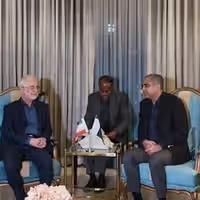
In the interview recorded in Paris on July 14, Pahlavi linked the military campaign to the January 8 and 9 protests, when demonstrators answered his call for nationwide action and were met with a brutal crackdown.
He said the scale of the violence showed that Iranians could not be expected to return safely to the streets while the forces responsible remained capable of crushing another uprising.
“We cannot expect people to be able to safely return to the streets to take on the final battle” without protection or the means to neutralize forces hostile to them, he said.
Pahlavi argued that US and Israeli strikes had weakened the Islamic Republic’s repressive apparatus and helped “equalize” the balance between the government and protesters.
“The campaign that started as a result of the massacre — that led to the intervention by the Israelis and the American forces to strike the regime — was an element that was perhaps a necessary step to avoid further bloodshed,” he said.
The protests began in late December after a sharp fall in the rial deepened economic and political discontent. As demonstrations spread, Pahlavi called on Iranians to take part in nationwide action on January 8 and 9 by gathering in the streets or chanting from their homes.
Millions joined the protests across Iran before security forces opened fire on demonstrators and authorities imposed sweeping internet restrictions.
Documents, medical records, field reports and testimony reviewed by Iran International indicate that at least 36,500 people were killed on January 8 and 9, making the crackdown one of the deadliest episodes of state violence against protesters in modern history.
Pahlavi said the killings demonstrated the limits of peaceful protest against a government willing to use overwhelming force against its own population.
“On January 8 and 9, people went to the street still peacefully, just chanting the slogan,” he said. “When that happens, you cannot expect that by the same method of nonviolence, you can achieve the same result with the way this regime is behaving.”
The United States and Israel launched their military campaign against Iran on February 28, striking Revolutionary Guards facilities, missile and drone units, military command centers and other state targets.
Pahlavi said the attacks had weakened the institutions responsible for suppressing dissent and could help prevent another massacre.
“When you have the mechanism of repression of the regime weakened as a result of those strikes, those are added help,” he said. “Those are the kind of outside interventions that may be required.”
He said the intervention could ultimately save lives that would otherwise be lost in another confrontation between protesters and the security forces.
“It’s really a matter of trying to protect more lives from being lost under this regime that is demonstrating that it has no limit in terms of how far it’s willing to go to kill its own citizens,” he said.
Pahlavi nevertheless stressed that foreign governments should not decide who would govern Iran after the Islamic Republic.
“It is not for a foreign government to decide who or what should be the alternative for Iran,” he said. “That’s up to the Iranian people.”
He said his campaign, which began after the 1979 revolution that overthrew his father, had always centered on Iranians’ right to determine their own political future.
“I’ve never asked for any kind of endorsement from any leader or governments,” he said.
‘A bridge to destination’
Pahlavi has presented himself as the leader of a temporary transition rather than a candidate seeking to predetermine whether Iran should become a monarchy or a republic.
“My position as a transitional leader is, I’m not the destination, I’m a bridge to the destination,” he said.
He said his role would be to act as a neutral arbiter and oversee a political process in which Iranians could debate and choose the country’s future system.
“I’m not taking sides, either for a monarchy or for a republic,” he said. “My job is to make sure that there’s a healthy debate and that in the end people decide what it is that they actually would prefer to have as the final form.”
Pahlavi said his coalition included former leftists, republicans and people once affiliated with groups that opposed his father’s government.
He said former members of the three major leftist groups Tudeh Party, the Fadaiyan-e-Khalq and the Mojahedin-e-Khalq (MEK) had joined his movement, presenting that as evidence that the opposition had become more unified.
“I don’t know how far more can you stretch the tent, including those people, to prove that in fact there is much more unity than ever, certainly inside Iran,” he said.
He added, however, that there were three groups with which he would not cooperate: supporters of the Islamic Republic, the MEK as an organization and separatists.
“There are certain lines that I’m not going to cross,” he said.
Pahlavi also rejected violence, intimidation or criminal conduct by people claiming to support him.
“I believe in pluralism. I believe in tolerance. I believe in civility, in debate, in argument, in comportment, respect, and no hostility of any kind,” he said.
He said anyone who violated those principles would not be considered a supporter and should face legal consequences if their conduct was criminal.
Pahlavi also acknowledged concerns over statements made by people associated with his political team, saying stricter internal protocols were being introduced.
He said those close to him would have to exercise greater caution because their remarks could be interpreted as representing his movement.
‘A democratic culture’
Turning to Iran’s political future, Pahlavi said most Iranians wanted secular democracy, the rule of law and protection of human rights, but warned that building a democratic political culture would take time.
“What I think will take some time, and I mean that in the most honest way possible, is to bring about a democratic culture,” he said.
Pahlavi also clarified earlier statements about contacts with members of Iran’s security forces.
He said individual members of the Basij, the Revolutionary Guards and the regular military had contacted him discreetly over the years to express opposition to the Islamic Republic.
He denied, however, that he had been in direct communication with the IRGC’s senior command.
“It’s not like, in fact, talking to the IRGC command. Not at all,” he said.
Pahlavi said he had advocated for the IRGC to be designated as a terrorist organization for at least a decade because of its role in repression at home and military operations abroad.
He described the Guards as the central institution keeping the Islamic Republic in power and said increasing pressure on it remained a key part of his political strategy.
Pahlavi is the eldest son of Mohammad Reza Shah, Iran’s last monarch, who was overthrown in the 1979 revolution that brought the Islamic Republic to power. The royal family left Iran shortly before the revolution, and Pahlavi has lived in exile since then.