Khamenei aide says leader's MoU remarks strengthened Iran's hand
A close aide to Iran's Supreme Leader Mojtaba Khamenei said the leader's remark that he held a different view of the nuclear deal with Washington "in principle" should be read in the context of his full statement.
Khamenei's wording, Expediency Council Gholam-Ali Haddad-Adel said, was designed to reinforce Tehran's negotiating leverage rather than signal opposition to the talks.
Haddad-Adel was speaking after the supreme leader issued a letter following the signing of the US-Iran memorandum of understanding.
He added that the carefully worded phrase reflected lessons learned from the 2015 nuclear deal, known as the JCPOA, arguing that Iran gains nothing by appearing eager for an agreement.
Iran's Shoja Khalilzadeh looks dejected after his last minute goal against Egypt gets disallowed after a VAR review, June 26, 2026
Iran's World Cup campaign ended on Saturday after a 1–1 draw with Egypt and results elsewhere confirmed Team Melli's elimination from the tournament.
But for many Iranians, the tournament had long ceased to be just about football.
Their final match in Seattle, played during the city's Pride celebrations, became a showcase for the political, cultural and human rights debates that increasingly follow Iran's national team wherever it plays.
Inside the stadium, rainbow flags flew alongside the pre-revolution Lion and Sun flag, while many Iranian supporters wore shirts and carried banners commemorating victims of the January 8–9 massacre. Outside, hundreds marched toward the stadium chanting against the Islamic Republic.
In parts of the Iranian diaspora, Team Melli no longer represents just a football team. It has become inseparable from debates over the Islamic Republic itself.
That question—whether it is possible to cheer for Iran's national team without appearing to cheer for the state it represents—has divided supporters for years. It resurfaced again in Seattle.
A stoppage-time goal by Shoja Khalilzadeh briefly appeared to keep Iran's World Cup hopes alive before it was ruled out for offside following a VAR review. Hours later, a 3–3 draw between Austria and Algeria ended Iran's hopes of advancing to the Round of 32 as one of the tournament's best third-placed teams.
Pride celebration
The match had been designated a Pride celebration by Seattle's local World Cup organizers before the tournament draw paired Iran with Egypt.
The pairing quickly drew attention because both countries have long been criticized by international human rights organizations for their treatment of LGBTQ+ people.
In Iran, same-sex relations are criminalized and can carry the death penalty. In Egypt, LGBTQ+ people have faced arrests, imprisonment and prosecution under morality-related laws.
Although later removed by city officials, Iranian and Egyptian national flags had earlier flown alongside the rainbow Pride flag in downtown Seattle.
Many fans admitted they knew little about the realities facing LGBTQ+ people in Iran.
"I honestly don't know much," one supporter said.
After learning that same-sex relations can carry the death penalty, another described the situation as "devastating."
A self-described queer man who supports LGBTQ+ refugees called the pairing "kind of ironic."
"I do think that it's kind of ironic that Egypt and Iran are doing the Pride match because obviously queer people are persecuted in those countries," he said.
The conversations reflected a broader disconnect. While many supporters expressed strong backing for LGBTQ+ rights, few were familiar with conditions in countries where homosexuality remains criminalized.
Politics follows Team Melli
In Seattle, the political divide surrounding Team Melli was embodied by the absence of goalkeeper Rashid Mazaheri.
Mazaheri publicly blamed Ali Khamenei and the Islamic Republic for the January 8–9 killings before reportedly being detained by Iranian authorities.
"I offer my condolences to the families who lost their loved ones for Iran," he wrote on social media. "We all know who is responsible for all the recent killings and crimes is none other than Ali Khamenei and the cursed Islamic Republic."
For many protesters outside the stadium, his absence from the World Cup squad served as another reminder that politics continues to shape Iranian football as much as events on the pitch.
The scrutiny surrounding Team Melli has extended far beyond Seattle. Throughout the tournament, players were repeatedly asked about the Islamic Republic, women's rights and LGBTQ+ issues—questions few other national teams routinely faced.
Captain Mehdi Taremi drew international attention when he said, "We respect all LGBT people," a statement that resonated with many supporters given Iran's laws criminalizing same-sex relations.
The exchange prompted comedian and former The Daily Show host Trevor Noah to write on social media: "Funny how some teams get asked about football… and others get asked to explain the world."
For many Iranian fans, the remark captured the reality facing Team Melli. Every press conference, every interview and every match has become intertwined with questions extending far beyond football.
Several members of the squad have also appeared at pro-government events or publicly backed the Islamic Republic, reinforcing the view among many protesters that the team cannot be separated from the state it represents.
Many demonstrators said they did not expect players to openly challenge the authorities. They did, however, expect them not to publicly advocate on behalf of the government.
"I'm here to protest because I think this team is not my team. This is the team of the Islamic Republic and the IRGC."
"I wish I could be in a place where I could support that team, but I am not. We are not supporting you—we are supporting the Iranian people," another supporter draped in the Lion and Sun flag said.
One fan carrying the official flag of the Islamic Republic took the opposite view.
"When it comes to the beautiful game, we should all unite under one flag and chant for our country's name, Iran," he said.
As supporters filed out of Seattle Stadium after the final whistle, Team Melli's World Cup journey had come to an end.
As supporters filed out of Seattle Stadium after the final whistle, Team Melli's World Cup journey had come to an end. Yet the defining images of Iran's final match were as much the Lion and Sun flags, rainbow banners and shirts bearing the names and faces of those killed in the January 8–9 massacre as the disallowed goal that sealed Iran's elimination—if not more so.
For many Iranians, whenever Team Melli takes the field, the game is rarely just about football.
Iran's Coordinating Council of Teachers' Trade Associations says primary school teacher Arya Norani has been sentenced to 14 months in prison over his arrest during the January protests.
The nationwide teachers' union said Norani, a tenured elementary school teacher in Maneh County in North Khorasan Province, was detained on the street during the demonstrations and held for about two weeks before being released on bail.
The council condemned the sentence, called for the case against Norani to be dropped, and renewed its demand for the release of all imprisoned teachers.
Iran is preparing an unprecedented security operation for the funeral of Supreme Leader Ali Khamenei, seeking to prevent a repeat of the deadly crowd crushes that marred the burials of Ayatollah Ruhollah Khomeini in 1989 and General Ghasem Soleimani in 2020.
Iran is preparing an unprecedented security operation for the funeral of Supreme Leader Ali Khamenei, seeking to prevent a repeat of the deadly crowd crushes that marred the burials of Ayatollah Ruhollah Khomeini in 1989 and General Ghasem Soleimani in 2020.
More than four months after Khamenei's death, authorities say he will be buried on July 9 following five days of ceremonies across Iran and Iraq.
The unusually long delay, officials say, reflects wartime conditions and security concerns, underscoring the political and logistical complexity of burying the Islamic Republic's longest-serving supreme leader.
Oil prices rose on Monday even as global stock markets rallied, reflecting continued caution over the fragile US-Iran peace process and lingering risks to energy supplies through the Strait of Hormuz.
Brent crude settled up $1.16, or 1.6%, at $73.15 a barrel, while U.S. West Texas Intermediate (WTI) gained $1.52, or 2.2%, to close at $70.75.
The gains came as investors monitored implementation of the interim peace agreement between Washington and Tehran following recent tit-for-tat strikes that briefly threatened to derail the deal.
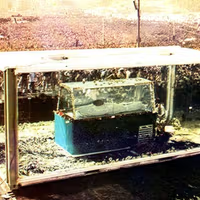
Ayatollah Khomeini's body in refrigerated glass enclosure at Tehran's prayer grounds. June 1989
Iran is preparing an unprecedented security operation for the funeral of Supreme Leader Ali Khamenei, seeking to prevent a repeat of the deadly crowd crushes that marred the burials of Ayatollah Ruhollah Khomeini in 1989 and General Ghasem Soleimani in 2020.
Iran is preparing an unprecedented security operation for the funeral of Supreme Leader Ali Khamenei, seeking to prevent a repeat of the deadly crowd crushes that marred the burials of Ayatollah Ruhollah Khomeini in 1989 and General Ghasem Soleimani in 2020.
More than four months after Khamenei's death, authorities say he will be buried on July 9 following five days of ceremonies across Iran and Iraq. The unusually long delay, officials say, reflects wartime conditions and security concerns, underscoring the political and logistical complexity of burying the Islamic Republic's longest-serving supreme leader.
The funeral will also be the first major state ceremony under Supreme Leader Mojtaba Khamenei, making it an important test of the new leadership's ability to project authority and maintain order.
The body will lie in state for three days at Tehran's Mosalla prayer complex before a funeral procession through the capital. It will then be taken to the Shiite holy cities of Najaf and Karbala before returning to Iran for ceremonies in Qom and burial in Mashhad, Khamenei's birthplace, at the shrine of Imam Reza, the eighth Imam of Shiite Islam.
Foreign Minister Abbas Araghchi visited Baghdad this week to coordinate with Iraqi officials on the cross-border procession.
Authorities have yet to announce who will lead the funeral prayer, traditionally one of the ceremony's most symbolic moments. If Mojtaba Khamenei, who has not appeared publicly since his father's death, attends, some observers believe he could lead the prayer himself, although officials have given no indication that will happen.
Security takes center stage
Iranian officials have repeatedly stressed that crowd management and security will be their foremost priorities.
Gholamhossein Mozaffari, governor of Razavi Khorasan Province, where Khamenei will be buried, has suggested helicopters could be used during parts of the operation to help control crowds and ensure the safe movement of the coffin.
It remains unclear whether such measures would be confined to Mashhad or employed throughout the ceremonies.
Protecting senior officials, managing crowds and transporting the coffin across several cities in two countries is likely to require one of the largest security operations in the Islamic Republic's history.
First Vice President Mohammad Reza Aref has described Khamenei's funeral as "the most important event of the 21st century," reflecting the political and symbolic significance authorities attach to the occasion.
Lessons from Khomeini's funeral
Iran's caution is rooted largely in the chaotic funeral of Islamic Republic founder Ayatollah Ruhollah Khomeini following his death on June 3, 1989.
His body lay in state at Tehran's Mosalla before funeral prayers led by Grand Ayatollah Mohammad Reza Golpayegani.
The following day, however, hundreds of thousands of mourners surged toward Khomeini's coffin as it was transported to the burial site. Security forces lost control as people attempted to touch the coffin, damaging it and tearing the burial shroud.
Authorities were forced to evacuate the body by helicopter and return it to Jamaran for re-shrouding before postponing the burial until the following day.
State media claimed attendance reached around 10 million people, although foreign estimates were considerably lower. Numerous people were reported injured and others are believed to have died in the crush, though no official casualty figure was ever released.
Khomeini was initially buried in a simple grave near Tehran's Behesht-e Zahra cemetery. The site was later transformed into a vast mausoleum complex.
Another tragedy
The funeral of Ghasem Soleimani after he was killed in a US drone strike near Baghdad airport on January 3, 2020, became the largest state funeral in Iran since Khomeini's.
His body was carried through several Iraqi and Iranian cities before reaching his hometown of Kerman, where a crowd crush and the collapse of barriers killed at least 56 people and injured more than 200, forcing officials to delay the burial.
The twin disasters at the funerals of Khomeini and Soleimani continue to shape Iranian planning for large state ceremonies.
By emphasizing crowd control, carefully staged processions and extraordinary security, officials appear determined to ensure Khamenei's funeral is remembered not for chaos, but as a demonstration of the state's ability to manage one of the most consequential events in the Islamic Republic's history.