• العربية
  • فارسی
Brand
  • Iran Insight
  • Politics
  • Economy
  • Analysis
  • Special Report
  • Opinion
  • Podcast
  • Iran Insight
  • Politics
  • Economy
  • Analysis
  • Special Report
  • Opinion
  • Podcast
  • Theme
  • Language
    • العربية
    • فارسی
  • Iran Insight
  • Politics
  • Economy
  • Analysis
  • Special Report
  • Opinion
  • Podcast
All rights reserved for Volant Media UK Limited
volant media logo

Teachers' union says Iranian teacher jailed over protest arrest

Jun 30, 2026, 00:38 GMT+1

Iran's Coordinating Council of Teachers' Trade Associations says primary school teacher Arya Norani has been sentenced to 14 months in prison over his arrest during the January protests.

The nationwide teachers' union said Norani, a tenured elementary school teacher in Maneh County in North Khorasan Province, was detained on the street during the demonstrations and held for about two weeks before being released on bail.

The council condemned the sentence, called for the case against Norani to be dropped, and renewed its demand for the release of all imprisoned teachers.

Most Viewed

Iran's top clerical body turns on itself over US deal
1

Iran's top clerical body turns on itself over US deal

2
INSIGHT

Past funeral disasters cast a shadow over Khamenei's burial

3
VOICES FROM IRAN

Citizens tell Iran football team it lost the public long ago

4
INSIGHT

Return of Iran-US thaw advocate ignites hardline debate

5

Iran bows out of World Cup amid flags, Pride and protest

Banner
Banner
Banner

Spotlight

  • Every flare-up narrows space for diplomacy in Tehran
    INSIGHT

    Every flare-up narrows space for diplomacy in Tehran

  • Iran bows out of World Cup amid flags, Pride and protest

    Iran bows out of World Cup amid flags, Pride and protest

  • Past funeral disasters cast a shadow over Khamenei's burial
    INSIGHT

    Past funeral disasters cast a shadow over Khamenei's burial

  • Why falling oil prices don't mean Hormuz crisis is over
    ANALYSIS

    Why falling oil prices don't mean Hormuz crisis is over

  • Return of Iran-US thaw advocate ignites hardline debate
    INSIGHT

    Return of Iran-US thaw advocate ignites hardline debate

•
•
•

More Stories

Past funeral disasters cast a shadow over Khamenei's burial

Jun 29, 2026, 23:57 GMT+1
Past funeral disasters cast a shadow over Khamenei's burial
100%

Iran is preparing an unprecedented security operation for the funeral of Supreme Leader Ali Khamenei, seeking to prevent a repeat of the deadly crowd crushes that marred the burials of Ayatollah Ruhollah Khomeini in 1989 and General Ghasem Soleimani in 2020.

Iran is preparing an unprecedented security operation for the funeral of Supreme Leader Ali Khamenei, seeking to prevent a repeat of the deadly crowd crushes that marred the burials of Ayatollah Ruhollah Khomeini in 1989 and General Ghasem Soleimani in 2020.

More than four months after Khamenei's death, authorities say he will be buried on July 9 following five days of ceremonies across Iran and Iraq.

The unusually long delay, officials say, reflects wartime conditions and security concerns, underscoring the political and logistical complexity of burying the Islamic Republic's longest-serving supreme leader.

Read full article here.

Oil climbs despite market optimism as US-Iran peace efforts continue

Jun 29, 2026, 23:14 GMT+1

Oil prices rose on Monday even as global stock markets rallied, reflecting continued caution over the fragile US-Iran peace process and lingering risks to energy supplies through the Strait of Hormuz.

Brent crude settled up $1.16, or 1.6%, at $73.15 a barrel, while U.S. West Texas Intermediate (WTI) gained $1.52, or 2.2%, to close at $70.75.

The gains came as investors monitored implementation of the interim peace agreement between Washington and Tehran following recent tit-for-tat strikes that briefly threatened to derail the deal.

Past funeral disasters cast a shadow over Khamenei's burial

Jun 29, 2026, 23:05 GMT+1
•
Maryam Sinaiee
Past funeral disasters cast a shadow over Khamenei's burial
100%
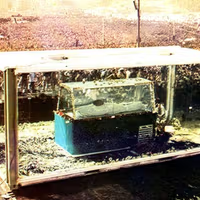
Ayatollah Khomeini's body in refrigerated glass enclosure at Tehran's prayer grounds. June 1989

Iran is preparing an unprecedented security operation for the funeral of Supreme Leader Ali Khamenei, seeking to prevent a repeat of the deadly crowd crushes that marred the burials of Ayatollah Ruhollah Khomeini in 1989 and General Ghasem Soleimani in 2020.

Iran is preparing an unprecedented security operation for the funeral of Supreme Leader Ali Khamenei, seeking to prevent a repeat of the deadly crowd crushes that marred the burials of Ayatollah Ruhollah Khomeini in 1989 and General Ghasem Soleimani in 2020.

More than four months after Khamenei's death, authorities say he will be buried on July 9 following five days of ceremonies across Iran and Iraq. The unusually long delay, officials say, reflects wartime conditions and security concerns, underscoring the political and logistical complexity of burying the Islamic Republic's longest-serving supreme leader.

The funeral will also be the first major state ceremony under Supreme Leader Mojtaba Khamenei, making it an important test of the new leadership's ability to project authority and maintain order.

The body will lie in state for three days at Tehran's Mosalla prayer complex before a funeral procession through the capital. It will then be taken to the Shiite holy cities of Najaf and Karbala before returning to Iran for ceremonies in Qom and burial in Mashhad, Khamenei's birthplace, at the shrine of Imam Reza, the eighth Imam of Shiite Islam.

Foreign Minister Abbas Araghchi visited Baghdad this week to coordinate with Iraqi officials on the cross-border procession.

Authorities have yet to announce who will lead the funeral prayer, traditionally one of the ceremony's most symbolic moments. If Mojtaba Khamenei, who has not appeared publicly since his father's death, attends, some observers believe he could lead the prayer himself, although officials have given no indication that will happen.

Security takes center stage

Iranian officials have repeatedly stressed that crowd management and security will be their foremost priorities.

Gholamhossein Mozaffari, governor of Razavi Khorasan Province, where Khamenei will be buried, has suggested helicopters could be used during parts of the operation to help control crowds and ensure the safe movement of the coffin.

It remains unclear whether such measures would be confined to Mashhad or employed throughout the ceremonies.

Protecting senior officials, managing crowds and transporting the coffin across several cities in two countries is likely to require one of the largest security operations in the Islamic Republic's history.

First Vice President Mohammad Reza Aref has described Khamenei's funeral as "the most important event of the 21st century," reflecting the political and symbolic significance authorities attach to the occasion.

Lessons from Khomeini's funeral

Iran's caution is rooted largely in the chaotic funeral of Islamic Republic founder Ayatollah Ruhollah Khomeini following his death on June 3, 1989.

His body lay in state at Tehran's Mosalla before funeral prayers led by Grand Ayatollah Mohammad Reza Golpayegani.

The following day, however, hundreds of thousands of mourners surged toward Khomeini's coffin as it was transported to the burial site. Security forces lost control as people attempted to touch the coffin, damaging it and tearing the burial shroud.

Authorities were forced to evacuate the body by helicopter and return it to Jamaran for re-shrouding before postponing the burial until the following day.

State media claimed attendance reached around 10 million people, although foreign estimates were considerably lower. Numerous people were reported injured and others are believed to have died in the crush, though no official casualty figure was ever released.

Khomeini was initially buried in a simple grave near Tehran's Behesht-e Zahra cemetery. The site was later transformed into a vast mausoleum complex.

Another tragedy

The funeral of Ghasem Soleimani after he was killed in a US drone strike near Baghdad airport on January 3, 2020, became the largest state funeral in Iran since Khomeini's.

His body was carried through several Iraqi and Iranian cities before reaching his hometown of Kerman, where a crowd crush and the collapse of barriers killed at least 56 people and injured more than 200, forcing officials to delay the burial.

The twin disasters at the funerals of Khomeini and Soleimani continue to shape Iranian planning for large state ceremonies.

By emphasizing crowd control, carefully staged processions and extraordinary security, officials appear determined to ensure Khamenei's funeral is remembered not for chaos, but as a demonstration of the state's ability to manage one of the most consequential events in the Islamic Republic's history.


Economist estimates Iran war has cost average US household $1,000

Jun 29, 2026, 22:34 GMT+1

The four-month Iran war has cost the average U.S. household roughly $1,000 so far, according to Moody's Analytics chief economist Mark Zandi, who says the economic burden continues to grow despite the recent ceasefire.

Writing in an op-ed, Zandi said the estimate includes about $300 in higher gasoline costs, $200 from rising diesel prices that have increased shipping costs, $100 from more expensive air travel, roughly $250 in military spending and a further $150 linked to higher borrowing costs if the Federal Reserve raises interest rates to combat inflation.

Zandi argued that while Washington and Tehran have agreed to halt hostilities and resume negotiations, the costs of the conflict are likely to persist.

He warned that shipping insurance in the Strait of Hormuz is expected to remain elevated and said any future Iranian fees on vessels using the waterway could keep upward pressure on energy prices.

Pezeshkian says Iran will honor MoU if US upholds commitments

Jun 29, 2026, 21:51 GMT+1
Pezeshkian says Iran will honor MoU if US upholds commitments
100%

Iranian President Masoud Pezeshkian said Tehran will abide by the memorandum of understanding with the United States if Washington honors its commitments, signaling continued support for diplomacy despite recent tensions.

"Understanding is a two-way matter. If the American side abides by the memorandum, we will also fulfill our commitments," Pezeshkian wrote on X.

He added that Iran's response to "unreasonable rhetoric and baseless threats" is to rely on "rationality and human dignity in decision-making, and firm and fearless action when necessary."

The remarks come as Tehran and Washington prepare for another round of technical talks aimed at implementing the interim agreement after recent exchanges of strikes threatened to derail the fragile deal.