• العربية
  • فارسی
Brand
  • Iran Insight
  • Politics
  • Economy
  • Analysis
  • Special Report
  • Opinion
  • Podcast
  • Iran Insight
  • Politics
  • Economy
  • Analysis
  • Special Report
  • Opinion
  • Podcast
  • Theme
  • Language
    • العربية
    • فارسی
  • Iran Insight
  • Politics
  • Economy
  • Analysis
  • Special Report
  • Opinion
  • Podcast
All rights reserved for Volant Media UK Limited
volant media logo

Schumer blasts Iran briefing as 'devoid of details'

Jun 30, 2026, 03:53 GMT+1

Senate Democratic leader Chuck Schumer sharply criticized a classified briefing on the US-Iran memorandum of understanding on Monday, calling it "deficient, and devoid of details."

"After dragging America into a costly war, the Trump administration still can't name a single thing Americans got in return," Schumer said after US envoy Steve Witkoff and Secretary of State Marco Rubio briefed members of Congress by phone.

Schumer said Rubio confirmed that Iran would receive billions of dollars in oil revenue while retaining what he described as "dangerous leverage" over the Strait of Hormuz.

Most Viewed

Iran's top clerical body turns on itself over US deal
1

Iran's top clerical body turns on itself over US deal

2
INSIGHT

Past funeral disasters cast a shadow over Khamenei's burial

3
VOICES FROM IRAN

Citizens tell Iran football team it lost the public long ago

4
INSIGHT

Return of Iran-US thaw advocate ignites hardline debate

5
ANALYSIS

Why falling oil prices don't mean Hormuz crisis is over

Banner
Banner
Banner

Spotlight

  • Every flare-up narrows space for diplomacy in Tehran
    INSIGHT

    Every flare-up narrows space for diplomacy in Tehran

  • Iran bows out of World Cup amid flags, Pride and protest

    Iran bows out of World Cup amid flags, Pride and protest

  • Past funeral disasters cast a shadow over Khamenei's burial
    INSIGHT

    Past funeral disasters cast a shadow over Khamenei's burial

  • Why falling oil prices don't mean Hormuz crisis is over
    ANALYSIS

    Why falling oil prices don't mean Hormuz crisis is over

  • Return of Iran-US thaw advocate ignites hardline debate
    INSIGHT

    Return of Iran-US thaw advocate ignites hardline debate

•
•
•

More Stories

Every flare-up narrows space for diplomacy in Tehran

Jun 30, 2026, 03:27 GMT+1
•
Behrouz Turani
Every flare-up narrows space for diplomacy in Tehran
100%
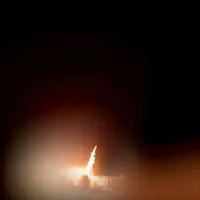
A screengrab from a handout video showing a missile launched by Iran, released on June 28, 2026.

Intermittent US-Iran escalations are giving Iran's anti-US hardliners fresh ammunition, strengthening their case against diplomacy and putting the country's pro-negotiation camp under growing pressure.

The latest exchange of strikes has allowed opponents of the Tehran-Washington memorandum of understanding (MoU) to argue that even a limited agreement cannot prevent conflict or deliver the economic relief promised to ordinary Iranians.

A majority of members of the Assembly of Experts seized on the renewed tensions over the weekend by issuing an unusually political statement questioning key elements of the MoU.

They criticized the reopening of the Strait of Hormuz, insisted Iran's nuclear rights must remain outside negotiations and called for those responsible for the killing of former Supreme Leader Ali Khamenei—including US President Donald Trump and Israeli Prime Minister Benjamin Netanyahu—to be punished, saying anyone with access to them had a religious duty to kill them.

The statement was followed by a commentary in the hardline newspaper Kayhan, whose editor Hossein Shariatmadari echoed calls for retaliation against Trump.

The intervention marked one of the clearest signs yet that recent military exchanges have emboldened factions that have long opposed negotiations with Washington.

At the same time, hardliners renewed attacks on President Massoud Pezeshkian and chief negotiator Mohammad Bagher Ghalibaf, arguing that diplomacy has failed to produce either a durable ceasefire or meaningful economic relief.

Throughout the past month, outlets such as Kayhan and Raja News, along with ultrahardline factions including the Paydari Party, have steadily intensified their criticism of the 60-day framework agreement.

Kayhan has described the MoU as "diplomatic capitulation under Western pressure," while Raja News has portrayed it as a retreat from Iran's red lines without securing comprehensive sanctions relief.

By linking economic hardship directly to continuing military pressure, these groups have shifted the domestic debate from how best to implement the agreement to whether negotiations with an adversary still engaged in military action can produce any meaningful benefit.

From their perspective, each exchange of strikes reinforces the argument that Washington cannot be trusted and that diplomacy merely gives the United States and Israel time to regroup.

Renewed maritime incidents and the slow pace of sanctions relief have become central to that narrative.

Hardline lawmakers including Kamran Ghazanfari and Mahmoud Nabavian have likewise criticized provisions allowing the resumption of commercial shipping through the Strait of Hormuz, arguing that Iran has reopened one of its most important strategic levers without securing sufficient concessions in return.

More pragmatic conservatives and state-aligned outlets, including the Ghalibaf-affiliated Khorasan newspaper, have found themselves defending the agreement as a state-approved tactical pause rather than a final settlement—an indication that the political debate is increasingly being fought on hardliners' terms.

The latest military exchanges have not fundamentally altered the balance of power inside the Islamic Republic, but they have strengthened the political position of those who opposed negotiations from the outset.

Whether that advantage proves temporary or enduring will depend largely on whether the ceasefire holds and whether the negotiations begin producing tangible results.

For the government, the immediate challenge extends beyond managing relations with Washington. It must also persuade skeptical political and clerical constituencies that diplomacy can still improve Iran's security and economic position.

Failure to do so could further strengthen arguments that negotiations have produced neither stability nor prosperity, narrowing the political space available to diplomats such as Foreign Minister Abbas Araghchi and others advocating continued engagement with the United States.

Whether the current ceasefire ultimately survives may prove less significant than what the latest escalation has already changed inside Iran's domestic debate. Each renewed exchange of fire gives opponents of diplomacy another opportunity to argue that negotiations cannot deliver either security or economic relief.

Unless the ceasefire becomes durable and visible economic benefits begin to emerge, the balance of political momentum is likely to continue shifting toward those advocating a more confrontational course.


Israel's UN envoy says Lebanon deal is 'bad news' for Hezbollah and Iran

Jun 30, 2026, 03:09 GMT+1

Israel's ambassador to the United Nations, Danny Danon, said the framework agreement between Israel and the Lebanese government is "bad news for Hezbollah and the Islamic Republic, and good news for peace."

"But agreements alone are not enough. What matters is their implementation," Danon said.

He added that Israel has "no interest" in remaining in Lebanon, saying its sole objective is to protect its citizens.

US eases Morocco fertilizer duties after Iran war disrupts supply

Jun 30, 2026, 02:32 GMT+1

The United States has temporarily suspended certain duties on phosphate fertilizer imports from Morocco, with President Donald Trump citing supply disruptions caused by the Iran war and the closure of the Strait of Hormuz.

In a proclamation issued on Monday, Trump said global phosphate fertilizer supply chains had been disrupted by conflicts affecting key producing regions, while the closure of the Strait sharply reduced exports from major Middle Eastern suppliers.

The proclamation said domestic US phosphate fertilizer production is insufficient to meet agricultural demand.

Morocco, one of the world's largest phosphate exporters, would help fill the gap while Washington works to expand domestic manufacturing capacity.

Tehran daily splashes Trump in crosshairs, vows 'revenge is certain'

Jun 30, 2026, 01:45 GMT+1
Tehran daily splashes Trump in crosshairs, vows 'revenge is certain'
100%

Hamshahri, a newspaper owned by Tehran Municipality, published a front page on Tuesday showing US President Donald Trump framed in a sniper scope's crosshairs beneath the headline: "Revenge is certain."

The cover attributed the message to Supreme Leader Mojtaba Khamenei and carried the subheading: "War criminals must be confronted."

It also featured comments from several senior clerics calling for retaliation over the killings of Iranian leaders during the joint US-Israeli military campaign.

Hamshahri, one of Iran's highest-circulation daily newspapers, is funded by Tehran Municipality.

Khamenei aide says leader's MoU remarks strengthened Iran's hand

Jun 30, 2026, 01:21 GMT+1

A close aide to Iran's Supreme Leader Mojtaba Khamenei said the leader's remark that he held a different view of the nuclear deal with Washington "in principle" should be read in the context of his full statement.

Khamenei's wording, Expediency Council Gholam-Ali Haddad-Adel said, was designed to reinforce Tehran's negotiating leverage rather than signal opposition to the talks.

Haddad-Adel was speaking after the supreme leader issued a letter following the signing of the US-Iran memorandum of understanding.

He added that the carefully worded phrase reflected lessons learned from the 2015 nuclear deal, known as the JCPOA, arguing that Iran gains nothing by appearing eager for an agreement.