Iran markets rally on US deal hopes, but economists warn relief is no cure
The US-Iran memorandum has raised expectations of oil waivers, access to frozen funds and a path toward sanctions relief, but economists warn that Tehran’s postwar economy will need far more than a diplomatic breakthrough to escape chronic inflation and structural weakness.
The reaction reflects a familiar hope in Iran: that lower tensions with Washington will strengthen the rial, cool inflation and ease living costs after years of sanctions, isolation and war. But economists are warning that the market rally may be pricing in more than the agreement can deliver.
Former Central Bank deputy governor Heydar Mostakhdemin-Hosseini put it succinctly. “An agreement is a necessary condition for economic improvement, but it is not a sufficient condition,” he told Jahan-e Sanat.
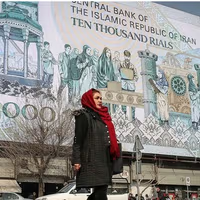
An Iranian woman walks past a billboard depicting a 10,000-rial note, worth less than one US cent (0.6).
The US-Iran memorandum has raised expectations of oil waivers, access to frozen funds and a path toward sanctions relief, but economists warn that Tehran’s postwar economy will need far more than a diplomatic breakthrough to escape chronic inflation and structural weakness.
The reaction reflects a familiar hope in Iran: that lower tensions with Washington will strengthen the rial, cool inflation and ease living costs after years of sanctions, isolation and war. But economists are warning that the market rally may be pricing in more than the agreement can deliver.
Former Central Bank deputy governor Heydar Mostakhdemin-Hosseini put it succinctly. “An agreement is a necessary condition for economic improvement, but it is not a sufficient condition,” he told Jahan-e Sanat.
That warning has become more relevant since the 14-point “Islamabad Memorandum of Understanding” emerged on Wednesday. The document outlines an immediate halt to military operations, a 60-day negotiation period, steps toward reopening the Strait of Hormuz, US Treasury waivers for Iranian oil exports and talks over frozen assets and sanctions termination.
But the most sensitive economic promises are conditional. Senior US officials said after the text emerged that Washington is not committing to immediate sanctions relief, upfront access to frozen assets or direct funding for Iran. They said economic incentives would depend on Iranian compliance and progress toward a final deal, particularly on nuclear issues.
The $300 billion reconstruction and economic development plan mentioned in the memorandum has already become one of the most disputed parts of the deal. US officials said it does not mean Washington will provide money to Tehran. Instead, they described it as a possible future framework for third countries and private investors if sanctions are eased and Iran meets its commitments.
President Donald Trump and Vice President JD Vance have also rejected the idea that the United States would provide direct financial aid or war reparations to Iran.
The issue of frozen assets is similarly uncertain. Iranian officials have presented the memorandum as a route to usable funds, while US officials said no assets would be released automatically upon signing. Some funds could become available during the negotiation period, they said, but only if Iran takes concrete steps demanded by Washington.
Central Bank Governor Abdolnasser Hemmati said Wednesday that the memorandum had been drafted in a way that clearly defines US obligations over asset releases and makes them enforceable.
But he added a note of caution: “As with any international agreement, a final assessment will depend on observing implementation and conducting the necessary verification in practice.”
For economists, that is the core problem: even if some relief arrives, Iran’s economic problems are not only external.
Economic analyst Nasser Zakeri told Fararu that the long-term effect of any diplomatic opening will depend on domestic policymaking. He said Iran would need to reassess its internal and regional realities and reorient its economic strategy around whatever opportunities the agreement creates.
Ali Ghanbari, an economics professor, made a similar point. “We should not become excessively excited or optimistic,” he said. “We should not assume that simply signing an initial understanding can solve all of Iran’s economic problems. Sustainable growth requires structural reforms, and such reforms are impossible without careful planning.”
Iran’s inflation problem shows the scale of the challenge. The latest official point-to-point inflation rate stands at 83.9%, according to the Statistical Center of Iran, and 77.2% according to the Central Bank.
Inflation briefly fell to single digits in the two years after the 2015 nuclear deal took effect, but surged again after Washington withdrew from the accord in 2018 and reimposed secondary sanctions.
A new deal could ease some of those pressures if it restores oil exports, reduces shipping restrictions and gives Tehran access to some blocked revenues. Under the memorandum, the US Treasury would issue waivers for Iranian crude oil, petroleum products and related services, including banking, insurance and transportation, pending a final agreement.
But Mostakhdemin-Hosseini warned that even higher oil revenue and reduced sanctions would not resolve budget deficits, rapid money-supply growth, banking imbalances and weak productivity. Without political stability, better governance and restored public trust, he said, chronic inflation could return quickly.
Hossein Selahvarzi, the former head of the Tehran Chamber of Commerce, also warned against reading peace as prosperity.
“A peace agreement does not, by itself, revive the economy, and the end of military conflict does not automatically mean the beginning of economic prosperity,” he wrote in Etemad.
He pointed to energy shortages, lack of working capital, aging equipment, limited access to technology, unstable regulations, weak investment and low productivity across industry and mining.
“The war only deepened and exposed these problems,” Selahvarzi wrote. “If we are now speaking of a post-war era, we should not expect miracles.”
At least three Iran-flagged tankers carrying a total of about 5 million barrels of oil have sailed from Iran since Tehran reached an agreement with Washington, CNN reported on Thursday, citing analytics firm Kpler.
“We have identified at least three laden, Iran-flagged crude oil tankers that have moved past the Gulf of Oman–Arabian Sea US naval blockade boundary,” Kpler said. None of those vessels had sailed through the Strait of Hormuz, it added.
Another tanker carrying about 2 million barrels of crude appeared to be approaching the same boundary based on the latest available AIS data, Kpler said.
UN nuclear watchdog chief Rafael Grossi welcomed the memorandum between the United States and Iran, saying the next stage would be to turn it into concrete technical steps.
“It is good that the memorandum is there - now the technical work starts,” Grossi said on Thursday.
He said the International Atomic Energy Agency would now sit down with US and Iranian officials to begin formulating specific measures that would need to be taken.
An Iranian lawmaker said on Thursday that the United States “cannot be wiped off the earth,” describing a memorandum of understanding with Washington as something Iran needed.
Ahmad Bakhshayesh Ardestani, a member of Iran parliament’s national security and foreign policy committee, said the fact that Iran had been able to “raise its head” was itself a victory.
He said the MOU would likely be discussed and reviewed in parliament.
The Iran war’s impact on food prices could linger long after the Strait of Hormuz reopens, with Bloomberg tracing how higher fuel, fertilizer, freight and energy costs are feeding through supply chains from farms to bakeries.
The report tracked the production of a chocolate croissant made by a London bakery, showing how the US and Israeli attack on Iran in late February and the subsequent closure of the Strait of Hormuz sent shocks through global supply chains.
Bloomberg reported that the disruption pushed up prices for fuel, energy, fertilizer and other agricultural and industrial products. Even though the United States and Iran have agreed to an interim deal expected to reopen the strait, the effects are still moving through the food system.
Fertilizer was one of the clearest pressure points. By the time the interim deal was reached, more than 40 fertilizer-laden vessels were stuck in the Persian Gulf, according to tanker-tracking data compiled by Bloomberg and Kpler. Fertilizer flows through the Strait of Hormuz fell from about 600,000 tons a week in late February to 60,000 tons in early June.
The spike hit during the spring planting season, raising costs for farmers even though fertilizer prices have since fallen back toward prewar levels. A French farmer cited by Bloomberg said his off-road diesel costs had risen from €0.70 a liter before the war to €1.20, adding about €25,000 to annual expenses.
The pressure also moved through mills, exporters, truckers, bakeries and cafes. Bloomberg said dry-bulk freight rates have risen 22% since the start of the war, while logistics firms have imposed fuel surcharges after diesel prices jumped.
In Britain, 82% of food and drink businesses said they would have to raise prices because of the impact of the Iran war, according to a May report from the Food & Drink Federation cited by Bloomberg.
The federation’s chief economist, Liliana Danila, said that while the Strait of Hormuz is reopening, supply chains will take “another six months, at least” to normalize, and some energy infrastructure may take longer to repair. She said food manufacturers’ long-term contracts mean some price increases could take as long as a year to appear fully.
“Higher costs are now baked into the system,” she said.