In a written response to Iran International, the Canadian government said all parties involved in the latest exchanges between Iran, Israel and the United States must comply with international humanitarian law, including the protection of civilians and civilian infrastructure.
Ottawa also stressed the need for diplomacy and dialogue to resolve the crisis. But in Canada’s case, that language does not signal a softer approach toward Tehran. It sits alongside one of the most restrictive Iran policies among Western governments, built around sanctions, terrorist designations and a long-standing diplomatic rupture.
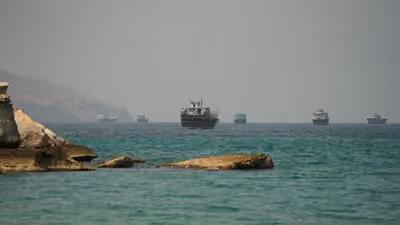
That tension is especially visible in Canada’s concern over the Strait of Hormuz.
Global Affairs Canada said Ottawa remains worried about disruptions in the strategic waterway and emphasized that respect for international navigation rights under international law is essential. It said the free flow of maritime traffic through the corridor is critical to global energy stability and supply chains.
For Canada, the crisis is therefore not only about preventing a wider war or limiting civilian harm. It is also about protecting the rules and routes that underpin global trade, energy flows and maritime security.
That is where Ottawa’s call for diplomacy begins to narrow. Canada supports de-escalation, but not in a way that separates the current crisis from Tehran’s broader conduct in the region.
Global Affairs Canada said Ottawa will continue working with allies and partners, both bilaterally and multilaterally, to support a diplomatic solution while countering what it describes as destabilizing activities by the Islamic Republic.
Those activities include Iran’s support for terrorist organizations, its ballistic missile program, nuclear activities and systematic human rights violations.
In other words, Canada’s message is not simply that the fighting should stop. It is that any diplomatic path must exist alongside continued pressure on the structures Ottawa believes drive Iran’s regional behavior.
That pressure is not only rhetorical.
Canada lists Hamas, Hezbollah and Yemen’s Houthi movement, also known as Ansarallah, as terrorist organizations. Ottawa has accused Iran of providing political, financial or military support to such groups.
In June 2024, Canada also listed the Islamic Revolutionary Guard Corps as a terrorist organization, following years of pressure from victims’ families of Flight PS752, human rights advocates and the Iranian-Canadian community.
Since 2012, Canada has designated Iran as a foreign state supporter of terrorism under the State Immunity Act, a legal framework that allows victims of terrorism to pursue civil action against the Iranian state in Canadian courts.
Together, those measures make Canada’s diplomatic language more constrained than it may first appear. Ottawa can call for dialogue, but it is doing so with a state it has legally and politically framed as a sponsor of terrorism and a source of transnational threats.
The sanctions record points in the same direction.
In March 2026, Canada sanctioned five individuals and four entities involved in procurement networks supplying technology used in IRGC weapons production, including drone-related systems. Canada said some Iranian arms, drones and technology have been transferred to Russia for use in the war against Ukraine.
A month earlier, Ottawa sanctioned seven individuals linked to Iranian state bodies responsible for intimidation, violence and transnational repression targeting dissidents and human rights defenders.
These measures show why Canada’s Iran policy cannot be read only through its latest call for restraint. The government is trying to prevent escalation in the short term while preserving the tools it has built over years to isolate and pressure Tehran.
The relationship has been moving in that direction for more than a decade.
Canada severed diplomatic relations with Iran in September 2012, closed its embassy in Tehran and declared Iranian diplomats in Canada persona non grata. Relations have not been restored since.
The gap widened further after the downing of Flight PS752, crackdowns on protests in Iran, allegations of transnational repression, Tehran’s regional activities, and concerns over its missile and nuclear programs.
Against that backdrop, Canada’s latest response is less a change in policy than a reminder of its limits. Ottawa wants diplomacy to contain the crisis, but it has little trust in the government with which diplomacy would have to be conducted.
That is the uneasy mix shaping Canada’s approach: avoid direct military involvement, keep channels for de-escalation open, and continue working with allies to restrict Iran’s room for maneuver.
The unresolved question is whether diplomacy can contain the crisis if Tehran is unwilling to make lasting changes, or whether negotiations will again become a way to delay pressure while preserving the policies that brought the region to this point.