• العربية
  • فارسی
Brand
  • Iran Insight
  • Politics
  • Economy
  • Analysis
  • Special Report
  • Opinion
  • Podcast
  • Iran Insight
  • Politics
  • Economy
  • Analysis
  • Special Report
  • Opinion
  • Podcast
  • Theme
  • Language
    • العربية
    • فارسی
  • Iran Insight
  • Politics
  • Economy
  • Analysis
  • Special Report
  • Opinion
  • Podcast
All rights reserved for Volant Media UK Limited
volant media logo

Iran still reviewing final text of possible MOU with US - Mehr News

Jun 2, 2026, 07:33 GMT+1Updated: 10:47 GMT+1

Iran was still reviewing the final text of a possible memorandum of understanding with the United States and has not yet sent a response, semi-official Mehr News reported on Tuesday, citing an informed source.

“America’s record of breaking commitments and historical mistrust have led Iran to take a very strict approach to the issue,” said the source, described as close to Iran’s negotiating team.

The source also said Iran was seeking “real benefit” based on past experience.

Most Viewed

Iran’s president offers resignation, citing total takeover by IRGC commanders
1
EXCLUSIVE

Iran’s president offers resignation, citing total takeover by IRGC commanders

2
INSIGHT

No breakthrough yet, but Iranians are betting on one

3
EXCLUSIVE

Leaked documents link Chinese firms to IRGC missile fuel network

4
ANALYSIS

Far-right overreach against Pezeshkian exposes cracks in the hardline camp

5
ANALYSIS

Lebanon becomes a test of Trump's Iran diplomacy

Banner
Banner

Spotlight

  • Iran's internet is back, but still broken
    INSIGHT

    Iran's internet is back, but still broken

  • Lebanon becomes a test of Trump's Iran diplomacy
    ANALYSIS

    Lebanon becomes a test of Trump's Iran diplomacy

  • Far-right overreach against Pezeshkian exposes cracks in the hardline camp
    ANALYSIS

    Far-right overreach against Pezeshkian exposes cracks in the hardline camp

  • Leaked documents link Chinese firms to IRGC missile fuel network
    EXCLUSIVE

    Leaked documents link Chinese firms to IRGC missile fuel network

•
•
•

More Stories

Outgoing Mossad chief urges regime change in Iran

Jun 2, 2026, 07:23 GMT+1
Outgoing Mossad chief urges regime change in Iran
100%

Outgoing Mossad chief David Barnea said Israel should remain committed to toppling Iran’s ruling system.

Speaking at a retirement ceremony late Monday, Barnea said the Islamic Republic was at its weakest after the recent war and that Israel should “complete the job.”

“I believed, and I still believe, that a change in the reality in Iran by virtue of toppling the regime is a possible and achievable goal,” Barnea said.

He said such a goal would require “persistence, a cool head, and commitment to the mission.”

“This mission must remain as our top priority,” he added.

Iran MP warns against taking political rifts into public sphere

Jun 2, 2026, 06:31 GMT+1

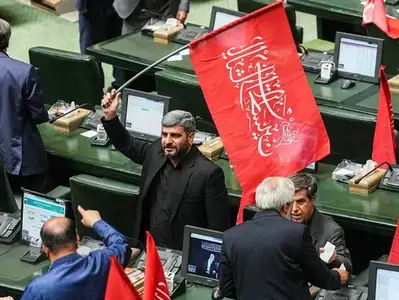
A member of Iran parliament’s presiding board warned on Tuesday against taking disputes among officials into the public sphere, saying it could harm unity.

“All political groups, elites and those with public platforms must align their positions and conduct with the Supreme Leader’s guidance,” Ahmad Naderi said.

The lawmaker said that during the “silence of the military scene,” preserving unity and avoiding division were conditions for maintaining power.

“The battlefield is not only the military arena; diplomacy is another domain of the same battlefield,” he added.

IRGC cleric cites ex-leader’s wartime addresses, urging public updates

Jun 2, 2026, 05:47 GMT+1
IRGC cleric cites ex-leader’s wartime addresses, urging public updates
100%
Iran’s slain Supreme Leader Ali Khamenei

An IRGC cleric said on Tuesday that the public should be given updates on the country’s wartime situation, citing how former Supreme Leader Ali Khamenei spoke directly to people when he was still alive.

“In the 12-day war, our martyred Imam would take the microphone, speak to the people and reassure them. Of course, we are not saying that secrets should be revealed… but people should be given reports on the situation so the enemy cannot exploit it,” said Abdollah Haji Sadeghi, the leadership’s representative to the Islamic Revolutionary Guards.

Since his appointment as the new Supreme Leader, Mojtaba Khamenei has not appeared in public and no image or audio recording of him has been released.

The IRGC cleric also said the United States had repeatedly shown it could not be trusted and warned that Iran would give “stronger and more astonishing” responses if necessary.

Sen. Schumer attacks Trump's 'no hurry' stance on Iran war

Jun 2, 2026, 04:38 GMT+1

Senate Democratic leader Chuck Schumer criticized President Donald Trump's recent remarks that he is in “no hurry” to end the war with Iran, arguing that the conflict has to be resolved "once and for all."

In a post on X, Schumer wrote: “Trump says he's in ‘no hurry’ to end the war in Iran. No hurry? Tell that to our troops in harm’s way. Tell that to their families. Tell that to the Americans getting crushed by record gas prices at the pump.”

“We will not stop fighting to end this war once and for all,” he added.

Trump said over the weekend that he was not rushing to reach an agreement with Tehran.

Iran's internet is back, but still broken

Jun 2, 2026, 04:20 GMT+1
•
Maryam Sinaiee
Iran's internet is back, but still broken
100%

International internet access has largely returned to Iran, but users and experts say the network remains degraded, unstable and significantly worse than before the war.

Despite the easing of restrictions, many websites, apps and online services continue to experience disruptions, slow speeds and intermittent outages.

Experts say the current wave of disruptions appears highly systematic, targeting core internet protocols that underpin everything from VPNs and video calls to websites and cloud services.

While restrictions on international internet traffic have reportedly been lifted significantly, internet quality still varies widely by province, provider and mobile operator.

Users across Iran report that connectivity remains noticeably worse than it was in the month before the war, when access had largely been restored following a 10-day shutdown triggered by nationwide unrest in January.

Many cite extremely slow connection speeds, repeated cycles of disconnection and reconnection, and severe difficulties accessing foreign websites and online services that were previously available.

Broken network environment

Rather than a return to normal internet access, many users describe what they call a “faulty” or “half-broken” network environment that imposes a more complex form of restriction and traffic manipulation.

At the same time, users and technology observers say a substantial share of DNS-based restrictions introduced during the shutdown remain active. The unresolved filters continue to disrupt email delivery, notifications, cloud services and other internet-dependent applications.

Public frustration is evident on social media and in comments posted on online news platforms.

“We have never experienced a normal, stable, and real internet at any period of time,” one user wrote in a comment on the Khabar Online news website.

Another user wrote on X that the situation had pushed many people to buy Starlink terminals or Iraqi SIM cards, while others were considering emigration. “They cut it in one go and restore it drop by drop. One can’t even be sure that this level of access will continue.”

An online poll conducted by Gadget News, while not necessarily representative of the broader population, illustrates the extent of dissatisfaction. According to the survey, 48.4% of respondents said they could access the internet but experienced low speeds and malfunctioning filtering systems. Another 26% reported effectively having access only to Iran’s national intranet.

VPN access still disrupted

Many Iranian internet users rely on Apple’s App Store and Google Play to download VPN applications that provide access to thousands of restricted websites and platforms.

Although authorities have technically removed filters blocking the app stores, users report a frustrating catch-22: network conditions often prevent VPN applications from downloading updates or functioning properly.

One user on X summed up the mood succinctly: “They want to make people get fed up and give up using the international internet.”

Core internet protocols targeted

Internet expert Vahid Farid told Gadget News that User Datagram Protocol (UDP) traffic—which underpins latency-sensitive services such as voice and video calls, online gaming and live streaming—has been almost completely disrupted.

As a result, many VPN protocols have either stopped working altogether or become highly unstable.

According to Farid, Transmission Control Protocol (TCP) traffic, which powers most websites and online services, is also experiencing persistent interference. The result is a cycle of VPN disconnections, stalled downloads and unreliable access to web services.

Farid said the apparent targeting of these protocols is effectively disabling widely available VPN tools and pushing users toward more complex and expensive alternatives, making access to the international internet both financially and technically burdensome.

Digital businesses struggle to recover

According to a report by Donya-ye Eghtesad newspaper, many digital businesses have been unable to return to normal operations because of the continuing disruptions.

Companies that depend on both domestic and foreign internet infrastructure report persistent difficulties maintaining critical services and data flows.

The restrictions have also affected search engine visibility, reducing traffic for e-commerce platforms, digital media outlets and startups that rely heavily on Google referrals.

Compounding the problem, network disruptions have interfered with the automated renewal of SSL security certificates. As a result, users are increasingly confronted with “Your connection is not private” warnings.

Industry observers say the alerts erode customer trust and further damage online businesses. Together with the broader disruptions, they reinforce a growing perception among users that while the shutdown may be over, many Iranians are still navigating a damaged version of the internet.