Explosion heard on Iran’s Qeshm Island - state media
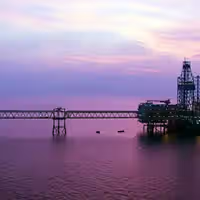
The sound of an explosion was heard on Iran’s southern Qeshm Island around midday Tuesday, state media reported.
A provincial security official told state media later that several consecutive explosions heard on Qeshm Island were caused by the disposal of unexploded ordnance.
The deputy security governor of Hormozgan province said specialist teams carried out an operation.
He urged the public not to worry and to ignore rumors on social media.

Iran has been treating the period of ceasefire with the US as wartime and using it to strengthen its combat capabilities, the army spokesman said on Tuesday.
“The Islamic Republic’s army has treated the ceasefire period as a time of war and used the opportunity to strengthen its combat power,” Mohammad Akraminia said.
He warned that if Iran was attacked again, the army would open “new fronts” with new tools and methods.
Dental treatment costs in Iran have surged in recent months, with industry officials warning that inflation and rising import costs are pushing basic care beyond the reach of many households.
Prices for some dental implants have nearly doubled over the past few months, according to Farid Hashemnejad, head of the Iranian Dental Technicians Association, who said clinics and laboratories are struggling to absorb mounting costs while maintaining service quality.
Iran’s ambassador to China said on Tuesday that mediation in talks between Tehran and Washington was the result of cooperation among Iran, Pakistan and China, Iran’s state media reported.
Abdolreza Rahmani Fazli said China did not welcome what he called US tension-making in international waterways and had always emphasized secure shipping and regional stability.
He added that a crisis in West Asia directly affected China’s economic and strategic calculations.
Iran’s internet blackout entered its 81st day on Tuesday after passing 1,920 hours, internet monitor NetBlocks said.
“Meanwhile, the regime is attempting to extend its digital chokehold internationally, demanding control over other countries' cables in the Strait of Hormuz and big tech compliance with Islamic Republic laws,” it added in a post on X.
Dental treatment costs in Iran have surged in recent months, with industry officials warning that inflation and rising import costs are pushing basic care beyond the reach of many households.
Prices for some dental implants have nearly doubled over the past few months, according to Farid Hashemnejad, head of the Iranian Dental Technicians Association, who said clinics and laboratories are struggling to absorb mounting costs while maintaining service quality.
“Some implant procedures that previously cost around 300 million rials (around $165) are now almost twice as expensive,” Hashemnejad told Rouydad24 on Monday. “In some areas, raw material prices have risen by up to 100%.”
Dental care in Iran has long received limited support from the social security system, leaving most patients to cover major treatment costs themselves. The latest increases add pressure to households, already grappling with years of inflation and declining purchasing power.
Hashemnejad said imported materials used in dentistry and dental laboratories have become significantly more expensive in recent months, although severe shortages have not yet fully emerged because clinics are still relying on older inventories.
“So far, serious shortages are not being felt because existing stock is still being used,” he said. “But with some items becoming more difficult to obtain, more problems may appear in the coming months.”
Iran, he said, remains heavily dependent on imported dental materials sourced mainly from China, along with Turkey, Japan, South Korea and several European countries.
While domestic production has improved in recent years, Hashemnejad said Iranian-made materials still cannot fully replace imported products across specialized fields.
“We would also prefer to depend less on imports, but the reality is that most of the materials we need are still imported,” he said.
File photo from a dental clinic in Iran, where soaring prices and economic pressure have left many unable to afford routine dental treatment.
According to Hashemnejad, prices for some imported materials used in removable dental treatments and laminate procedures have risen between 80% and 90%, while resin and acrylic materials used in prosthetic work have also recorded sharp increases.
Patients shift toward lower-cost care
The rise in prices is also changing treatment choices, with many patients abandoning implant-based procedures or internationally recognized brands in favor of cheaper alternatives.
“Naturally, when costs increase, the number of patients also declines,” Hashemnejad said. “This directly affects clinics and dental laboratories.”
He warned that continued price increases could eventually push part of the population out of the dental care market entirely, creating further strain for healthcare providers already facing weaker demand and higher operating costs.