• العربية
  • فارسی
Brand
  • Iran Insight
  • Politics
  • Economy
  • Analysis
  • Special Report
  • Opinion
  • Podcast
  • Iran Insight
  • Politics
  • Economy
  • Analysis
  • Special Report
  • Opinion
  • Podcast
  • Theme
  • Language
    • العربية
    • فارسی
  • Iran Insight
  • Politics
  • Economy
  • Analysis
  • Special Report
  • Opinion
  • Podcast
All rights reserved for Volant Media UK Limited
volant media logo

Iran says US violated ceasefire with attacks near Hormuz

May 8, 2026, 12:33 GMT+1

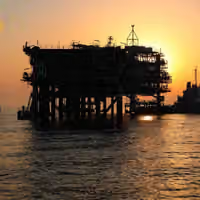
Iran’s foreign ministry said on Friday that the United States violated the ceasefire by attacking two Iranian oil tankers near Jask port and the Strait of Hormuz, as well as several coastal areas overlooking the waterway.

In a statement, the ministry said the attacks took place late on Thursday and early Friday and were met with what it described as a “powerful response” by Iranian armed forces that prevented the attackers from achieving their objectives.

The ministry said the actions constituted a “clear violation” of the ceasefire agreement reached last month and accused Washington of "aggressive and provocative" behavior.

It also warned the UN Security Council and Secretary-General about what it described as the dangerous consequences of international inaction toward US conduct in the region.

Iran’s foreign ministry added that the presence of US forces in the Persian Gulf and Gulf of Oman had become a source of instability rather than security.


Most Viewed

How to beat Iran’s internet kill switch
1
OPINION

How to beat Iran’s internet kill switch

2
VOICES FROM IRAN

Iranians vent frustration as Trump revives talk of Tehran deal

3
INSIGHT

Hope and hostility collide in Tehran over possible deal with US

4

Iranian threat in Germany more urgent than publicly announced - NYT

5
VOICES FROM IRAN

Internet shutdown pushes Iranians onto distrusted domestic apps

Banner
Banner

Spotlight

  • Tehran hails China’s support, but Beijing’s limits are showing
    INSIGHT

    Tehran hails China’s support, but Beijing’s limits are showing

  • Internet shutdown pushes Iranians onto distrusted domestic apps
    VOICES FROM IRAN

    Internet shutdown pushes Iranians onto distrusted domestic apps

  • Iranians vent frustration as Trump revives talk of Tehran deal
    VOICES FROM IRAN

    Iranians vent frustration as Trump revives talk of Tehran deal

  • Hope and hostility collide in Tehran over possible deal with US
    INSIGHT

    Hope and hostility collide in Tehran over possible deal with US

  • How to beat Iran’s internet kill switch
    OPINION

    How to beat Iran’s internet kill switch

  • Pro-regime graffiti in Los Angeles sparks concern in Iranian-American hub

    Pro-regime graffiti in Los Angeles sparks concern in Iranian-American hub

•
•
•

More Stories

US and Israeli strikes hit Iran sites tied to nuclear weapon work, think tank says

May 8, 2026, 12:29 GMT+1

At least six Iranian nuclear sites were attacked in recent US and Israeli strikes, with most confirmed or suspected targets tied to work needed to build a nuclear weapon, a new satellite-imagery analysis by the Institute for Science and International Security shows.

The Washington-based Institute said three other attacked sites could also be nuclear-related, but there was not enough information to be certain. In total, it said six to nine recently attacked sites were nuclear-related.

The most consequential finding is that four to seven of those sites were directly, or possibly, connected to nuclear weaponization – the process of turning nuclear material into an actual bomb.

Iran’s nuclear program has two main parts. One is producing enriched uranium, the material that can be used as fuel for civilian reactors or, at much higher levels, in a nuclear weapon. The other is weaponization: designing, testing and producing the components needed to make a working bomb.

The Institute’s report suggests the latest strikes focused heavily on the second part.

It said the recent phase of the war appeared aimed less at Iran’s already damaged enrichment infrastructure and more at degrading its ability to make the weapon itself. Some of the sites hit in this phase had not previously been publicly identified, the report said, offering new insight into what it described as the extent of Iran’s nuclear weapons-related work.

Across both phases of the war – the 12-day conflict in June 2025 and the renewed fighting from February 28 until a ceasefire on April 7/8, 2026 – the Institute said nine to 12 sites involved in developing and building nuclear weapons were targeted.

The report said Iran’s major enrichment facilities remained severely damaged from the June 2025 war. It said there was no significant new damage to facilities directly associated with uranium enrichment because they had already been destroyed, and that no reconstruction or renewed enrichment had been detected.

But the Institute said the latest strikes added another layer of damage by targeting places linked to the practical work of making a bomb.

Min-Zadayi is a previously unknown site suspected to play a key role in Iran’s attempt to reconstitute nuclear weapons capabilities post-June 2025. A close up of the hillside crater and smaller craters on a nearby concrete surface, apparently a roof for a partially buried area. (Photo by the Institute for Science and International Security)
100%
Min-Zadayi is a previously unknown site suspected to play a key role in Iran’s attempt to reconstitute nuclear weapons capabilities post-June 2025. A close up of the hillside crater and smaller craters on a nearby concrete surface, apparently a roof for a partially buried area. (Photo by the Institute for Science and International Security)

One of the most important sites was Min-Zadayi (also Minzadehei), a previously unknown complex east of Tehran.

Israel described it as a secret nuclear compound where scientists were working on a key component of a nuclear weapons system. The Institute said later reporting suggested the site may have been involved in metallurgy – likely work connected to producing the uranium metal core of a nuclear weapon.

In simple terms, that would be one of the most sensitive stages of bomb-making: taking nuclear material and preparing it in the physical form needed for a weapon.

Satellite imagery showed three large above-ground buildings destroyed at Min-Zadayi, as well as craters near hillside and possibly partially buried structures, the report said.

Another major target was Taleghan 2, inside the Parchin military complex. The site has long been associated with Iran’s past nuclear weapons work under the Amad Plan, a program believed to have been halted in its original form in 2003 but followed by later, more concealed work.

The Institute said Iran had rebuilt and heavily fortified Taleghan 2 before it was hit in March. Satellite imagery showed earth-penetrating weapons struck the facility directly. The report said the site may have contained high-explosive containment equipment.

That is significant because high explosives are central to the design of many nuclear weapons. They are used to compress nuclear material rapidly and evenly, a crucial step in producing a nuclear explosion.

The two newly targeted buildings are close to the previously targeted (June 2025) SPND Mojdeh site and connected by footpaths. All three are involved in nuclear weapons development, according to David Albright (Photo by the Institute for Science and International Security)
100%
The two newly targeted buildings are close to the previously targeted (June 2025) SPND Mojdeh site and connected by footpaths. All three are involved in nuclear weapons development, according to David Albright (Photo by the Institute for Science and International Security)

The report also mentioned strikes near the Mojdeh site, also known as Lavisan 2, and at Malek Ashtar University. Both have been linked in the report to Iran’s nuclear weapons research network.

A newly built engineering-laboratory building near Mojdeh was destroyed, while a building at Malek Ashtar was described by Israel as a research and development site used to develop components for nuclear weapons production.

Other targets included the Shahid Chamran Group complex, which the Institute connected to nuclear-related research, and a building at Imam Hussein University that Israel labeled as a physics center used for Iran’s nuclear program.

The strikes also hit two sites tied to Iran’s broader nuclear fuel cycle. The Arak heavy water production plant was destroyed more thoroughly than during the June war, the Institute said. Heavy water can be used in certain types of reactors that can produce plutonium, another possible route to a nuclear weapon.

The Ardakan Yellowcake Production Plant was also rendered inoperable. Yellowcake is an early processed form of uranium. It is not bomb material, but it is a starting point for later nuclear work, including enrichment.

  • Iran runs covert nuclear procurement network with Vienna-based front firms

    Iran runs covert nuclear procurement network with Vienna-based front firms

  • Brain behind Iran’s nuclear detonation technology killed in Israeli strike

    Brain behind Iran’s nuclear detonation technology killed in Israeli strike

Enriched uranium stockpile

Despite the damage, the report does not suggest Iran’s nuclear challenge has been eliminated.

The most important unresolved issue is Iran’s enriched uranium stockpile. The Institute said tunnel complexes at Esfahan and near Natanz were not directly attacked in this phase and are believed to hold most of Iran’s enriched uranium, including about 440 kilograms of uranium enriched to 60 percent.

That level is below weapons-grade, but far above what is typically needed for civilian nuclear power and much closer to the level needed for a bomb.

The Institute said Iran had sealed some tunnel entrances before the latest war and that much of the enriched uranium appears “bottled up” in places where movement would be easier to detect. But without international inspection, the exact status of the material remains unclear.

The report also said additional nuclear scientists were killed, including senior figures linked to SPND, the military research organization associated with Iran’s nuclear weapons-related work. The Institute drew a distinction between knowledge, which cannot be destroyed, and practical know-how, which can be much harder to replace in a secret weapons program.

The overall picture is therefore one of severe damage, but not finality as Iran may still possess a large stockpile of enriched uranium, and underground sites remain a central uncertainty.

The Institute’s assessment is that the attacks have increased both the time Iran would need to build a nuclear weapon and the chance that an attempt could fail. Its argument is not simply that buildings were destroyed, but that Iran lost facilities, equipment and people connected to the difficult final steps of making a usable weapon.

UAE says air defenses intercepted Iranian missiles and drones

May 8, 2026, 12:24 GMT+1

The United Arab Emirates said on Friday its air defense systems intercepted two ballistic missiles and three drones launched from Iran, leaving three people with moderate injuries.

The UAE defense ministry said the latest incident brought the total number of projectiles intercepted since the start of Iranian attacks on the country to 551 ballistic missiles, 29 cruise missiles and 2,263 drones.

The ministry said total injuries had reached 230 people of multiple nationalities, while 13 people had been killed, including three military-related personnel and 10 civilians.

The ministry said the UAE remained fully prepared to confront threats against the country’s security and stability.

'Iranians never bow to pressure,' Araghchi says amid Hormuz tensions

May 8, 2026, 12:02 GMT+1

Iranian Foreign Minister Abbas Araghchi said the United States chooses military action whenever diplomacy becomes possible, adding that Iranians would “never bow to pressure.”

“Every time a diplomatic solution is on the table, the US opts for a reckless military adventure,” Araghchi wrote on X on Friday.

He also rejected what he said were CIA assessments about Iran’s missile capabilities, saying Iran’s missile inventory and launcher capacity stood at “120%” compared with levels before the conflict that began on Feb. 28.

“As for our readiness to defend our people: 1,000%,” Araghchi added.

Work equipment shortages squeeze Iranian livelihoods

May 8, 2026, 11:33 GMT+1

Rising fertilizer prices and shortages of basic work equipment are squeezing Iranian farmers, laborers and small business owners as inflation, unemployment and falling purchasing power deepen during the fragile ceasefire.

Information received by Iran International points to growing financial pressure across sectors including agriculture, fishing, retail and manufacturing after weeks of disruption linked to conflict, internet shutdowns and trade uncertainty.

The price of potassium fertilizer for a 50-kilogram sack has increased tenfold compared to last year, reaching about 70 million rials (around $40), one farmer told Iran International.

Rice farmers typically require around six sacks of fertilizer per hectare, sharply increasing cultivation costs at a time when many already struggle with falling incomes.

  • Iran taps reserves again as inflation bites and layoffs mount

    Iran taps reserves again as inflation bites and layoffs mount

The farmer added that urea fertilizer prices have also risen severalfold in recent months.

Mehdi Hosseinizadeh, head of Iran’s Association of Pesticide and Fertilizer Importers, linked the increase in fertilizer prices on Thursday to damage suffered by some petrochemical facilities during the war and shipping disruptions through the Strait of Hormuz.

Hosseinizadeh also cited rising import costs, shortages in global fertilizer markets, difficulties securing supplies from China and India, and problems related to currency allocation and import registration.

Another farmer had earlier told Iran International that the price of drip irrigation tape rose from 4 million rials ($2.25) to 30 million ($17), while fertilizer costs climbed from 8 million rials ($4.5) to more than 100 million ($57).

Drip irrigation tape is a thin polymer tube used in irrigation systems to deliver water gradually to plant roots and reduce water consumption in row crops.

Workers report layoffs and business closures

Citizens from several provinces described worsening conditions for workers and tradespeople during the ceasefire period following the conflict.

A fisherman from Qeshm island said he had been unemployed for several months and that falling prices for export fish had increased pressure on local fishermen.

Another resident from Sarbandar, Khuzestan province, described rising unemployment among port workers and shrinking household incomes.

  • Iran’s labor market cracking under layoffs and inflation

    Iran’s labor market cracking under layoffs and inflation

“Everything I earn goes toward rent, transportation and a small amount of food,” the resident said.

Several citizens had previously told Iran International they were selling household goods, work tools and personal belongings to cover food and basic living expenses after losing jobs and income.

One former worker from Tehran said he had been unemployed for nearly three months after beginning work in the electrical equipment market.

“My financial situation has deteriorated sharply and daily life has become difficult to endure,” he said.

A florist from Arak said the prices of supplies including paper, glue, ribbons, boxes and floral foam had quadrupled over the past two months.

Residents in Kashan also described carpet factories shutting down and laying off workers.

Shopkeepers in several parts of Tehran, also reported widespread business closures.

Iran releases video of tanker seizure in Persian Gulf

May 8, 2026, 10:53 GMT+1

IRGC-affiliated Tasnim news agency released a video on Friday that it said showed Iranian naval forces seizing the tanker Ocean Koi, accusing the vessel of attempting to disrupt Iran’s oil exports and national interests.

Tasnim said the tanker was carrying an Iranian oil cargo and accused it of “taking advantage of regional conditions to damage and disrupt Iran’s oil exports and the interests of the Iranian nation.”

The agency did not specify when or where the tanker was seized.

The vessel appears to be the Barbados-flagged OCEAN KOI, which was sanctioned earlier this year by the US Treasury as part of what Washington described as Iran’s “shadow fleet” used to transport sanctioned Iranian petroleum products.

The US Treasury said in February that OCEAN KOI had transported millions of barrels of Iranian fuel oil and condensate and had operated as part of Iran’s shadow fleet since at least 2020.