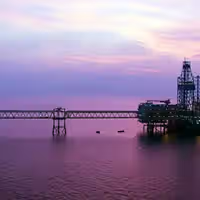
On March 24, reports indicated that Iran had suspended natural gas exports to Turkey following damage to facilities at the South Pars gas field after a March 18 strike. The disruption affects flows that accounted for roughly 14% of Turkey’s gas supply in 2025.
While Ankara’s response was swift and reassuring—with officials stressing that storage, diversification, and system flexibility prevented supply problems—the episode reveals a deeper issue on the Iranian side.
The halt is not simply a temporary interruption; it reflects structural constraints within Iran’s gas sector that limit its ability to sustain exports even to key regional partners.
A system under strain
The disruption originates from damage to South Pars, the world’s largest gas field and the backbone of Iran’s energy system. Because most of its output is consumed domestically, Iran operates with minimal export flexibility. Even limited disruptions can force immediate cuts to external deliveries.
Despite holding the world’s second-largest gas reserves, Iran has struggled to translate resource abundance into export capacity due to sanctions, underinvestment, and rising domestic demand.
As a result, exports to Turkey via the Tabriz–Ankara pipeline have often been inconsistent, with repeated disruptions over the past decade linked to technical issues and winter shortages.
In practice, Iran’s gas exports function less as a strategic tool than as a residual output constrained by domestic priorities.
Asymmetry
Energy relations between Iran and Turkey have long been framed as mutually beneficial: Iran gains export revenue while Turkey secures relatively affordable pipeline gas. In reality, the relationship is asymmetrical.
Iranian gas typically accounts for around 7–8 billion cubic meters annually. It is an important but non-dominant share of Turkey’s supply mix. Turkey’s broader portfolio, including Russia, Azerbaijan and LNG imports, limits dependence on any single supplier.
For Iran, by contrast, Turkey represents one of the few stable export outlets available under sanctions.
This imbalance becomes clear during disruptions. While Turkey can replace lost volumes through alternative sources, Iran cannot easily offset lost exports or the reputational damage that follows.
The timing is also significant. Turkey’s long-term gas contract with Iran is due to expire in mid-2026, and renegotiation was already expected to involve reduced volumes. Repeated supply interruptions are likely to strengthen Ankara’s bargaining position and further weaken Iran’s leverage.
Credibility and market impact
Turkey’s ability to absorb the disruption reflects years of diversification. The country consumes more than 50 bcm of gas annually and can draw on multiple pipeline suppliers as well as LNG imports.
Substitution, however, carries economic costs. Iranian pipeline gas has historically been cheaper than spot LNG, meaning replacement supplies raise import expenses.
Spot LNG prices in the Mediterranean have already risen amid broader geopolitical tensions, implying higher energy bills for Turkey if the disruption persists.
Yet these dynamics also underline Iran’s limited influence. Supply interruptions may impose short-term costs, but they do not create dependency. Instead, they highlight Turkey’s ability to adapt while reducing Iran’s strategic relevance over time.
In energy markets, credibility is as important as capacity. Repeated disruptions—whether caused by infrastructure damage, domestic shortages, or external shocks—undermine confidence in Iran as a dependable supplier.
Unlike major exporters such as Qatar or the United States, which maintain surplus capacity and flexible supply chains, Iran operates with structural constraints that limit responsiveness.
Turkey’s gas disruption therefore reveals more about Iran than about Turkey. Despite vast reserves, Iran lacks the infrastructure, investment and flexibility needed to turn those resources into consistent geopolitical influence.
Rather than demonstrating strength, the episode highlights constraint. Turkey’s ability to adapt reduces Iran’s leverage, while recurring supply interruptions erode its credibility as a regional energy partner.
In today’s energy landscape, influence depends not only on resources but on reliability—and that is where Iran continues to fall short.