France advises citizens against traveling to Israel amid tensions
The French foreign ministry on Friday advised its citizens against travel to Israel, citing security concerns amid rising regional tensions.


The UN nuclear watchdog warned it will not be in a position to provide assurance that Iran’s nuclear program is exclusively peaceful unless Tehran restores access to key facilities, according to confidential reports seen by Bloomberg and the Associated Press.
International Atomic Energy Agency Director General Rafael Grossi said the agency has been unable to verify the status and location of Iran’s stockpile of highly enriched uranium since military strikes by the United States and Israel hit several nuclear sites in June.
The IAEA said it has not been granted access to Iran’s four declared enrichment facilities and has therefore lost “continuity of knowledge” over previously declared nuclear material at affected sites. As a result, it cannot verify whether Iran has suspended all enrichment-related activities or confirm the current size, composition or whereabouts of its enriched uranium stockpile.
Grossi said his agency “will not be in a position to provide assurance that Iran’s nuclear program is exclusively peaceful” until Iran improves its cooperation.
Inspectors have observed regular vehicular activity at bombed sites, including the underground complex at Isfahan and the enrichment facilities at Natanz and Fordow, through satellite imagery. However, Grossi said that without on-site inspections the agency cannot determine the nature or purpose of those activities.
According to the IAEA, Iran holds 440.9 kg (972 pounds) of uranium enriched up to 60% purity, a short technical step from weapons-grade levels of 90%. Grossi has previously said that while such material does not mean Iran has a nuclear weapon, it could, in theory, be sufficient for multiple bombs if further enriched.
The warning comes as Iran and the United States continue indirect talks over Tehran’s nuclear activities. Iran maintains that its nuclear program is exclusively peaceful.
Some of Iran’s most highly enriched uranium, enriched to up to 60% purity, was stored in an underground area at its nuclear site in Isfahan, the UN nuclear watchdog said in a confidential report seen by Reuters on Friday.
It is the first time the International Atomic Energy Agency has specified where uranium enriched to that level, close to weapons grade, has been kept.
The entrance to the tunnel complex was hit in US and Israeli military strikes in June, diplomats said, but the underground facility appears to have remained largely unharmed.
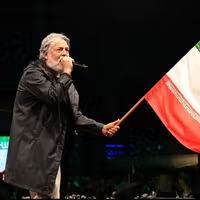
Rasoul Falahati, Supreme Leader Ali Khamenei’s representative in Gilan province in northern Iran, said on Friday that the United States fears Iran’s resilience and its cyber, drone and missile capabilities, and warned of a tougher response if it takes action.
“If the enemy makes a mistake, we will give them a lesson harsher than the 12-day war,” he said, according to state media.
Falahati added that Israel fears war more than others because it knows "it would face difficult conditions" in any conflict.
At least nine US Air Force refueling aircraft arrived overnight at Israel’s Ben Gurion Airport, according to footage and analysts tracking open-source flight data, the Times of Israel reported.
The report said there are now at least 14 US refueling tankers at the airport, as part of a broader US military buildup in the region.
It added that 11 F-22 stealth fighter jets and support aircraft landed this week at Ovda Airbase in southern Israel.
The tankers could support US fighter jets aboard the USS Gerald R. Ford aircraft carrier, which is heading toward Israel’s northern coast, the report said.
A senior Iranian cleric said on Friday that US threats of military action are a political bluff and that Washington has no choice but to negotiate with Iran.
Kazem Nourmofidi, Friday prayer leader of Gorgan in northern Iran, said talk of a possible attack is aimed at showing strength and pushing Iran into a weak position.
“These threats are more a show of power and a political bluff than reality,” he said, according to state media. “They have no choice but to negotiate with Iran.”
Nourmofidi said regional opposition to war, Iran’s military capabilities and control of the Strait of Hormuz make an attack unlikely.
“Control of the Strait of Hormuz is in the hands of the Islamic Republic, where one-fifth of the world’s energy passes, and closing it could raise oil prices to $200 and create severe economic crises for the United States,” he said.