US moves 150 aircraft to Europe, Mideast amid Iran tensions - report


The US military has rapidly increased its presence near Iran, shifting more than 150 aircraft to bases in Europe and the Middle East since nuclear talks between Washington and Tehran ended without a breakthrough on Feb. 17, The Washington Post reported, citing flight tracking data and satellite imagery.
The current US force presence in the region is among the largest in more than two decades, dating back to the period before the 2003 Iraq war, the report said.
Experts who reviewed the deployment said the scale exceeds the buildup seen before US strikes on Iran’s nuclear program in June last year and reflects preparations consistent with a multiday air campaign without a ground invasion, according to the report.


The Netherlands summoned Iran’s ambassador on Tuesday to protest the seizure of a Dutch diplomat’s luggage at Tehran airport.
“Iran caused a diplomatic incident on January 28, 2026, by forcing a Dutch diplomat to hand over his diplomatic luggage at the airport of Tehran,” the Dutch Foreign Ministry said in a statement. “This is unacceptable.”
The ministry said it had repeatedly asked Iran to immediately release the seized goods, without providing further details.
It added that the ambassador was summoned after Iran disclosed footage of the incident online.
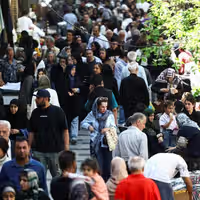
Escalating talk of war and renewed negotiations with the United States may dominate Iran’s political discourse, but the country’s deepening economic crisis is more present in daily life—and no less likely to drive change.
On Monday morning, the Foreign Ministry spokesman said foreign reporters visiting the country had described life as “normal.” Yet the indicators and daily experience suggest anything but.
That same day, Iranian media quoted bakers and grocers saying that wealthier customers now leave deposits so poorer families can take bread or meat without paying upfront.
Even newspapers aligned with Supreme Leader Ali Khamenei have begun issuing warnings.
Khorassan cautioned about the political consequences of rising bread prices. Days earlier, Kayhan warned that bread riots were likely if the government proceeds with plans to raise prices for a fourth time since President Massoud Pezeshkian took office in mid-2024.
Tabnak, the news site run by former IRGC commander Mohsen Rezaei, reported that a family of two or three now needs about twice the government’s worst-case estimate from last year to cover food costs.
Overall inflation is above 60 percent and expected to approach 70 percent this month. Donya-ye Eqtesad warned that food inflation could soon reach triple-digit levels. The Statistical Center of Iran reports inflation for agricultural goods above 85 percent and services above 45 percent.
Across the media spectrum, analysts point to three converging pressures: soaring food prices, wages that lag behind living costs and persistent instability in financial markets.
Specialized economic outlets report continued volatility in the foreign-exchange market. The dollar has fluctuated between 1,630,000 and 1,650,000 rials in recent days, with traders describing “high-tension anticipation” tied to uncertainty over negotiations with the United States and broader political risks.
Gold prices have surged alongside the currency, placing what has long been a traditional hedge against instability beyond the reach of most households.
The stock market has added to public unease. Shargh reported sharp index declines and heavy retail capital flight on Monday, with roughly 110 trillion rials ($680 million) exiting the market in 24 hours.
Analysts cite eroding confidence in government support policies and fears that regional tensions could spill into the domestic economy. Even those with no investments feel the consequences, as market instability feeds broader uncertainty.
Ramadan, traditionally marked by nightly gatherings and shared meals, has taken on a subdued tone. Many families can no longer afford customary foods, let alone host guests.
State television and pro-government social-media accounts now openly discuss the possibility of war. Online documentaries show Tehran’s pre–New Year shopping districts open but nearly empty. Instead of browsing, residents exchange advice on stockpiling food, fuel and clothing — precautions in case the capital comes under attack.
If this is normal, it is a fragile and increasingly costly version of it.
“We have a historic opportunity to strike an unprecedented agreement that addresses mutual concerns and achieves mutual interests," Iran's foreign minister Abbas Araghchi said on X on Tuesday referring to upcoming talks with the US in Geneva.
"A deal is within reach, but only if diplomacy is given priority,” he said.
The foreign minister also stressed Iran’s readiness to defend its sovereignty while pursuing a negotiated outcome.
“We have proven that we will stop at nothing to guard our sovereignty with courage. We bring the same courage to the negotiating table, where we will pursue a peaceful resolution to any differences,” he added.
Chief of Staff of Iran’s Armed Forces Abdolrahim Mousavi warned the United States against any military action against Iran, saying it would suffer heavy losses in the event of aggression.
“We have not initiated any war, and in the past our approach was to prevent the expansion of conflict and reduce casualties. However, the actions of the United States have caused us to change our approach, and this time, if they make a mistake, we will inflict heavy casualties on the enemy,” Mousavi said.
“Our nation and armed forces are determined to stand to the end against the hegemonic system.”
Two US lawmakers introduced bipartisan legislation aimed at supporting human rights in Iran and expanding internet access for Iranians while increasing accountability on Tehran.
House Foreign Affairs Middle East and North Africa Subcommittee Chairman Mike Lawler and Ranking Member Brad Sherman introduced the Iran Human Rights, Internet Freedom, and Accountability Act in Washington on Tuesday.
“The Iranian regime fears one thing above all else: a connected, informed population,” Lawler said in a statement. “Comprehensive legislation is needed to expand internet freedom and target the financial networks of corrupt officials.”
Sherman said the bill seeks to back Iranians protesting for freedom.
“I’m proud to join my colleague Congressman Lawler in introducing legislation to stand with these brave protesters by creating a new, whole of government strategy to take down this regime,” he added.
The bill includes provisions condemning protest crackdowns, calling for the release of political prisoners, expanding funding for internet freedom programs and directing US agencies to develop tools to bypass censorship and disrupt Iranian officials’ financial networks.