Pahlavi urges mass turnout for 40th-day ceremonies of slain protesters
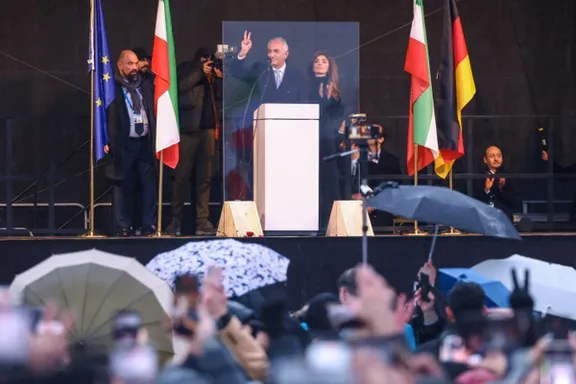
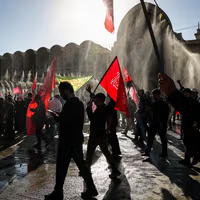
Exiled Prince Reza Pahlavi called on Iranians to attend ceremonies marking the 40th day since the deaths of protesters killed in the government crackdown.
In a statement, Pahlavi said the Islamic Republic and its leader had “shed the blood of tens of thousands of Iran’s brave sons and daughters,” particularly on January 8 and 9, leaving many families in mourning.
“Now, at the same time as the 40th day of the eternalization of Iran’s bravest children, I ask all of you noble and aware compatriots to take part in the memorial ceremonies and commemorations of those immortal names,” he said.
He urged supporters to honor the dead and to visit and support grieving families, adding: “All of us, together, with hearts heavy and chests full of certainty in victory, will move forward and soon cleanse Iran of Khamenei and his occupying and hellish regime.”
In recent days, there have been reports of a cemetery closure in Arak and a heavy security presence at Tehran’s main cemetery ahead of the planned 40th-day commemorations.



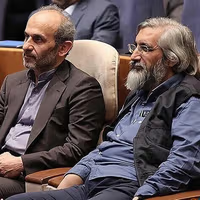
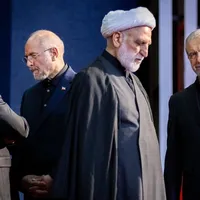
“The US president said in one of his recent remarks that for 47 years America has been unable to eliminate the Islamic Republic; he complained about it to his own people. For 47 years, America has not been able to eliminate the Islamic Republic. That is a good admission,” Khamenei said at a meeting with people from East Azarbaijan province on Tuesday.
“I say: You, too, will not be able to do this.”
His comments come days after Trump said regime change “would be the best thing that could happen.”
Khamenei also addressed remarks by the US president that the American military is the strongest in the world.
“The strongest army in the world may at times receive such a slap that it cannot rise,” he said.
“They keep saying we have sent an aircraft carrier toward Iran. Very well, an aircraft carrier is a dangerous device, but more dangerous than the carrier is the weapon that can send it to the bottom of the sea.”
His statements come amid heightened rhetoric between Tehran and Washington over military deployments and regional security and at the time a new round of negotiations mediated by Oman is underway in Geneva.
Talks with US
US threats and demands, Khamenei added, reflected an attempt to dominate Iran. “These statements by the US president, sometimes threatening, sometimes saying this must be done or that must not be done, mean they seek domination over the Iranian nation,” he said.
“Iran will not pledge allegiance to corrupt leaders currently in power in the United States.”
“They say let us negotiate about your nuclear energy, and the result of the negotiation should be that you do not have this energy,” he continued. “If a negotiation is to take place, and there is no place for negotiation, determining its result in advance is wrong and foolish.”
US presidents and some senators, he went on, were making an “absurd” demand by setting conditions before any dialogue.
January protest remarks
In the same speech, Khamenei said those killed during the January protests are mourned as martyrs.
“Blood was shed. We are grieving. I say we are in mourning for the blood that was shed,” he said, adding that not all of the dead fell into the same category.
Security forces responded to the latest nationwide protests with lethal force, mass arrests, and communication blackouts. At least 36,500 people killed in the recent wave of unrest, while authorities acknowledge a far lower figure of about 3,117.
Security forces, according to the Amnesty International, moved quickly after the killings to impose sweeping controls aimed at silencing survivors, intimidating families of victims and preventing documentation of what it described as unlawful mass killings carried out to crush what it called a popular uprising.
The measures included arbitrary mass arrests, enforced disappearances, bans on gatherings, night-time curfews, and a near-total internet blackout, alongside the deployment of heavily armed patrols across cities and inter-city roads, Amnesty International said.
Khamenei argued some were “corrupt elements and instigators,” while others were not involved in organizing the protests. He divided the dead into three groups, beginning with what he described as "defenders of security" – police, Basij and Guards members and those alongside them – calling them “among the greatest martyrs.”
He described a second group as bystanders. When turmoil breaks out in a city, he said, “innocent people walking toward their workplace or their homes are also killed,” adding that they too should be considered martyrs because their deaths occurred within “the enemy’s sedition.”
A third group, he said, consisted of those who had been misled. “They were deceived, inexperienced… they are also ours; they are our children,” he said, adding that some later wrote to him expressing regret. Officials, he said, were right to count those killed from this group as martyrs.
“Therefore, the circle of our fallen whom we count as martyrs is a wide one,” he added, excluding only what he called “the ringleaders and those who took money and weapons from the enemy.”
Khamenei concluded by offering prayers for mercy and forgiveness for those he described as misled participants, framing the uprising as an enemy-driven plot rather than a domestic protest movement.

