The bodies of 50 women killed during protests remain unidentified in Kahrizak morgue near Tehran, a member of parliament’s social committee said on Saturday.
“These bodies have not yet been identified due to a lack of documentation or because families have not come forward,” Mohammad Seraj told local media.
Mizan News Agency, affiliated with the judiciary, later denied the presence of 50 unidentified women’s bodies in Kahrizak, citing the Legal Medicine Organization as saying that only “seven bodies” were unidentified and that all were men.


Iran’s Fajr Film Festival went ahead this year as planned. But it did so in a country still reeling from bloodshed, and the red carpets beneath its guests carried a symbolic weight that many in the film community found difficult to ignore.
Some chose not to attend. Others did, and the result was a festival that felt unusually detached from the public mood—less a national cultural event than a carefully managed display of continuity.
Now in its 44th year, the festival took place less than forty days after tens of thousands of protesters were killed during the government’s crackdown. Under those circumstances, the decision to proceed on schedule was bound to draw scrutiny.
The nature of the festival itself has evolved over time, with an increasing share of films produced by state institutions or affiliated organizations. This year, too, such bodies as municipal authorities and even the judiciary appeared among the producers.
This has contributed to a growing perception, particularly among independent filmmakers, that the festival increasingly reflects official priorities rather than the diversity of Iranian cinema.
That perception was reinforced by a number of high-profile absences. Some directors and actors announced they would not attend.
The actor Elnaz Shakerdoost, one of Iran’s most recognizable performers, publicly questioned the timing of the festival and announced she would step away from acting. “Which festival? Which celebration?” she wrote. “I will not attend any celebration, nor will I ever again play a role in this land that smells of blood.”
Other films were screened without their directors or cast present. In several cases, producers appeared alone at press conferences. The director Soroush Sehat and the cast of his widely discussed film declined to attend altogether, leading organizers to cancel its press session.
These absences altered the character of the festival’s public discussions. Press conferences often featured only those filmmakers who had chosen to participate, some of whom criticized colleagues who had stayed away.
Mohammad Hossein Mahdavian, a director known for films focusing on Iran’s security institutions, described actors who declined to attend as “cowards.”
Many film critics and journalists opted not to cover the event. Even Film Emrooz, a long-established cinema magazine known for its cautious editorial line, did not publish its customary festival issue.
Public turnout appeared subdued as well. Organizers sought to maintain the appearance of normal activity, but attendance remained visibly lower than in previous years.
The closing ceremony reflected similar tensions. Several winners did not appear to accept their Simorgh awards. President Massoud Pezeshkian attended and praised those who had participated, signaling the government’s continued investment in the festival’s symbolic importance.
One award recipient attempted to acknowledge the broader context, alluding to the recent violence while accepting his prize. His remarks, however cautiously phrased, underscored the gap between the official narrative of continuity and the unresolved trauma still shaping public life.
Iran’s film industry has long occupied a complex position—both an instrument of national identity and a space for independent artistic expression. This year’s festival highlighted how difficult it has become to sustain that balance.
The chief of the US Navy warned on Friday against extending the deployment of the USS Gerald R. Ford, as the carrier is redirected from the Caribbean to the Middle East amid heightened tensions with Iran, The War Zone reported.
Chief of Naval Operations Adm. Daryl Caudle has previously said he would push back against prolonged deployments, warning of severe strain on sailors, disruption to family life, and maintenance risks for the first-in-class ship.
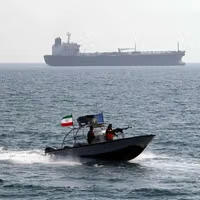
The Ford, deployed since June 2025 and previously operating in the Mediterranean and Caribbean, is now expected to join the USS Abraham Lincoln in the region later this month, significantly boosting US naval power as President Donald Trump presses Tehran over its nuclear program.
The Pentagon is deploying the USS Gerald R. Ford to the Middle East as Washington steps up pressure on Iran, the Wall Street Journal reported on Friday, citing US officials.
The carrier strike group will join the USS Abraham Lincoln and other warships already in the region, significantly boosting US naval firepower.
The move comes as President Donald Trump presses Tehran to make concessions over its nuclear program while warning of “very steep” consequences if talks fail.
Binance appears to have violated US sanctions by facilitating more than $1 billion in transactions tied to Iran from March 2024 to August 2025, according to internal documents and sources cited by Fortune.
Investigators on Binance’s compliance team uncovered evidence of the flows, routed through the exchange using Tether (USDT) on the Tron blockchain.
US President Donald Trump said on Friday that regime change in Iran would be ideal after 47 years of fruitless talks, amid escalating tensions.
“Regime change in Iran would be the best thing that could happen. For 47 years, they've been talking and talking and talking. In the meantime, we've lost a lot of lives while they talk. Legs blown off, arms blown off, faces blown off. We've been going on for a long time so let's see what happens,” Trump told reporters.
"If they give us the right deal, we won't do that — but, you know, historically, they haven't done that. I will say they want to talk — but so far, they do a lot of talking and no action," he added. "If we could get it settle for once and for all, that would be good."
Asked who you want to take over? Trump said: “I do not want to talk about that, there are people.”