Iran denies 14-year-old detainee access to asthma medication, family says
A 14-year-old Turkmen protester arrested in the northeastern city of Gonbad-e Kavus is under psychological pressure in custody and has been denied full and regular access to his asthma medication, sources close to his family told Iran International.
Eiltay Akhoundi was detained on Friday, January 9, 2026, in Gonbad-e Kavus. After being held for three days in a detention facility run by the Islamic Revolutionary Guard Corps’ intelligence unit, he was transferred to the Juvenile Correction and Rehabilitation Center in Gorgan.
Akhoundi, who suffers from asthma, has not had consistent and full access to his prescribed medication while in custody, raising concerns about his health condition, according to the sources.
Family sources said the teenager has been subjected to repeated interrogations during his detention and has faced both psychological and physical pressure.
They added that at the time of his arrest and during questioning, he was denied access to a lawyer or any form of legal representation.
The Trump administration covertly sent thousands of Starlink satellite internet terminals into Iran following a deadly crackdown on demonstrations and sweeping internet shutdowns, The Wall Street Journal reported citing US officials.
Roughly 6,000 terminals were smuggled into the country after Iranian authorities suppressed unrest in January by killing thousands of protesters and restricting connectivity, marking the first time Washington has directly sent Starlink kits into Iran, the report said.
The State Department had purchased nearly 7,000 terminals in prior months — most in January — to help anti-government activists bypass internet blackouts, officials said, adding that some funding was redirected from other internet freedom programs to finance the purchases.
President Donald Trump was aware of the deliveries, officials said, though it was unclear whether he or another official directly approved the operation.
A 14-year-old Turkmen protester arrested in the northeastern city of Gonbad-e Kavus is under psychological pressure in custody and has been denied full and regular access to his asthma medication, sources close to his family told Iran International.
Eiltay Akhoundi was detained on Friday, January 9, 2026, in Gonbad-e Kavus. After being held for three days in a detention facility run by the Islamic Revolutionary Guard Corps’ intelligence unit, he was transferred to the Juvenile Correction and Rehabilitation Center in Gorgan.
Akhoundi, who suffers from asthma, has not had consistent and full access to his prescribed medication while in custody, raising concerns about his health condition, according to the sources.
Family sources said the teenager has been subjected to repeated interrogations during his detention and has faced both psychological and physical pressure.
They added that at the time of his arrest and during questioning, he was denied access to a lawyer or any form of legal representation.
Spain’s football (soccer) federation has withdrawn from a planned friendly with Iran’s national team, Tehran-based football outlet Football 360 reported, one month after Iranian authorities quashed nationwide protests with deadly force.
“Officials from the Spanish Football Federation have backed down and, at the current stage, have no decision to hold a friendly match with Iran’s national team,” the report said.
A new US military operation against Iran cannot be ruled out, Russia’s deputy foreign minister said, warning that the Middle East situation remains alarming amid Washington’s military deployments, Russian state news agency TASS reported.
“The situation in the Middle East, where the Americans have deployed huge numbers of attack systems, increasing pressure by the day and threatening to use force … raises some alarms. Another military operation there cannot be ruled out,” Sergei Ryabkov said at the Zhirinovsky Readings international scientific and expert forum in Moscow.
"The Americans and their allies in China’s geopolitical circle are simultaneously ramping up their military buildup in the Asia Pacific which poses risks not only to the PRC (People’s Republic of China) but also to Russia," he added.
Demonstrators burn a large horned, bull-headed “Baal” statue during a state-organized rally marking the anniversary of Iran’s 1979 Islamic Revolution in Isfahan on February 11, 2026.
During state-organized rallies marking Iran’s 1979 revolution anniversary, demonstrators in several cities burned large statues of a horned, bull-headed figure identified by organizers as “Baal,” an ancient deity referenced in biblical and Islamic tradition.
The burnings, some reported to have taken place at the same time in different cities, were presented by organizers as a symbolic protest linked to renewed online conspiracy theories surrounding the late financier Jeffrey Epstein and alleged child abuse by Western elites.
Iranian news agency Mehr said the effigy represented “the idol of Baal,” described in religious texts as a false god associated with deviation from monotheism.
Participants, chanting “Death to Israel” and “Death to America,” were quoted as saying the act symbolized resistance to what they described as corrupt Western systems and Zionist ideology.
Images circulated by Iranian and foreign media showed a giant statue with a bull’s head engulfed in flames in Tehran’s Azadi Square. Some versions included additional imagery such as the number “666” and references to US President Donald Trump.
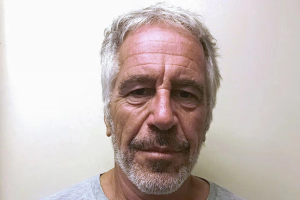
Hardline outlets and channels said the burning was a symbolic reference to documents recently released by the US Justice Department related to Epstein, who was charged in 2019 with running a sex trafficking ring involving underage girls. Epstein died in jail later that year.
Online speculation in recent weeks has revived unverified allegations linking Epstein to ancient deities such as Baal or Moloch, figures that in some traditions are associated with child sacrifice.
Fact-checkers and mainstream media have previously reported that many such claims stem from misinterpretations of financial documents or from longstanding internet conspiracy theories, including allegations about a “temple” on Epstein’s private island that US media said was designed as a music pavilion.
Baal, a title meaning “lord” in ancient Semitic languages, was worshipped by Canaanite peoples in the ancient Near East and is portrayed in Jewish, Christian and Islamic texts as a false deity. Some scholars say there is limited archaeological evidence of child sacrifice practices in parts of the ancient Levant, though interpretations remain debated.
Iranian organizers described the statue burning as a “symbolic protest” aimed at drawing attention to alleged moral corruption in the West.
One conservative outlet linked the initiative to the Masaf Institute, a group associated with propagandist Ali Akbar Raefipour, which has promoted anti-Western and anti-Zionist narratives.
The coordinated burnings formed part of broader anniversary events that included anti-US and anti-Israel slogans, flag burnings and displays criticizing Western governments.
While state media framed the act as a message from Tehran to the world, some Iranian clerics expressed concern about the symbolism, and online users debated whether the act itself risked unintended religious connotations.