United Against Nuclear Iran (UANI) will display a downed Iranian Shahed-136 drone – described as a "terror weapon" central to Russia's war in Ukraine – during a briefing at the Munich Security Conference on Friday.
“The Iran-Russia military partnership represents a direct and growing threat to European and global security. The international community must act with urgency to disrupt Iran’s aggression, cut off the regime’s illicit funding networks, and impose meaningful costs on those who enable this dangerous alliance,” Jeb Bush, Chairman of UANI said in a statement.
The drone, acquired with help from Poland and Ukraine, follows prior UANI displays at UK Parliament, US Congress, and UN. The briefing urges stronger European drone defenses and disruption of funding for Iran-Russia drone programs.
President Trump on Thursday warned that failure to reach an agreement with Iran will lead to a “very traumatic” outcome for the country, tying the stakes of ongoing talks to the precedent of the last June “Midnight Hammer” operation.
“With Iran, we have to make a deal, otherwise it's going to be very traumatic, very traumatic,” Trump said in remarks at the White House. “They should have made a deal the first time, and they got Midnight Hammer instead.”
“We had a very good meeting yesterday with Bibi Netanyahu, and he understands, but it's ultimately up to me if the deal is in a very fair deal and a very good deal with Iran, and it's going to be. I think a very difficult time for them,” Trump added.
Iran’s President Masoud Pezeshkian on Thursday told families of those killed in recent unrest that he feels ashamed over the deadly incidents in the country, while suggesting that most of the unrest was stoked from abroad.
“We are ashamed of what has happened in this country. Unfortunately, most of these incidents were provoked from outside,” Pezeshkian said.
“These events should never have happened in the first place, and what has happened is very grave. For me personally, as an official who holds responsibility in this country, many nights I cannot sleep, wondering why things had to turn out this way, why the young people of our country should lose their lives like this,” he added.
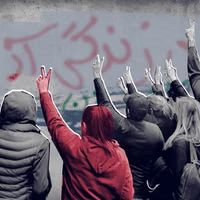
Iran’s exiled prince Reza Pahlavi called on Iranians inside the country to chant slogans from their homes and rooftops over the weekend, coinciding with planned diaspora demonstrations on Saturday.
"On February 14, the Global Day of Action, Iranians abroad will once again take to the streets to carry the voice of our great and united nation to the world and to mobilize broader international support for Iran’s Lion and Sun Revolution," Pahlavi said in a message addressing Iranians inside the country.
"I invite you, on the evenings of February 14 and 15 at 8:00 p.m., to raise your voices and chant from your homes and rooftops. Shout your demands. Show your unity," he said in a message addressing Iranians inside the country," he added.

The night air on Jan. 8 in northeastern Tehran filled with chants rising in defiance. Among them stood Pooya Faragerdi, a violinist whose life was measured in music and a heart that beat for Iran. Then came the gunfire.
Faragerdi, 44, was shot by security forces near a police station in Pasdaran that night.
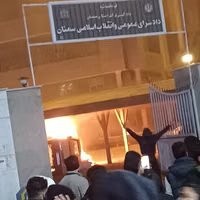
Videos verified by Iran International from Pasdaran on Jan. 8 showed wounded protesters lying bloodied on the street as others tried to help, with gunfire audible in the background.
“At first we thought he had been killed in Majidiyeh… but later I learned he went to Pasdaran and was shot there,” his brother Payam Fotouhiehpour told Iran International.
A bullet pierced the right side of his abdomen around 11 p.m., and he was taken to a hospital. He died the following day, Jan. 9, his brother said, but for days the family did not know where he was.
Nearly 12 days later, they learned his body was at Kahrizak — a forensic medical complex south of Tehran where many protest victims were taken.
Footage verified by Iran International from Kahrizak showed families searching among rows of black body bags as the complex filled with protest victims.
Searching through darkness
While Faragerdi joined protests in Tehran, his brother was in the United States, cut off by a nationwide internet blackout imposed on Jan. 8 as demonstrations intensified.
Connectivity dropped to near zero, with tens of millions cut off from global internet access and phone communication severely disrupted. Rights groups said the shutdown aimed to prevent information from leaving the country and obscure the scale of the crackdown.
“I was unaware of everything,” he said.
Only days later, when limited international calls were partially restored, he learned his brother was missing.
“I convinced myself he had gone somewhere with a friend… I told myself he would show up and I would scold him for ten or fifteen minutes.”
He never did.
“Every moment his image was in front of my eyes. I had to go into the storage room or my office to cry so my wife and daughter would not lose themselves.”
On Jan. 20, authorities informed the family that Faragerdi’s body was in Kahrizak. He was buried the following day at Tehran’s Behesht-e Zahra cemetery.
“These days, images of his childhood come to my mind more and more. Even his childhood voice is in my ears — ‘Dada Payam.’”
Defiance through music
Long before the protests, Faragerdi had resisted Iran’s cultural licensing system, which requires artists to obtain approval from the Ministry of Culture and Islamic Guidance before performing or releasing music.
Born on Sept. 7, 1981, he trained in violin from childhood, developing a foundation in classical performance. Though he held a degree in agricultural machinery engineering, music remained central to his life.
“He decided to play the violin professionally - and teach,” his brother said. “He taught my daughter Baran as well.”
Faragerdi played classical music—from Baroque to modern—and had a taste for all types, his brother said: jazz, blues, rock.
But the permit system pushed him away from formal stages.
“He hated that,” his brother said. “It was insulting to him that these creatures would decide what he could do.”
Faragerdi redirected his creativity into craftsmanship. Skilled with tools, he began carving wooden instruments by hand, including ocarinas he built and played himself.
A fellow musician who performed with him, speaking on condition of anonymity, said Faragerdi had once been part of an independent orchestra in Tehran.
“He was part of an independent orchestra—meaning no government body oversaw it. It was private,” the musician said.
Following the 2019 crackdown, during which at least 1,500 protesters were killed, many artists moved away from orchestras requiring ministry permits, the musician added.
'Your bow is still, but not our rage'
Tributes from fellow musicians and students have surfaced across social media.
“We shared a stage, a stand, a country. We played side by side for years, and we still hear your velvet voice in the pauses between movements,” two of his fellow musicians told Iran International.
“On January 8, you were shot for daring to breathe free… They might have silenced your body but not your echo. They killed a musician, not sound itself. Your bow is still, our rage is not.”
Faragerdi’s final Instagram post showed him burning an Iranian banknote bearing the image of Ruhollah Khomeini, founder of the Islamic Republic, holding it over a toilet before dropping the ashes into the bowl. The clip was captioned: “Let us count the life that has passed,” and set to “The Final Countdown” by Swedish band Europe.
In text messages, his brother shared memories with care.
Asked why Pooya joined the protests, his brother said he was not someone who would stay home while others took to the streets.
“I think on Jan. 8 he fell in love with his people again,” he said. “I wish he had lived to see freedom as well.”
The last sounds Pooya heard were not drawn from his violin, but from chants rising through the streets. Perhaps that was the music he had wanted to hear all along — a chorus of voices rising through the streets.

Iranians took to social media on the anniversary of the 1979 Revolution to challenge the Islamic Republic’s claims of overwhelming public support, sharing videos of anti-government chants and questioning the authenticity of state broadcasts.
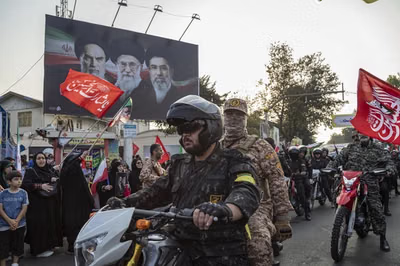
Authorities said “tens of millions” rallied nationwide to back Supreme Leader Ali Khamenei and the Islamic Republic’s ideology on the 47th anniversary of the revolution. Opponents—many still grieving the deaths of thousands shot during January protests—argued that attendance was often compelled and official imagery exaggerated.
State television aired long processions of marchers chanting pro-government slogans.
In Tehran, special police units and armored vehicles were deployed in what officials described as a show of stability. Critics said the heavy security presence signaled coercion rather than confidence.
What was presented as a unified celebration instead revealed competing narratives. While state media depicted unwavering loyalty, many Iranians online asserted that genuine political support cannot be measured in choreographed crowds or tightly controlled broadcasts.
Fireworks and counter-chants
Tuesday evening’s commemoration began with fireworks across Tehran and other cities. As in previous years, mosque loudspeakers and Basij bases urged citizens to step outside at 9 p.m. on the eve of the anniversary to chant “Allah-u-Akbar” from rooftops and streets.
But videos posted online from several cities, including Tehran, showed opponents raising anti-government slogans such as “Death to the dictator”, at times drowning out pro-state chants amplified through megaphones.
Clips shared on X and Instagram captured competing chants echoing across neighborhoods, reflecting a contested public atmosphere rather than a single unified voice.
Social media users also accused authorities of pressuring public employees, teachers, conscripts and others to attend the marches. Some alleged that participation was encouraged through incentives, including paid leave or material benefits—even implied threats to job security.
In several cities, critics said buses transported families to designated gathering points despite the anniversary being a public holiday.
One widely circulated claim alleged that relatives of those detained during the January unrest were told that sharing photos or videos of their families attending anniversary rallies could help secure the release of their loved ones. The claim could not be independently verified.
Staged testimonials?
Accusations extended to state media broadcasts. Opponents pointed to a now-viral clip in which the same woman—holding portraits of Khamenei and revolutionary founder Ruhollah Khomeini—appeared in live footage from Qazvin and Khorramabad, cities hundreds of kilometers apart.
One user wrote that the anniversary had produced “a woman teleporting on state TV.”
Others questioned the authenticity of official images, alleging digital manipulation or the reuse of footage, though no conclusive evidence has been publicly presented.
State media also aired interviews with participants including women without traditional hijab expressing loyalty to the leadership. Opposition voices dismissed the segments as staged propaganda.
In one broadcast from Isfahan, a woman said she had joined the marches after 30 years “for love of the Leader, to support the country and Islam against threats.”
In another clip released Wednesday, a woman without a headscarf declared: “Many enemies of Iran said the Islamic Republic would not see this anniversary—we’re glad it didn’t happen because if it had, surely Iran would have split.”
Critics argued such testimonials were carefully selected to project enthusiasm that may not reflect the broader political mood.