Egypt pushes de-escalation through talks with regional, US officials
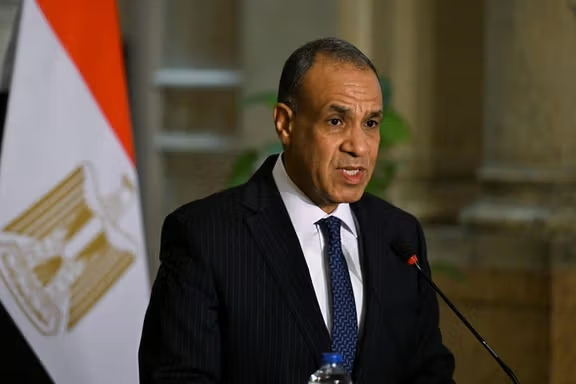
Egypt’s foreign ministry said on Thursday that Foreign Minister Badr Abdelatty had held intensive contacts with officials from Qatar, Oman and Iran, as well as US special envoy Steve Witkoff, to push efforts to de-escalate regional tensions.
According to the statement, Abdelatty held calls separately with Qatar’s Prime Minister and Foreign Minister Sheikh Mohammed bin Abdulrahman Al Thani, Oman’s Foreign Minister Badr bin Hamad Al Busaidi, and Iran’s Foreign Minister Abbas Araghchi.
The discussions focused on reducing escalation in the region and developments related to a planned meeting between the United States and Iran in Oman, the ministry said.
Egypt will continue its diplomatic efforts with regional partners and both the US and Iran to advance political solutions, the ministry added.
The Australian Senate on Thursday passed a motion condemning Iran’s crackdown on nationwide anti-government protests that began in late December, citing killings, mass arrests and internet blackouts imposed on civilians.
The motion said senators noted “with grave concern” reports of indiscriminate killings of civilians, the targeting of women and children, mass arrests and internet and communications blackouts. It also acknowledged the distress felt by Iranian-Australians unable to contact relatives in Iran.
It called on the Albanese government to keep working with international partners, including the United Nations, to support independent investigations into human rights violations in Iran, press for accountability, expand targeted sanctions and push for an end to violence, executions and communications restrictions.
Labor Senator Raff Ciccone, one of the co-sponsors, said in a post on X that the Senate had condemned “the Iranian regime’s brutal repression of peaceful protesters” and reaffirmed Australia’s solidarity with the Iranian people and the Iranian-Australian community.
His comments followed earlier action this week, when Australia imposed new sanctions on 20 individuals and three entities linked to Iran’s security apparatus over the protest crackdown.
Speaking in the Senate earlier this week, Ciccone said he supported the government’s steps and voiced solidarity with Iranians protesting inside the country.
“Since 28 December last year, the Iranian regime has responded to peaceful protests with extraordinary and horrifying violence against its own people,” he told parliament.
He said authorities had tried to hide the scale of the crackdown. “The regime has attempted to conceal the scale of its brutality through nationwide internet and telecommunication blackouts,” he said.
Referring to the new sanctions, Ciccone said they targeted those responsible for repression, including figures linked to the Islamic Revolutionary Guard Corps. “These sanctions are not symbolic; they are targeted, deliberate and designed to impose real consequences on those responsible for repression and violence,” he said.
Ciccone also highlighted the impact on Iranians living in Australia. “Members of the Australian Iranian community have watched these events unfold with profound anguish,” he said, adding that many had relatives at risk.
“Australia’s message is clear: the use of violence against civilians, the silencing of dissent and the systemic denial of human rights will not be met with indifference,” he said.
Iran’s Foreign Minister Abbas Araghchi criticized Germany’s stance on Iran after Chancellor Friedrich Merz said Berlin was ready to increase pressure to end Tehran’s nuclear program.
“We are ready to further increase the pressure and to engage in talks that serve the purpose of a swift end to the Iranian nuclear program,” Merz wrote on X on Wednesday.
In response, Araghchi said Germany had abandoned a constructive role in diplomacy, pointing to Berlin’s earlier support for restoring UN sanctions on Iran. While emphasizing Iran’s long-standing relations with Germany and praising the German people, he added: “We hope that more mature and honorable political leadership will return to Germany.”
Russia is not pushing to act as a mediator between Iran and the United States despite what it describes as an increasingly dangerous situation, Foreign Minister Sergey Lavrov said.
“The situation is explosive,” Lavrov said on Thursday in an interview with RT, adding that Moscow was “not imposing ourselves as mediators to Iran, Israel, or the United States,” but was closely following developments because they affect “not only Iran itself, but the entire Middle East.”
Lavrov warned that “there are too many time bombs waiting to be triggered by a clumsy foot,” while stressing that Russia remains ready to help enforce any agreements if they are reached. He said both Iran and Israel were aware that Moscow was prepared to assist in implementing deals, should negotiations succeed.
Former US Ambassador to Israel Dan Shapiro said on Thursday he saw little chance the next round of Iran-US talks would produce an agreement, as negotiators prepare to meet on Friday.
In an interview with Israel’s military radio Galei Zahal, Shapiro said the prospects were low given the negotiating format and Washington’s position, according to a transcript published by Israel National News.
“I don't see a path to a deal - Trump will not have the patience for long and complicated negotiations,” Shapiro said.
“He has no choice - there will be military action, he won’t be able to overthrow the regime without it,” he added.
The talks are expected to be held in Muscat, Oman, after a venue dispute in recent days, and are set to focus on Iran’s nuclear program
US Representative Claudia Tenney said on Wednesday that she had introduced a bipartisan bill aimed at expanding access to open internet for people in Iran, as authorities continue to restrict communications during protests.
“The Iranian people have shown extraordinary courage in demanding basic freedoms from a regime that fears open communication,” the Republican lawmaker wrote on X.
She said the proposed legislation, titled the IRAN Act, would require the US government to develop a clear strategy to support open and secure internet access inside Iran.
The bill would focus on protecting essential communication tools, countering bans on virtual private networks, and responding more directly to nationwide internet blackouts, according to her statement.
Tenney said the measure was intended to confront those restrictions “head-on” and ensure US policy more effectively supports free communication for Iranians.