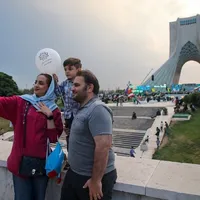
Videos received by Iran International show moments of laughter and joy shared by Mozhgan Zeynali, a 38-year-old protester, with her children, as well as scenes from her funeral, following her killing during protests in Iran.
She was killed in protests on January 7 in the city of Fardis, west of Karaj in central Iran.
Persian Gulf countries led by Saudi Arabia have warned Iran they could intervene if they come under heavy attack as part of a confrontation between Tehran and Washington, Israel’s Kan public broadcaster reported on Sunday.
According to the report, they have told Iran they do not want to be drawn into a US-Iran clash and have passed direct messages that they will not allow the United States to use their territory or airspace to launch an attack on Iran.
A source from the Saudi royal family was quoted as warning that if Iran or its allies carry out significant strikes on Persian Gulf countries or on US bases there, they would find it hard to remain silent, potentially leading to their involvement.
The source said they preferred pressure on Iran to remain economic rather than expand into broad military action, Kan reported.
Israel’s Kan public broadcaster said in a separate report on Sunday that Israel and the United States are operating in full coordination, and Israel expects to receive sufficient advance warning from Washington in the event of a US strike against the Islamic Republic.
According to the report, Israeli Chief of Staff Eyal Zamir held intensive discussions with senior US officials over the weekend amid US preparations for a possible attack on Iran.
Kan said the talks focused on operational coordination and readiness, as Washington steps up military deployments in the region and tensions with Tehran remain high.

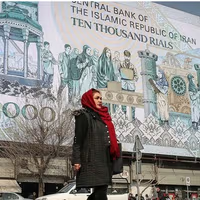
Iran’s central bank has begun distributing the country’s largest banknote, a 5 million-rial (about $3.10) Iran-cheque, as the national currency continues to weaken and cash transactions require ever-higher denominations.
The Central Bank of Iran said the pre-printed 5,000,000-rial note entered the banking network on Sunday, describing the move as part of efforts to manage and facilitate the circulation of cash and to speed up everyday transactions.
At an exchange rate of about 1.6 million rials per US dollar, the new note is worth roughly $3.10, showing how years of inflation and currency depreciation have eroded purchasing power.
The central bank said the measure was intended to ease cash payments and provide a replacement for smaller denominations, and did not signal any change in the volume of liquidity.

Iran’s Islamic Revolutionary Guard Corps reacted on Sunday to the European Union’s move to place it on the terrorist list, accusing the bloc of aligning with US policies and ignoring the destabilizing role of some regional actors.
The Guards said the EU approach amounts to “an obvious alignment with US interventionist policies,” according to the statement.
It added that the designation would not improve peace or regional security and would instead strengthen confrontation, making engagement and constructive cooperation more difficult.

US President Donald Trump is giving Iran time to step back from confrontation but will not remain patient indefinitely, Washington’s ambassador to NATO said, as the United States maintains military pressure while signaling an opening for de-escalation.
Matthew Whitaker told Fox News that Trump has set clear limits for Tehran, saying Iran must not pursue a nuclear weapon and must stop killing protesters at home.
Whitaker said Iran could reduce tensions quickly if it chose to do so, but warned that Trump’s restraint had limits.
“The ball’s in their court, but President Trump is not going to be forever patient on this,” he said.
“President Trump is backing that up with this armada that is sitting off the coast of Iran and in the region,” Whitaker said. He described the deployment as an off-ramp, adding that Washington was “not asking for much.”
Iran’s parliament moved on Sunday to press for the expulsion of European military attaches from Tehran, after lawmakers said EU armed forces are “terrorist groups” in retaliation for Europe’s designation of Iran’s Revolutionary Guards.
Alireza Salimi, a member of parliament’s presiding board, told Speaker Mohammad Bagher Ghalibaf that military representatives posted at European embassies in Iran should be expelled immediately.
Salimi said parliament had passed a law classifying European armies as terrorists and argued that allowing their attaches to remain in the country would violate Iranian law. He urged the foreign ministry to notify embassies without delay.
Ghalibaf responded by instructing parliament’s national security and foreign policy committees to pursue the matter with the foreign ministry.